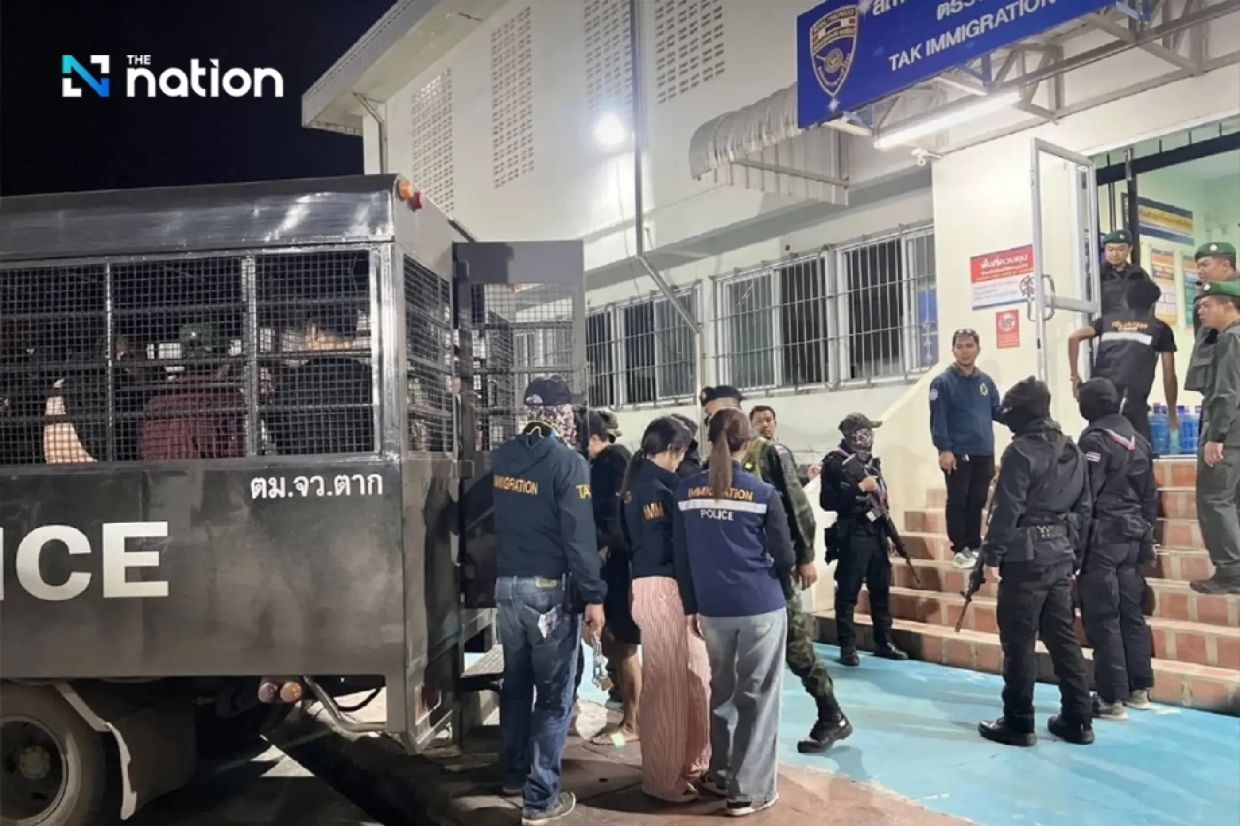
Thailand is moving to overhaul key sections of its immigration legislation to accelerate the deportation of foreign nationals convicted of crimes, stepping up the government's response to transnational criminal networks that have increasingly used the kingdom as an operational base. The initiative addresses longstanding frustrations within Thailand's law enforcement and immigration authorities over the pace of removal procedures, which have historically left foreign offenders languishing in detention facilities whilst legal challenges wind through multiple court stages and diplomatic channels.
Government officials have identified significant weaknesses in the current enforcement framework, tracing many of them back to the 60-day visa exemption scheme implemented in July 2024 under Prime Minister Srettha Thavisin's administration. This arrangement permitted arrivals from 93 countries and territories to enter Thailand without advance visa applications, effectively eliminating Thai diplomatic missions' ability to screen visitors for criminal histories or financial irregularities before they crossed the border. The absence of pre-arrival vetting has created opportunities that criminal elements have exploited, using repeated border runs and visa resets to establish quasi-permanent residency without formal authorisation.
The consequences have been documented across Thailand's major tourist and urban centres, where foreign nationals have engaged in a troubling range of illicit activities. Authorities report involvement in illegal employment within hospitality sectors, acquisition of property through nominee schemes designed to circumvent Thai ownership restrictions, participation in sophisticated call-centre fraud operations targeting regional victims, and integration into grey-capital money laundering networks. Problem areas have emerged with particular intensity in Pai within Mae Hong Son province, the coastal resort city of Pattaya in Chonburi, the island destinations of Koh Phangan in Surat Thani, and metropolitan Bangkok itself, prompting coordinated enforcement responses across multiple agencies.
Prime Minister Anutin Charnvirakul's government has designated transnational crime suppression as a core security objective, mobilising the Immigration Bureau, Royal Thai Police and supporting agencies to strengthen border screening and operational enforcement capabilities. Four concrete measures have been deployed to address identified vulnerabilities: enhanced monitoring of travellers exhibiting patterns of frequent entry and exit without discernible legitimate purpose, intensified screening protocols applied to nationals from jurisdictions designated as higher risk, systematic integration of international criminal records databases with Thai authorities and Interpol intelligence systems, and administrative reforms aimed at eliminating duplicative visa pathways that allow extended stays through regulatory loopholes.
The government's response to visa-related security gaps has proven decisive. On May 19, 2026, the Cabinet approved termination of the 60-day visa exemption for all 93 participating countries, representing a fundamental reversal of the prior administration's approach. Thailand will revert to bilateral country-by-country visa arrangements, with the overwhelming majority of leisure and business visitors now limited to maximum stays of 30 days. Officials have publicly articulated the policy rationale, emphasising that the exemption scheme failed to generate proportionate increases in tourist arrivals or visitor spending whilst substantially expanding exposure to security risks that the kingdom had previously managed through more selective and controlled visa processing.
Despite intensified enforcement operations involving coordinated military, police and administrative personnel that have resulted in substantial apprehensions of foreign nationals engaged in illegal residence and criminal activities, Thai authorities face a persistent systemic bottleneck. Many foreign detainees remain trapped within extended legal processes, unable to return to their home countries due to administrative and logistical constraints. Financial obstacles represent one significant category of delay—some deportees lack sufficient resources to cover repatriation transportation costs and must await Thai authorities' completion of embassy coordination to secure external funding support. This procedural requirement can extend detention periods substantially, complicating case management and straining prison resources.
The substantive legal framework presents more fundamental obstacles to rapid deportation. Under the Immigration Act of 1979, foreign nationals issued removal orders retain statutory rights to file appeals within 48 hours, submitting supporting evidence and detailed grounds for challenging the deportation decision. Whilst such appeals are pending determination, deportation proceedings are ordinarily suspended except in cases involving particularly serious criminal charges. The Immigration Commission additionally possesses discretionary authority to postpone removals or grant temporary stay extensions based on humanitarian considerations or unresolved legal questions, creating additional procedural layers that extend timelines considerably. Anutin has specifically identified Sections 54 and 55 of the Immigration Act of 1979, which govern foreign national removal procedures, as requiring modernisation to increase flexibility and efficiency whilst maintaining compliance with international legal obligations.
Deputy Prime Minister Pakorn Nilprapunt, who supervises legal affairs within the Anutin government, has been assigned responsibility for leading consultations among the Royal Thai Police, Immigration Bureau, Interior Ministry and other relevant institutional stakeholders to develop concrete legislative amendments. The initiative reflects recognition that traditional law enforcement responses—arrests, prosecutions and convictions—address only partially the challenge posed by transnational criminal elements. When deportation timelines stretch into months or years, offenders frequently transition from active detention status to quasi-legitimate existence within Thai society whilst administrative procedures progress through successive stages. This interim status creates elevated risk of recidivism and continued criminal activity, undermining both public safety and the effectiveness of the broader law enforcement response.
The extradition and repatriation framework itself embodies substantial complexity that contributes to processing delays. Where bilateral extradition treaties exist between Thailand and an offender's home country, the attorney-general must conduct formal case review before forwarding documentation to the court for issuance of binding extradition orders. When no such treaty applies—a frequent situation given the limited bilateral extradition arrangements Thailand maintains with many nations—the Foreign Ministry must submit formal requests to the attorney-general, who then petitions the court to issue extradition orders under domestic law. This multi-stage process necessarily involves human rights considerations throughout, with detainees retaining statutory rights to petition courts, oppose removal proceedings and request temporary release on humanitarian grounds.
Thailand's obligations under international human rights frameworks substantially complicate efforts to streamline deportation procedures. As a United Nations Human Rights Council member party to eight major international human rights conventions covering children's rights, women's rights, civil and political rights, economic and social rights, racial discrimination, torture prevention, disability protections and protection against enforced disappearance, the kingdom faces binding constraints on deportation practices. Royal Thai Police spokesman Pol Lt Gen Trairong Phiwpan has acknowledged that every individual case involves multiple human rights considerations requiring careful judicial assessment. Detainees who do not invoke human rights challenge procedures can be repatriated more expeditiously, but assertions of human rights concerns trigger court review processes that necessarily extend timelines pending judicial determination.
Trong's characterisation of the reform initiative as constructive acknowledges both the necessity of system modernisation and the inherent complexity of the legal architecture involved. He emphasised that the government intends to prioritise compressed timeframes, elimination of redundant procedural steps and reduction of unnecessary delays, whilst preserving the capacity of authorities and the judiciary to conduct individualised assessment of each case's gravity and circumstances. Factors requiring such differentiated analysis include illegal border crossing offences, visa overstay violations, participation in transnational criminal enterprises and involvement in scammer networks targeting regional populations. The proposed reforms do not envision wholesale elimination of detainee rights or human rights protections, but rather more efficient procedural management within existing legal constraints.
The policy direction reflects broader Southeast Asian concerns regarding transnational crime's facilitation by porous visa regimes and slow deportation procedures. Malaysia and other regional governments have observed similar vulnerabilities within their own immigration systems, with foreign criminal elements and organised networks exploiting bureaucratic delays and legal procedural complexities to maintain regional operations. Thailand's legislative initiative thus carries potential relevance beyond its borders, potentially prompting regional counterparts to reassess their own deportation frameworks. The Pakorn-led inter-agency consultations will assess how legal reforms can be structured to achieve genuine efficiency gains without compromising either detainee rights protections or Thailand's standing within the international human rights institutional framework, establishing a model that balances security imperatives against established legal commitments.