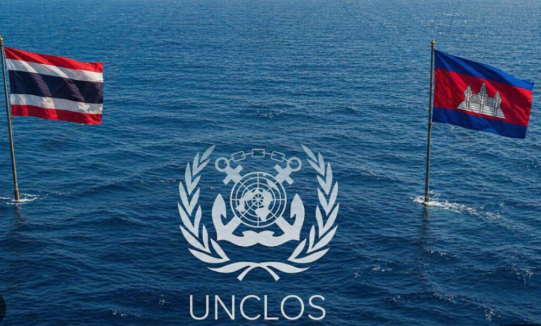
Thailand has formally accepted Cambodia's request to enter compulsory conciliation proceedings under the 1982 United Nations Convention on the Law of the Sea over their longstanding maritime boundary dispute, though Bangkok has carefully stressed that the process will not constitute court litigation and any recommendations emerging from it will carry no legal force. The Ministry of Foreign Affairs submitted its formal response to Cambodia on June 19, following Cambodia's initial notification delivered on June 2, marking an important procedural step in a dispute that has simmered for decades and involves competing claims to resource-rich waters.
The conciliation mechanism represents a structured diplomatic pathway for resolving the boundary question, though Thailand's acceptance comes with explicit caveats about the limited scope and non-binding character of the proceedings. In framing its participation, Thailand emphasised that the conciliation should focus narrowly on maritime delimitation under Unclos rather than encompassing broader issues such as provisional resource-sharing arrangements or joint development frameworks. This distinction reveals underlying tensions about what precisely the two neighbours are seeking to resolve through this international process.
Deputy Prime Minister and Foreign Minister Sihasak Phuangketkeow will represent Thailand as its Agent in the conciliation proceedings, supported by Songchai Chaipatiyut, Thailand's ambassador to Kuwait and former senior official at the Department of Treaties and Legal Affairs, who serves as Deputy Agent. Thailand has also nominated two conciliators to the proceedings: Judge Albert J Hoffmann of South Africa and Judge Rudiger Wolfrum of Germany, both of whom the Foreign Ministry describes as internationally recognised specialists in maritime law. These appointments signal Thailand's intent to ensure technical expertise shapes the conciliation process, even as Bangkok maintains that the exercise remains fundamentally advisory rather than adjudicatory.
The mechanics of the conciliation commission reflect the careful balance built into Unclos procedures. The four conciliators appointed by Thailand and Cambodia collectively have thirty days from Thailand's formal response to select a fifth conciliator who will chair the commission. This chairman will oversee proceedings expected to conclude within approximately twelve months, though both parties retain the option to extend the timeline by mutual agreement. The timeline suggests a deliberate pace designed to allow thorough examination of technical and legal arguments without imposing artificial urgency that could breed resentment.
Thai officials have taken pains to explain that compulsory conciliation operates fundamentally differently from court proceedings or binding arbitration. The conciliators, they emphasise, function as neutral experts tasked with comprehending both nations' positions, grasping the historical and geographical context of their disagreement, and facilitating identification of common ground rather than adjudicating rights and wrongs. This characterisation positions the conciliators as facilitators rather than judges, a distinction that may appeal to both countries' desire to avoid the appearance of legal defeat while still securing international input into their dispute.
Under Unclos Annex V, the conciliation commission's report containing conclusions and recommendations remains explicitly non-binding on the parties, a principle Thailand has repeatedly invoked. The Foreign Ministry has indicated that the report will serve as a foundation for resumed bilateral negotiations between the two governments rather than as a definitive settlement. This approach essentially transforms the conciliation into a sophisticated fact-finding and problem-solving exercise designed to inform direct diplomatic discussions, preserving ultimate decision-making authority for both nations' governments.
Thailand's position that bilateral negotiation must ultimately resolve the dispute reflects a broader strategic preference for maintaining flexibility and avoiding international legal constraints. Bangkok's insistence on limiting conciliation to maritime boundary delimitation, rather than allowing it to encompass provisional arrangements for joint development or resource-sharing mechanisms, suggests Thailand wishes to keep those questions separate. This compartmentalisation may allow Thailand to negotiate boundary issues independently from resource-development frameworks, potentially preserving negotiating leverage on the latter.
The maritime dispute itself concerns overlapping territorial and continental shelf claims in the Gulf of Thailand, an expanse believed to contain substantial natural gas reserves and other hydrocarbon resources worth considerable economic value. The intersection of boundary demarcation with natural resource access means that what appears on the surface to be a technical maritime law question carries profound implications for both nations' energy security and economic interests. Cambodia's decision to invoke Unclos compulsory conciliation, therefore, represents a significant escalation from traditional bilateral diplomacy, though one that remains considerably less confrontational than arbitration or litigation.
Thailand's May 2024 Cabinet decision to terminate the 2001 memorandum of understanding with Cambodia, known domestically as MoU 44, preceded Cambodia's conciliation notification and established the backdrop for current negotiations. Prime Minister Anutin Charnvirakul attributed the termination to two and a half decades of negligible progress rather than to any acute conflict, framing the decision as a technical reset of the cooperation framework. Thailand maintained that cancelling the agreement did not signal abandonment of maritime discussions but rather signalled intention to pursue resolution through Unclos mechanisms that both nations have now ratified.
The termination of MoU 44 introduced uncertainty into a previously established structure, yet simultaneously cleared space for engagement with cleaner legal and diplomatic foundations. By invoking compulsory conciliation, Cambodia demonstrated determination to move beyond the stalled bilateral framework, while Thailand's acceptance of the process, coupled with its stress on non-binding outcomes, reflects recognition that refusing participation would appear unreasonable internationally while simultaneously preserving its insistence that direct negotiation remains indispensable.
For Southeast Asia and regional maritime stability more broadly, the Thailand-Cambodia conciliation carries implications extending beyond the two nations' immediate interests. The Gulf of Thailand's energy resources make boundary resolution consequential for regional energy supply, while the precedent of using Unclos compulsory conciliation might influence how neighbouring states approach their own overlapping maritime claims. Malaysia, Vietnam, and Indonesia have watched the Thailand-Cambodia process develop, as each faces their own complex maritime boundary questions in contested waters.
Thailand's careful calibration of its conciliation participation—accepting the process while denying binding effect and emphasising continued bilateral primacy—represents a pragmatic accommodation to international pressure for transparent dispute resolution without surrendering the flexibility that bilateral negotiation preserves. Whether conciliation commissioners can genuinely facilitate movement toward agreement remains uncertain, particularly given that fundamental disagreements about the conciliation's scope have already surfaced. Nonetheless, the process provides both nations with an internationally recognised mechanism for sustained engagement on a persistently thorny question.