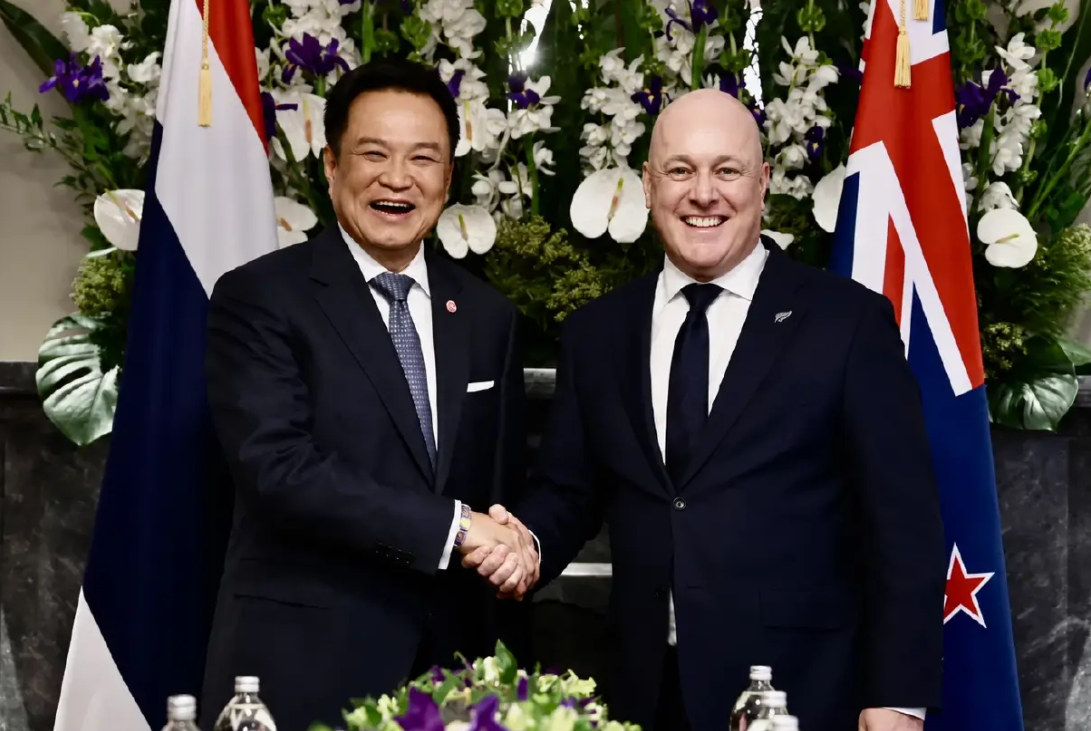
Thailand and New Zealand have formally elevated their diplomatic relationship to a strategic partnership, coinciding with celebrations of seven decades of formal ties between the two nations. The milestone announcement came during Prime Minister Anutin Charnvirakul's official visit to Wellington, where he and New Zealand Prime Minister Christopher Luxon signed a Joint Declaration on the Strategic Partnership following bilateral talks at Government House on Friday, August 21. The elevation represents a significant shift in how both governments intend to structure cooperation across multiple domains, moving beyond traditional bilateral engagement into a more comprehensive and institutionalised framework designed to deliver tangible benefits for citizens on both sides of the Tasman Sea.
The strategic partnership encompasses four pillars of cooperation framed within the Thailand–New Zealand Joint Plan of Action 2026–2030, establishing a structured roadmap for deepening ties across political, economic, educational, cultural and regional dimensions. This formalised approach signals both governments' commitment to translating the partnership declaration into measurable outcomes rather than leaving cooperation at the level of diplomatic rhetoric. The framework reflects contemporary priorities shared by both nations, particularly concerns about transnational threats and the need for sustainable economic development in an increasingly complex geopolitical environment.
On security and law enforcement, Thailand and New Zealand have committed to strengthening their collaborative response to transnational crime, online fraud schemes and human trafficking. Both countries have agreed to facilitate closer coordination and information-sharing between their respective law enforcement agencies, recognising that criminal networks increasingly operate across borders and require coordinated international responses. This dimension of the partnership addresses challenges that directly affect Southeast Asian nations like Malaysia, where cross-border criminal activities have become increasingly sophisticated and threaten regional stability.
The economic pillar represents perhaps the most tangible aspect of the partnership, with both nations setting an ambitious goal to triple bilateral trade to US$7.5 billion by 2045. Currently, trade volumes remain substantially below this target, making the 25-year timeframe realistic yet challenging. Beyond the headline figure, both countries have committed to expanding investment flows and fostering innovation-driven commerce. The two governments will work to further develop the Thailand–New Zealand Closer Economic Partnership framework, seeking to unlock new opportunities for businesses and entrepreneurs in both countries. Priority areas include food and energy security, green economy development, sustainable agriculture and environmental conservation—issues that increasingly influence trade patterns across the Asia-Pacific region.
Education and cultural exchange constitute the third cooperative pillar, with both nations planning to expand collaboration in education, skills development, innovation and capacity-building. This reflects a broader recognition that sustained economic partnerships require deep people-to-people connections and human capital development. Enhanced educational cooperation could see increased student mobility, academic exchanges and collaborative research initiatives between Thai and New Zealand institutions, fostering the next generation of leaders who understand both cultures and can facilitate business and diplomatic relations.
Regionally, Thailand and New Zealand intend to deepen collaboration through Mekong cooperation frameworks, Association of Southeast Asian Nations-led mechanisms and Asia-Pacific Economic Cooperation forums. This dimension carries particular significance for Malaysia and other Southeast Asian nations, as it positions New Zealand as a more active participant in regional architecture and demonstrates how dialogue partners can contribute meaningfully to ASEAN-led initiatives addressing shared challenges ranging from climate change to maritime security.
Perhaps the most concrete immediate manifestation of renewed ties is Thai Airways' commitment to resume direct services between Bangkok and Suvarnabhumi Airport and Auckland International Airport, with March 2027 set as the target date. Prime Minister Anutin indicated his willingness to accelerate this timeline if operationally feasible. Restoration of direct connectivity carries significance beyond aviation economics; historically, direct flight routes have catalysed tourism growth, facilitated business travel, enabled student exchanges and strengthened cultural ties. For Malaysia's tourism and aviation sectors, the Bangkok-Auckland route's revival demonstrates how strategic partnerships translate into infrastructure improvements that enhance regional connectivity and competitiveness.
The bilateral relationship also encompasses security and law enforcement dimensions that extend beyond traditional crime prevention. A Memorandum of Agreement between the Royal Thai Police and New Zealand Police on Partnership and Mutual Information Exchange formalises intelligence-sharing and operational coordination protocols. Simultaneously, four cooperation documents were signed, including agreements on cultural cooperation and a private-sector memorandum between Chata Instruments Company Limited and Aeroqual Limited, indicating that the partnership encompasses both governmental and commercial dimensions.
Anutin sought and received New Zealand's expressed support for Thailand's bid to join the Organisation for Economic Co-operation and Development, an institution that significantly influences global economic policy-making and standards-setting. OECD membership would elevate Thailand's economic governance profile and facilitate access to peer-learning opportunities with developed economies, potentially influencing how Southeast Asian nations approach policy coordination and regulatory harmonisation.
The strategic partnership comes at a moment when both nations increasingly recognise the value of deepening engagement with established democracies and market economies. For New Zealand, enhanced Thailand ties offer a gateway to deeper Southeast Asian engagement and positioning within regional institutions where its influence has historically been limited. For Thailand, the relationship provides access to New Zealand's expertise in agricultural innovation, environmental management and renewable energy development—sectors critical to regional sustainability ambitions.
Both Prime Ministers emphasised the importance of a rules-based international order and multilateral systems in supporting peace, stability and sustainable development. This language reflects shared concerns about regional stability and commitment to international law, particularly relevant given evolving geopolitical tensions in the Asia-Pacific. The partnership declaration explicitly incorporates discussion of regional and international developments, suggesting both countries intend to coordinate positions on matters ranging from climate action to maritime security.
Looking ahead, the success of this elevated partnership will largely depend on implementation capacity and political continuity in both nations. While the 2026–2030 action plan provides a structured framework, translating ambitious targets like tripling trade requires sustained business engagement, regulatory harmonisation and removal of non-tariff barriers. The timing of the partnership elevation, marking 70 years of diplomatic relations, provides an opportune moment for both governments to demonstrate renewed commitment to what have traditionally been cordial but relatively limited bilateral ties, thereby establishing a model for how established democracies can deepen engagement within the Asia-Pacific region.

