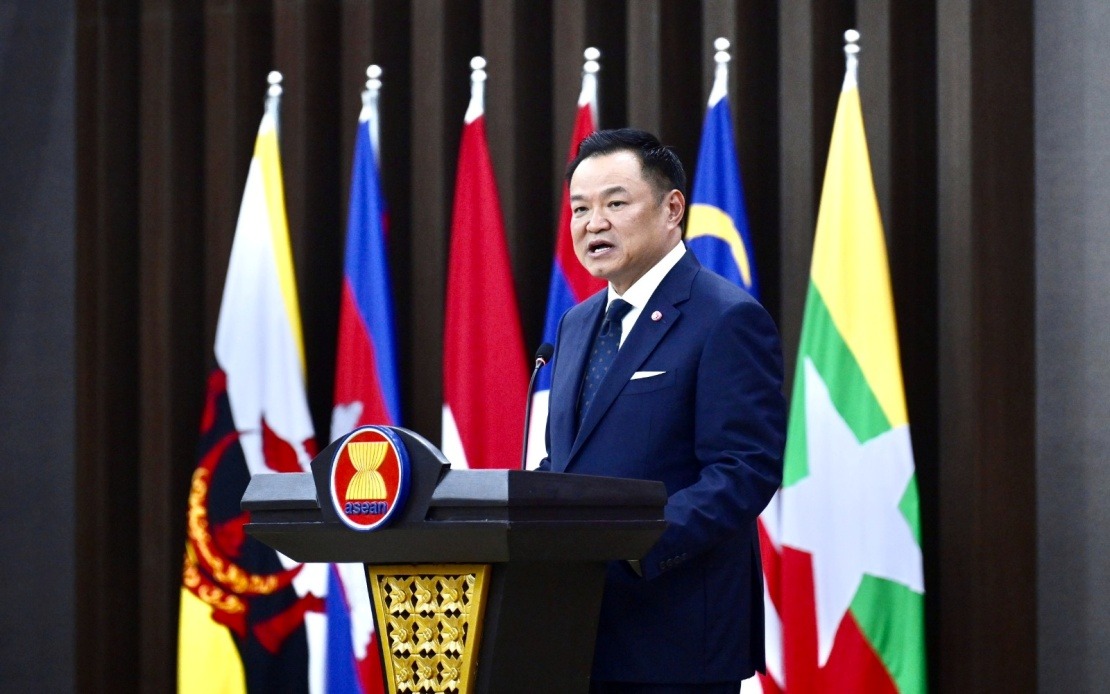
Thai Prime Minister Anutin Charnvirakul delivered a comprehensive blueprint for ASEAN's future on Tuesday, arguing that the regional bloc must evolve into a stronger, more resilient organisation capable of delivering meaningful outcomes to its 650 million citizens. Speaking at the ASEAN Secretariat in Jakarta during an official visit to Indonesia, Anutin presented a three-part strategy centred on reinforcing regionalism, building defences against mounting global uncertainties, and ensuring that the bloc's efforts translate into concrete improvements in people's lives. His remarks reflected Bangkok's growing conviction that ASEAN's traditional approach requires recalibration to remain relevant in an era of accelerating geopolitical fragmentation and multipolar competition.
The Thai leader's emphasis on collective regional problem-solving carries particular weight for Southeast Asian capitals grappling with challenges that transcend borders. Anutin stressed that contemporary pressures—spanning geopolitics, economic volatility, technological disruption, and security threats—cannot be tackled by individual nations acting in isolation. This assertion resonates strongly in Malaysia and across the region, where transnational issues from cybercrime to pandemic preparedness demand coordinated responses. By framing regional solutions as imperative rather than optional, Anutin has effectively redefined the conversation around ASEAN cooperation as a matter of survival rather than convenience.
Crucially, Anutin proposed that ASEAN should modernise its decision-making processes, suggesting that the bloc apply consensus principles and non-interference doctrine with greater flexibility. This proposal, while diplomatically cautious, represents a subtle but significant pivot from ASEAN's traditional reluctance to interfere in member states' internal affairs. For Malaysia and other regional players, such flexibility could enable faster, more decisive responses to humanitarian crises or security emergencies—though it simultaneously raises questions about how such flexibility would be defined and enforced without generating discord among members with varying strategic interests.
On the economic front, Anutin outlined an ambitious agenda targeting supply chain robustness, food and energy security, and accelerated digital infrastructure development. These priorities directly address vulnerabilities exposed by recent global disruptions and reflect shared anxieties across Southeast Asia about dependence on external suppliers and technological bottlenecks. The Thai prime minister also called for expanded engagement with middle powers and Global South nations, a strategic repositioning that acknowledges ASEAN's desire to diversify partnerships beyond traditional Western allies and China. For Malaysian policymakers, this recalibration offers opportunities to strengthen South-South cooperation and reduce exposure to great-power competition.
His call for enhanced preparation of young people for the digital economy underscores recognition that demographic advantage alone is insufficient; ASEAN must actively equip its workforce for future employment. This dimension holds particular relevance for Malaysia, which faces skilled labour shortages even as automation threatens traditional manufacturing jobs. Anutin's framing suggests that ASEAN nations must view workforce development as a collective challenge requiring shared solutions rather than competitive positioning, a perspective that could reshape regional approaches to education and vocational training.
Thailand's assertion that ASEAN must act preemptively rather than reactively marks a departure from the bloc's historical mode of crisis-driven policymaking. By advocating that ASEAN "prepare in advance" rather than await crises, Anutin challenges members to adopt forward-looking strategies on issues ranging from climate adaptation to pandemic prevention. This philosophy, if adopted broadly, could fundamentally alter how ASEAN approaches regional governance and resource allocation.
Another significant dimension of Anutin's address focused on measuring ASEAN's success through tangible benefits: stronger economic opportunities, improved security outcomes, and effective responses to organised crime. This metrics-driven approach offers a counterweight to ASEAN's occasional tendency toward performative cooperation. Malaysian observers will note that this emphasis on measurable outcomes aligns with domestic pressure for results-oriented governance, suggesting potential convergence between national and regional expectations.
On Myanmar, Anutin's balanced position reflects Thailand's delicate diplomatic position as both a neighbour to the military-controlled state and an ASEAN member committed to its Five-Point Consensus. His concept of "calibrated re-engagement" represents an attempt to maintain dialogue channels while respecting ASEAN's official stance on the 2021 coup. The reported International Committee of the Red Cross visit to Aung San Suu Kyi, which Anutin cited as evidence of progress, illustrates how incremental developments can be leveraged diplomatically to justify continued engagement despite broader international isolation of Myanmar's junta.
Thailand's overture toward Cambodia, emphasising mutual trust-building and peaceful resolution of differences, signals Bangkok's intent to repair regional relationships that have shown strain. This bilateral approach complements the larger ASEAN framework and demonstrates how individual member states continue to pursue parallel diplomacy alongside collective initiatives. For Malaysia, Cambodia's rehabilitation within ASEAN carries implications for regional stability and the bloc's ability to maintain cohesion on contentious issues.
Antin's visit to Indonesia, his first since assuming office in September 2025, carries symbolic weight as the first Thai prime ministerial visit to Jakarta in 15 years. This gap underscores how bilateral relationships within ASEAN can deteriorate without high-level engagement. His journey to the Indonesian capital signals Thailand's commitment to rebuilding these critical linkages and positioning itself as an active architect of ASEAN's future. For regional observers, the visit demonstrates that despite ASEAN's consensus-based structure, individual members continue to vie for influence and leadership roles in shaping the bloc's direction.
Thailand's articulation of an ambitious vision for ASEAN arrives at a critical juncture, as the bloc approaches its 60th anniversary next year. Anutin's three-pronged strategy—stronger regionalism, enhanced resilience, and people-centred outcomes—reflects Bangkok's conviction that ASEAN's continued relevance depends on substantive reform rather than rhetorical repackaging. Whether other member states, including Malaysia, will embrace this agenda with equivalent enthusiasm remains uncertain, but the framework Anutin has outlined will likely shape ASEAN discussions for months ahead. His emphasis on preparedness, flexibility within established principles, and tangible results offers a template that contrasts with more preservationist approaches to ASEAN governance, potentially catalysing broader debates about institutional evolution across Southeast Asia.

