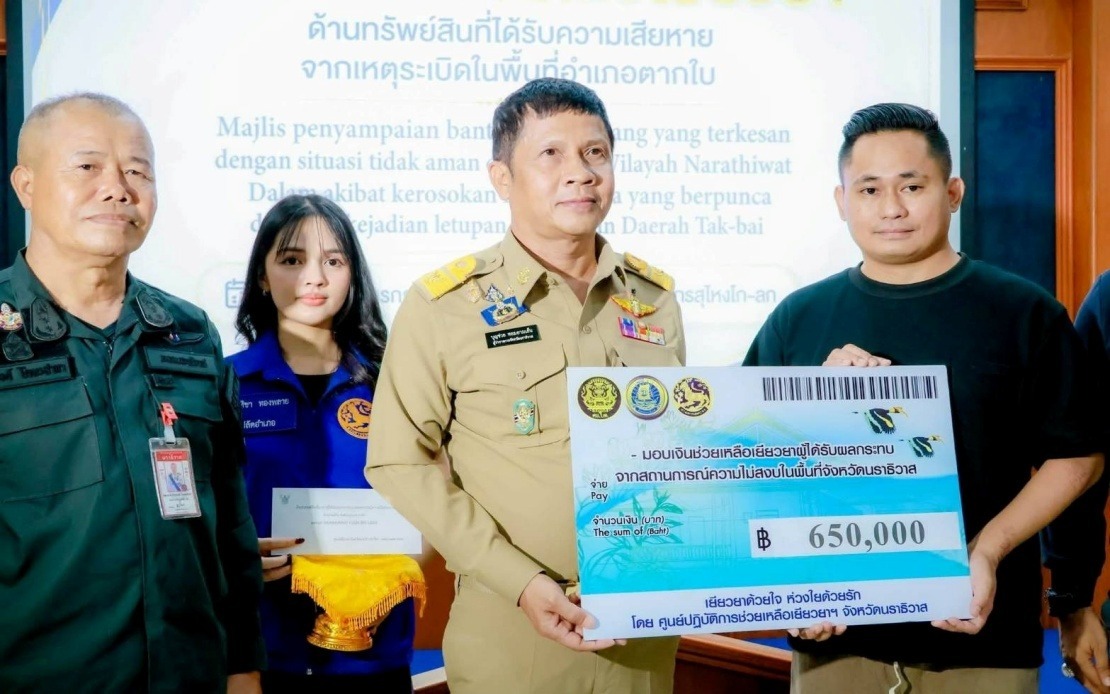
Thailand's government delivered compensation totalling 650,000 baht—approximately RM80,000—on Friday to one of two Malaysian nationals wounded in a roadside bombing in the southern border province of Narathiwat. The payment marks an official acknowledgement of the incident and reflects Bangkok's commitment to addressing the fallout from the attack that occurred in Tak Bai district on June 29.
Narathiwat Governor Boonchuay Homyamyen presented the compensation cheque to Muhammad Yusri Udin, 38, during a ceremony held at the Sungai Golok Customs Office. The provincial administrator expressed deep regret over the incident and stressed that the Thai government takes the safety of both residents and cross-border visitors with utmost seriousness. His statement underscores the sensitivity surrounding security incidents in Thailand's southernmost provinces, where decades of unrest have created a complex political and security environment affecting regional stability.
The June 29 bombing occurred near the Sapom junction in Tak Bai when an improvised explosive device concealed in a roadside drain detonated at approximately 11:40 am local time. Muhammad Yusri sustained injuries alongside Abdullah Syarapi Abd Rahman, 45, who also requires ongoing medical attention. Both men are Malaysian citizens engaged in cross-border activities, highlighting the interconnected nature of daily life along the Malaysia-Thailand frontier, where thousands of residents regularly traverse provincial boundaries for work, commerce, and family obligations.
Thailand's authorities have determined that the two Malaysians were not the intended targets of the attack. This assessment carries significant weight in regional security circles, as it suggests the bombing was motivated by the longstanding separatist insurgency in Thailand's deep south rather than deliberate targeting of foreign nationals. Thai security forces subsequently detain a 40-year-old suspect believed connected to the attack and attributed the operation to an armed rebel faction active in the region, though specific group attribution remains under investigation.
The compensation mechanism deployed in this instance operates through an established Thai government fund designed to support victims of security-related incidents, encompassing both injury compensation and reimbursement for property losses. This institutional framework reflects Thailand's experience managing conflict-related civilian casualties and demonstrates a formal process for acknowledging external claims arising from domestic security operations. For Malaysian policymakers, understanding these compensation channels is essential when negotiating support for injured nationals or coordinating cross-border security cooperation.
Governor Boonchuay's public commitments during the compensation handover reveal Bangkok's anxiety about declining tourist arrivals in southern Thailand. His emphasis that "the Thai government is committed to ensuring the safety of all parties and will continue to work on restoring tourist confidence to visit Thailand" reflects economic pressures facing the region's development ambitions. Southern Thailand's tourism infrastructure, while less developed than beach destinations further north, contributes meaningfully to provincial economies and cross-border trade, making security perception crucial for economic recovery.
Thailand's southern insurgency, rooted in complex historical and cultural grievances spanning decades, continues generating sporadic attacks despite various reconciliation initiatives. The Tak Bai district itself carries historical weight as the site of a 2004 military crackdown that killed dozens of detainees, an event that intensified separatist sentiment and remains symbolically significant for regional movements. This historical context illuminates why contemporary bombings in the area provoke particular concern among Thai policymakers conscious of underlying grievances.
For Malaysia, incidents involving injured nationals in Thai territory raise diplomatic considerations and underscore the importance of coordination mechanisms between neighboring governments. The relatively swift compensation payment suggests functional bilateral channels and Thai willingness to demonstrate responsibility toward affected foreign nationals. However, the incident also highlights persistent security challenges along the porous border region, where criminal networks and militant groups exploit ungoverned spaces to conduct operations affecting civilians across jurisdictional boundaries.
The comprehensive Thai response—involving explosive ordnance disposal operations, forensic examinations, suspect detention, and compensation disbursement—demonstrates institutional capacity for managing security crises. Yet the continuation of such incidents reveals the limitations of security-focused approaches alone in addressing underlying drivers of insurgency. Malaysian observers should note that cross-border stability depends partly on Thailand's success in managing southern unrest through combined security and political measures addressing legitimate grievances alongside counterinsurgency operations.
Governor Boonchuay's assertion that the Thai government will "not sit idly by" signals official rejection of complacency while committing to enhanced protective measures. Implementation of these promises—whether through increased border patrols, improved intelligence gathering, or community-based security initiatives—will determine whether similar incidents can be prevented. For Malaysian citizens and businesses operating in adjacent Thai provinces, observable improvements in security posture will likely influence investment and cross-border activity decisions.
The compensation payment, while materially significant for the injured Malaysian, also carries symbolic importance as official acknowledgement of responsibility and commitment to preventing future incidents. This gesture may influence broader regional perceptions of Thai government reliability in managing security matters and protecting foreign nationals. As Southeast Asian economies deepen integration and cross-border mobility increases, such incidents and official responses assume greater importance for international confidence and bilateral relations.

