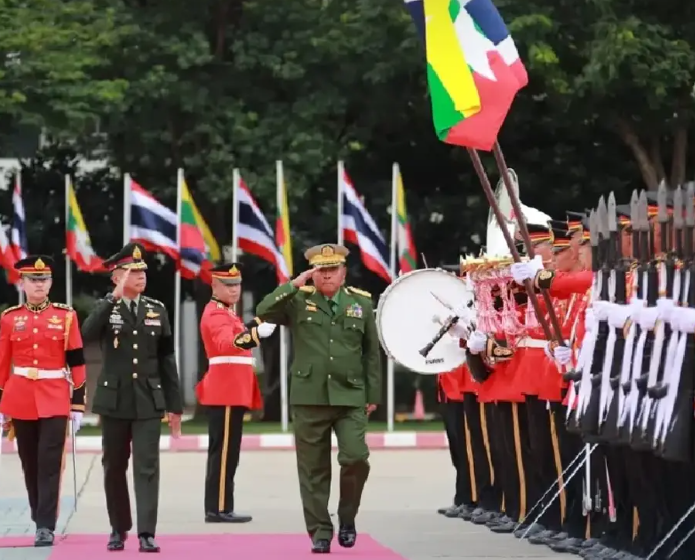
Thailand's armed forces have extended a high-level diplomatic welcome to Myanmar's military chief Ye Win Oo during his maiden overseas trip since assuming the post, underscoring the extent to which the Thai government is willing to normalise ties with Naypyidaw despite mounting international criticism. The meeting between Thai military chief Ukris Boontanondha and Ye Win Oo at a Bangkok hotel on Thursday represents a significant thaw in relations following Myanmar's military coup nearly five years ago, signalling that neighbouring countries are now prepared to move beyond condemnation and engage directly with the junta's leadership.
Ye Win Oo's ascension to Myanmar's top military post came after his predecessor Min Aung Hlaing, who orchestrated the 2021 coup that ousted Aung San Suu Kyi's elected government, transitioned into a civilian presidency following heavily restricted elections at the start of 2026. This reshuffling of leadership positions has enabled the military to maintain its grip on power while creating a facade of civilian governance that international observers have largely dismissed as theatrical. Ye Win Oo, a career intelligence operative who served as a key operative within Myanmar's ruling junta apparatus, has become the face of Myanmar's military establishment during this attempted rebranding exercise, though his background immediately disqualifies him from international legitimacy.
The border region separating Thailand and Myanmar, stretching approximately 2,400 kilometres, has become an acute concern for both governments following the eruption of a devastating civil war that has fundamentally destabilised the area. Thailand's willingness to host Myanmar's top military officials reflects the practical reality that Bangkok cannot afford to remain estranged from a neighbour with which it shares immediate security concerns. Cross-border insurgencies, refugee flows, and weaponry trafficking have made direct military-to-military engagement increasingly necessary from Thailand's perspective, regardless of ideological considerations. The talks scheduled between Ukris and Ye Win Oo are expected to centre on border management, displacement populations, and security coordination.
Myanmar's military has embarked on an aggressive diplomatic campaign aimed at rehabilitating its international image following five years of near-total isolation. The junta has leveraged its controversial 2026 elections—which were characterised by severe restrictions on political participation and the systematic exclusion of Suu Kyi's National League for Democracy—as justification for resetting diplomatic relations. By framing the elections as a return to electoral normalcy, the military hopes to convince regional neighbours that Myanmar is transitioning away from outright authoritarian rule, thereby warranting renewed engagement and the lifting of international sanctions.
Thailand's Prime Minister Anutin Charnvirakul demonstrated this shift in policy earlier this month by rolling out the diplomatic red carpet for Min Aung Hlaing during a visit to Bangkok. When pressed to justify this unprecedented hospitality toward Myanmar's coup leader, Thai Foreign Minister Sihasak Phuangketkeow articulated a pragmatic rationale: "It's not about legitimacy, it's about reality." This statement encapsulates the calculus of regional countries facing Myanmar—namely, that geopolitical necessity and practical border management concerns supersede questions of democratic legitimacy or human rights considerations. For Thailand, maintaining a functional relationship with Myanmar's military command structure is presented as an unavoidable requirement of responsible regional governance.
However, the Thai government's strategy has attracted scathing criticism from international civil society organisations monitoring Myanmar's political trajectory. The Special Advisory Council for Myanmar condemned Thailand's diplomatic engagement by asserting that "by embracing a warlord, Thailand has torched its credibility," while describing the decision to host Ye Win Oo as "adding to its ignominy." This rebuke encapsulates the broader international consensus that Myanmar's 2026 elections constituted a fundamentally flawed exercise designed to legitimise indefinite military rule rather than institute genuine democratic transition. Critics argue that countries like Thailand are complicit in enabling the junta's consolidation of power through tactical recognition.
The accusations levelled against Myanmar's military establishment remain extraordinarily grave, extending far beyond mere political repression. The United Nations' Independent Investigative Mechanism for Myanmar released its annual report last week documenting systematic patterns of arbitrary detention, torture, and sexual violence perpetrated by military personnel against civilian populations. The UN's investigators also determined that Myanmar's armed forces have substantially increased their aerial bombardment campaigns targeting civilian infrastructure and populated areas. These findings paint a portrait of a military institution engaged in what amounts to crimes against humanity on an institutionalised scale.
The broader civil war triggered by the 2021 coup has inflicted catastrophic human costs, with researchers estimating that the conflict has claimed approximately 100,000 lives across Myanmar. This staggering casualty toll reflects the profound destabilisation unleashed by the military's decision to eliminate elected civilian governance. The armed forces have subsequently waged a brutal campaign against armed resistance groups, ethnic minority militias, and urban resistance movements across the country. The scale of displacement, humanitarian suffering, and economic destruction has positioned Myanmar as one of the world's most severe ongoing humanitarian crises, yet one that receives diminishing international attention.
Myanmar's government has categorically rejected the UN's findings, dismissing the investigative mechanism's conclusions as "one-sided allegations against Myanmar's security forces based on unverifiable and inaccurate information." This denial strategy is unsurprising given that international documentation of systematic rights abuses directly undermines the junta's legitimacy narrative. By attacking the credibility of UN investigators, Myanmar's leadership attempts to delegitimise any findings that contradict its carefully constructed image of military professionalism and restraint. This defensive posture reflects the tension between the junta's rehabilitation campaign and the accumulating evidence of its institutional brutality.
For Southeast Asian readers, particularly those in Malaysia and neighbouring countries, this diplomatic pivot carries significant implications. The willingness of Thailand—a regional peer of Malaysia—to pragmatically engage Myanmar's military despite documented atrocities suggests that border management concerns increasingly override human rights considerations in regional diplomacy. This precedent may influence how Malaysia and other ASEAN members approach their own Myanmar policies, potentially creating pressure to prioritise stability over principled opposition to military rule. The tension between realpolitik engagement and principled human rights advocacy will likely define ASEAN's approach to Myanmar for the foreseeable future, with serious consequences for the credibility of regional institutional frameworks.

