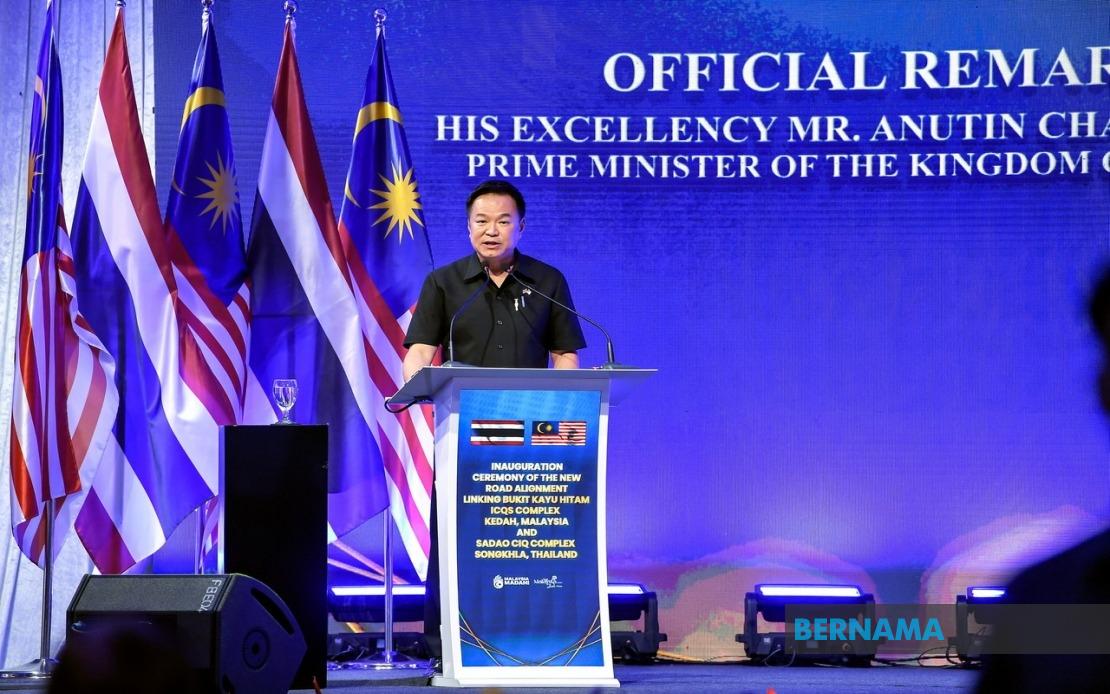
Thai Prime Minister Anutin Charnvirakul reaffirmed his government's dedication to filling critical gaps in the transport infrastructure linking Malaysia and Thailand, declaring that completing these connections would unlock significant trade and economic potential across the broader Southeast Asia-China corridor. Speaking at the inauguration of a new road alignment connecting border checkpoints in Bukit Kayu Hitam, Kedah and Sadao, Thailand, Anutin outlined an ambitious vision for seamless cross-border movement that extends far beyond bilateral trade, reaching toward China and Russia in the longer term.
The new road alignment, jointly developed through collaborative efforts between Bangkok and Kuala Lumpur, directly addresses one of the region's persistent bottlenecks. The Bukit Kayu Hitam Immigration, Customs, Quarantine and Security (ICQS) Complex and the Sadao Customs, Immigration and Quarantine (CIQ) Complex have long served as the busiest crossing along the Malaysia-Thailand frontier, frequently experiencing congestion that hampers the movement of commercial vehicles and travellers. By redesigning the road connection between these facilities, the two governments hope to substantially reduce waiting times and facilitate more efficient border procedures without compromising security or regulatory oversight.
Prime Minister Anutin emphasised that the infrastructure improvements would function as a two-way conduit, enabling not only Malaysian products to reach Thai and northern markets, but also allowing Thai and Chinese goods to flow southward through Malaysian territory toward Singapore and other Indonesian hubs. This reciprocal arrangement reflects a broader understanding that regional connectivity benefits all participating economies by shortening supply chains, reducing logistics costs, and encouraging direct investment in border regions. The vision extends beyond traditional merchandise trade to encompass passenger mobility, services, and human capital movement that increasingly characterises modern regional commerce.
The inauguration ceremony, jointly officiated by Anutin and Malaysian Prime Minister Datuk Seri Anwar Ibrahim, underscored the political commitment at the highest levels to accelerate these connectivity initiatives. Anwar's presence, alongside his wife Datuk Seri Dr Wan Azizah Wan Ismail, signalled Malaysia's equal enthusiasm for deepening infrastructure ties with its northern neighbour. Anutin's two-day official visit, occurring at Anwar's invitation, provided an opportunity for both leaders to discuss not only the completed project but also a slate of future connectivity schemes that could reshape trade patterns across the peninsula and southern Thailand.
Beyond the immediate Bukit Kayu Hitam-Sadao corridor, both governments have identified three additional cross-border connectivity initiatives with substantial economic ramifications. The proposed Songkhla-Kedah, Satun-Perlis, and Narathiwat-Kelantan linkages would essentially create a network of interconnected passages throughout the Malaysia-Thailand border, allowing traffic to be distributed more evenly and giving landlocked regions in both countries improved access to international trade routes. This multi-point approach prevents overconcentration of border traffic at a single checkpoint and enables smaller towns and provinces to participate more actively in cross-border commerce and regional value chains.
The southern Thailand and northern Malaysia corridor occupies strategic importance within the broader Southeast Asian economic landscape. These regions, historically peripheral to their respective national centres of economic gravity, stand to benefit significantly from improved connectivity. Border communities have long faced constraints in accessing capital, markets, and skilled labour, partly owing to geographic isolation and the friction imposed by border procedures. By systematically upgrading transport links and harmonising customs protocols, both governments aim to catalyse economic activity in these areas, creating employment opportunities and improving living standards for residents who have historically borne the costs of geographic remoteness.
Anutin framed these connectivity improvements as essential to realising what he termed the full economic potential of the Malaysia-Thailand border region. His remarks reflected a recognition that modern trade and investment increasingly depend on seamless logistics and minimal friction at international boundaries. Regions that can offer efficient cross-border movement attract manufacturing facilities, distribution centres, and regional headquarters, generating multiplier effects throughout local economies. The infrastructure investments therefore represent not merely border management tools but strategic economic development initiatives with implications for employment, poverty reduction, and regional inequality.
The commitment to resolving outstanding border procedures and facilitating easier movement for citizens from both countries suggests that infrastructure improvements will be complemented by regulatory harmonisation and simplified visa or travel arrangements. Such administrative reforms often prove as significant as physical infrastructure in determining the practical usability of border crossings. By coupling road improvements with procedural streamlining, both governments signal an intention to create an integrated borderland characterised by minimal bureaucratic friction, appealing to legitimate travellers, merchants, and investors while maintaining appropriate security protocols.
For Malaysian policymakers and business communities, these developments carry particular significance given Malaysia's position as a geographic bridge between ASEAN and the wider Indo-Pacific region. Enhanced connectivity to Thailand and beyond strengthens Malaysia's role as a transit nation and transshipment hub, potentially attracting logistics investments and regional supply chain activities. The Bukit Kayu Hitam corridor, being the primary overland link to upper Thailand and beyond, represents a critical artery for Malaysia's engagement with the broader Asian economy, particularly as regional trade increasingly integrates production networks across national borders.
The timing of these initiatives reflects broader regional momentum toward infrastructure integration. The Pan-Asia Railway, ASEAN connectivity frameworks, and various bilateral development corridors have created competitive pressure for individual border regions to upgrade their facilities and procedures or risk becoming bypassed in modern trade flows. Malaysia and Thailand's actions at Bukit Kayu Hitam-Sadao thus represent responses to these competitive dynamics while simultaneously advancing shared interests in prosperity and stability along their historically significant border region.
Looking forward, the success of these connectivity projects will depend on sustained political commitment beyond inaugural ceremonies, adequate funding for ongoing maintenance and upgrades, and willingness from both governments to address the practical challenges that inevitably arise in cross-border operations. The symbolic significance of joint leadership presence at the inauguration must translate into operational coordination between customs officials, transport regulators, and local authorities responsible for day-to-day border management. Furthermore, private sector participation in logistics, warehousing, and transport services will be essential to translating infrastructure investments into actual improvements in trade flows and economic activity.

