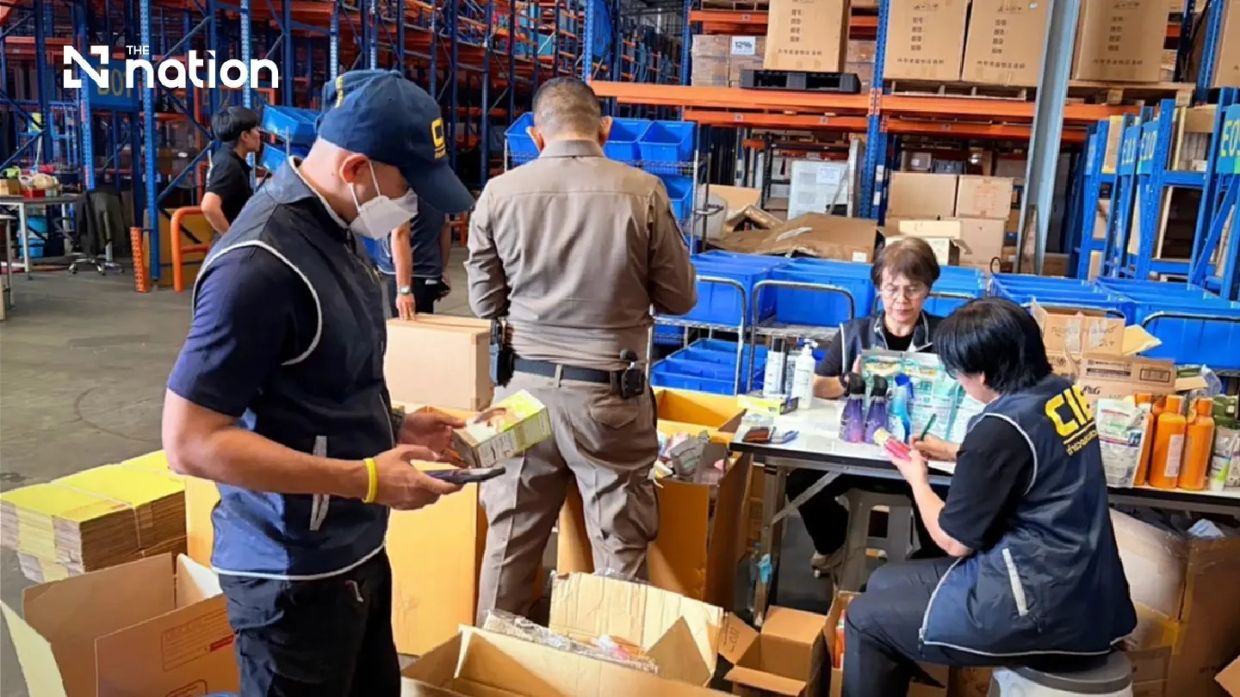
Thai police have dismantled a large-scale distribution operation supplying unlicensed Japanese cosmetics, dietary supplements, and medicines to online retailers across the kingdom. Acting on directives from Pol Maj Gen Kongkrit Lertsittikul, commander of the Consumer Protection Police Division, officers descended on a warehouse in Bang Phli district, Samut Prakan, and confiscated 83,483 items spanning 116 different product types. The haul, valued at more than 8.34 million baht, represents one of the more substantial crackdowns on the illicit cosmetics and supplements trade that has flourished on digital marketplaces throughout Southeast Asia.
The operation exposed a systematic approach to circumventing Thailand's stringent product safety requirements. All seized items had been imported directly from Japan without undergoing mandatory safety inspections, obtaining necessary certifications from relevant regulatory authorities, or bearing Thai-language labelling as required by law. These procedural gaps are not merely administrative oversights—they indicate intentional non-compliance with frameworks designed specifically to protect consumers from potentially harmful substances. The warehouse had operated this scheme for more than four years, processing between 200 and 300 items daily at packing fees of 10 to 12 baht per box, suggesting the operation had generated substantial profits while systematically flouting regulatory oversight.
The investigation began following mounting complaints from Thai consumers who discovered that numerous online sellers were offering cosmetics, supplements, and household hazardous substances without proper labelling. Investigators traced the source of these goods back to a centralised distribution point, revealing how a single warehouse had become the hub for a network of e-commerce sellers operating across multiple platforms. Rather than maintaining direct relationships with licensed importers, these retailers had instead purchased from an intermediary operation that stored and repackaged Japanese products, essentially creating a shadow supply chain that bypassed official regulatory checkpoints entirely. This model represents a particular challenge for consumer protection authorities because it fragments accountability across numerous online vendors, many of whom may have been unaware of the legal status of their merchandise.
The warehouse's operational model evolved over its four-year lifespan. Initially established as a simple storage facility for imported goods, it gradually expanded into a comprehensive logistics operation offering storage, packing, and distribution services to multiple online businesses. This transformation underscores how commercial infrastructure designed for routine warehousing can be repurposed to facilitate regulatory evasion. Staff processed hundreds of items daily, bundling products for shipment to sellers who listed them on various digital platforms without disclosing their origin or regulatory status. The efficiency of this operation—charging standardised packing fees and maintaining consistent throughput—suggests the operators understood they were engaged in illicit activity but calculated that the profit margins justified the regulatory risk.
Thailand's multi-layered regulatory framework addresses the risks posed by such unapproved products. The Cosmetics Act, Food Act, Drug Act, and Hazardous Substances Act collectively establish requirements for import documentation, safety testing, product labelling, and distribution oversight. Products entering the Thai market through official channels must satisfy the standards set by agencies including the Thai FDA and the Department of Medical Sciences. When cosmetics and supplements bypass these processes, consumers face unquantified risks—formulations may contain undisclosed allergens, prohibited substances, or active ingredients at concentrations that differ from what manufacturers claim. The absence of Thai-language labelling compounds these dangers, as consumers cannot access ingredient lists, usage instructions, or safety warnings.
For Malaysian and broader Southeast Asian consumers, this raid carries particular relevance. The ease with which Japanese products have infiltrated Thai e-commerce platforms demonstrates how regional supply chains remain vulnerable to regulatory arbitrage. Online marketplaces operate across borders, and products seized in Thailand often circulate simultaneously in Malaysia, Indonesia, and other neighbouring markets. Consumer behaviour has shifted dramatically toward digital purchasing, yet enforcement capacity has not expanded proportionally. A single warehouse in Bang Phli was supplying sellers across Thailand; similar hubs likely operate throughout the region, each serving as a distribution point for products that would never receive regulatory approval if subjected to formal import procedures.
The implications extend beyond individual consumer safety. The existence of this network reflects structural weaknesses in how e-commerce platforms manage supplier verification and product compliance. Online marketplaces typically operate on a model that prioritises transaction volume and vendor autonomy, creating environments where regulatory non-compliance becomes economically rational for suppliers. Sellers who purchase from illicit distributors face lower input costs than those sourcing from licensed importers, and platforms themselves have limited incentive to conduct rigorous pre-listing compliance checks when doing so would reduce available inventory and merchant participation.
Those implicated in the distribution scheme now face prosecution under multiple statutes. Legal proceedings will determine whether operators knowingly distributed potentially hazardous goods, whether online sellers knew the products lacked required approvals, and what penalties are appropriate for violations spanning years and thousands of transactions. Thai courts have increasingly taken consumer protection violations seriously, recognising that e-commerce represents a growing vector for unsafe products. However, securing convictions in complex supply chain cases remains challenging, particularly when responsibility is diffused across warehouse operators, logistics providers, and individual online merchants.
The seizure also highlights the resource-intensive nature of effective enforcement. Police obtained court approval to search the warehouse only after investigators had painstakingly traced complaints back to a specific location—a process that required sustained investigative effort across multiple cases. Scaling such operations to address the full extent of illicit cosmetics and supplement trafficking would require substantially larger enforcement budgets and more sophisticated intelligence gathering. Many regional governments lack these capacities, allowing similar operations to flourish with minimal risk of detection.
From a consumer perspective, the most practical lesson concerns verification of seller legitimacy. Products bearing official Thai regulatory markings, complete ingredient labelling in Thai, and verifiable distributor information represent significantly lower risk than those sourced through marketplace sellers offering suspiciously low prices or unclear provenance. The cosmetics and supplements sector remains particularly vulnerable to counterfeiting and regulatory evasion because these products command premium prices and suffer from information asymmetries—consumers cannot easily assess quality or safety before purchase. Regional authorities should consider coordinated approaches to online marketplace compliance, including mandatory seller verification, pre-listing product documentation requirements, and rapid takedown procedures for non-compliant listings.
The operation underscores that consumer protection in Southeast Asia's rapidly evolving digital economy requires sustained vigilance. As e-commerce continues expanding and international shipping becomes frictionless, the temptation to circumvent regulations grows proportionally. The warehouse in Bang Phli represented an unusually large operation, but it almost certainly was not unique. Understanding how these networks function—how they source products, how they market them online, and how they evade detection—remains essential for regulators seeking to protect consumers while preserving legitimate commercial activity. The 83,483 items seized represented one snapshot of a much larger problem that transcends national borders and demands regional solutions.

