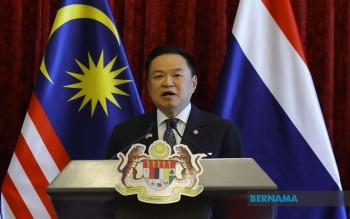
Thailand is poised to achieve a landmark US$30 billion bilateral trade target with Malaysia by 2027, according to Thai Prime Minister Anutin Charnvirakul, who arrived in Kuala Lumpur on an official visit underscoring deepening economic ties between the two Southeast Asian neighbours. Speaking at a joint press conference with Malaysian Prime Minister Datuk Seri Anwar Ibrahim following an exchange of memoranda of understanding at Perdana Putra Complex in Putrajaya, Anutin expressed confidence that the ambitious goal was within reach given the momentum of current cooperation initiatives.
The trade relationship between Thailand and Malaysia has reached a mature and substantial level, with bilateral commerce currently standing at approximately US$28 billion annually. This figure positions Malaysia as Thailand's largest trading partner within ASEAN, a distinction that reflects decades of economic integration, geographical proximity, and complementary industrial sectors between the two nations. The proximity of the US$30 billion target—requiring only modest growth from the current baseline—has prompted both governments to accelerate collaborative efforts aimed at removing trade barriers and facilitating smoother cross-border commercial activity.
Thai leadership intends to leverage the joint trade committee structure to formulate even more ambitious targets beyond 2027, signalling that the US$30 billion figure represents a waypoint rather than an endpoint in expanding economic engagement. This strategic approach acknowledges that as regional economies mature and integrate deeper into global value chains, bilateral trade relationships must evolve to capture emerging opportunities in sectors where both countries hold competitive advantages. By establishing progressive targets, Bangkok and Kuala Lumpur are committing to sustained institutional focus on trade growth rather than treating economic milestones as isolated achievements.
Thailand has committed to supporting endeavours aimed at fortifying regional value chains and supply chains by capitalising on the complementary strengths embedded in both economies. Malaysia's significant downstream petroleum refining capabilities, advanced electronics manufacturing base, and expanding renewable energy sector dovetail effectively with Thailand's agricultural strength, automotive assembly expertise, and growing chemical processing industries. Strategic alignment in these areas offers opportunities to create integrated production networks that enhance competitiveness against external competitors and reduce supply chain vulnerabilities that regional economies experienced during recent global disruptions.
The bilateral agenda prioritises three interconnected strategic pillars that reflect broader regional and global concerns. Food security remains paramount given population pressures, climate volatility, and the need for agricultural modernisation across Southeast Asia. Energy security has become increasingly critical as the region seeks to balance economic growth with decarbonisation commitments and reduced reliance on energy imports. The digital economy and high-tech industries represent the frontier where both nations seek to establish themselves as centres of innovation and advanced manufacturing, particularly as global technology supply chains recalibrate away from concentrated dependencies.
Malaysian Premier Anwar Ibrahim acknowledged the significance of the trade target and confirmed that his government would direct substantial institutional effort toward realisation of the goal. The Ministry of Foreign Affairs and the Ministry of Investment, Trade and Industry have been tasked with coordinating the push to expand bilateral commerce, reflecting recognition that sustained trade growth requires not merely private sector initiative but also deliberate government facilitation through policy harmonisation, investment promotion, and regulatory alignment. This whole-of-government approach signals serious commitment to transforming the trade relationship into an even more central pillar of bilateral partnership.
Anwar emphasised that economic and trade cooperation must serve as the foundation for broader friendship and collaborative engagement spanning multiple domains. Tourism emerges as a particularly promising sector for expansion, given the popularity of both destinations among regional and international travellers and the potential for joint destination marketing that could enhance visitor flows to both countries. By anchoring partnership in concrete economic metrics and tangible commercial relationships, both governments believe they can cultivate broader political goodwill and mutual understanding that extends beyond transactional dealings.
Anutin's visit represents his first journey to Malaysia since his reappointment as Thai Prime Minister in March 2026, timing that underscores the significance of bilateral relations within Thailand's foreign policy priorities. The formal bilateral meeting at Perdana Putra Complex encompassed comprehensive review of existing cooperation frameworks and identification of areas where deepened engagement could yield mutual benefits. Such high-level diplomatic engagement, particularly when focused explicitly on economic expansion, typically catalyses momentum for implementing agreements reached at technical and ministerial levels, ensuring that announced targets translate into concrete action.
The two-day official visit schedule provides extended opportunity for substantive discussions spanning security cooperation, cultural exchanges, people-to-people connections, and collaborative approaches to regional challenges including maritime security and environmental management. These broader discussions acknowledge that sustainable economic partnership requires supportive political environment and mutual commitment to shared values and interests extending well beyond quarterly trade statistics. For Malaysia, Thailand represents a crucial partner in navigating regional geopolitical complexities and strengthening ASEAN's collective voice; for Thailand, Malaysia offers access to downstream industries and consumer markets while reinforcing bilateral bonds within the association.
From a Malaysian perspective, the expansion of bilateral trade with Thailand carries particular relevance given Malaysia's strategic positioning as a trade hub linking ASEAN to broader regional and global commerce. Strengthened Malaysia-Thailand ties contribute to ASEAN economic integration objectives and demonstrate that deeper regional cooperation remains achievable despite occasional political tensions elsewhere in the association. The sectors identified—food security, energy, and digital technology—align closely with Malaysian development priorities and offer opportunities for Malaysian companies to access Thai markets while collaborating on production activities that serve broader Southeast Asian demand.
The institutional mechanisms surrounding this trade partnership warrant attention for their potential applicability elsewhere in ASEAN. The joint trade committee framework, combined with explicit numerical targets and timeline-bound goals, creates accountability structures that can drive progress. If Thailand and Malaysia successfully breach the US$30 billion barrier by 2027, the model they employ could inspire similar ambitious arrangements among other ASEAN pairs, potentially accelerating regional integration and generating prosperity that extends beyond the bilateral relationship itself.

