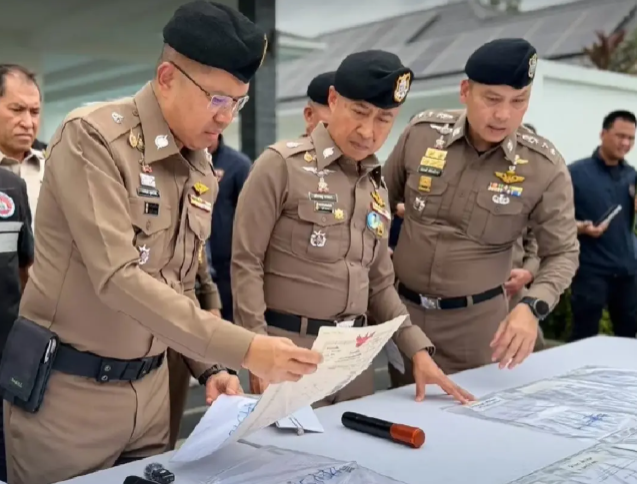
Thai police have intensified their investigation into foreign property ownership schemes by arresting 13 foreign nationals during coordinated raids in Hua Hin's exclusive resort area. The operation, which unfolded across 15 locations in Prachuap Khiri Khan province on August 10, represents the sixth phase of an expanding nationwide campaign against nominee structures used to circumvent Thailand's restrictions on foreign land ownership. The arrested individuals included three British nationals, four Chinese nationals, and one each from Italy, France, the Netherlands, Austria, the Philippines and the United States, though none have faced court charges as investigations continue.
The scale of the Hua Hin operation reflected heightened law enforcement coordination, involving more than 200 police officers and government officials working alongside the Prachuap Khiri Khan governor, the Department of Business Development, and the Department of Lands. Deputy national police chief Pol Gen Samran Nuanma authorized the raids, with operational command handled by senior police commissioners. This level of institutional involvement signals that Thai authorities view nominee property schemes as a systematic threat requiring multi-agency responses, particularly in tourist-dependent provinces where foreign investment pressures are intense.
The targeted development in Thap Tai subdistrict consists of modern pool villas individually valued between 10 and 20 million baht, representing the kind of high-end residential properties that attract foreign buyers seeking to establish Thai residency or investment portfolios. Within this single development alone, investigators identified six companies allegedly serving as fronts for foreign ownership, with four tied to the first phase of the scheme and two to a second phase. The broader investigation encompasses 33 companies suspected of holding approximately 300 million baht in property assets on behalf of foreign nationals, revealing the substantial financial scale of these arrangements across Thailand's property sector.
Central to the scheme's operation were professional intermediaries who provided legal and accounting advice to foreign buyers, directing them to establish Thai companies ostensibly to hold property legally. Foreign nationals questioned during the investigation explained they had been counseled that this approach would allow them to own Thai real estate while complying with local regulations. However, police investigations revealed a critical disconnect: these companies conducted no genuine business operations beyond serving as property repositories, functioning instead as elaborate legal structures designed to obscure foreign beneficial ownership and circumvent Thailand's constitutional prohibition on foreign land tenure.
The nominee arrangement typically involved Thai nationals listed as registered shareholders who claimed to investigators that they had neither paid for their shares nor participated in company management decisions. These individuals stated they possessed no financial documents, investment records, or knowledge of the companies' operations, presenting themselves as passive participants in arrangements they barely understood. Their testimonies pointed to a deliberate compartmentalization of responsibility, with foreign buyers remaining distant from corporate administration while Thai nationals provided legal cover, a structure that police view as evidence of intentional circumvention rather than legitimate foreign investment.
During the raids, investigators seized comprehensive documentation including company registration papers, accounting records, computers, mobile phones, and electronic data. This evidence will undergo forensic examination to trace financial flows, identify additional participants in the networks, and determine connections to overseas individuals or organizations. The financial dimension proves particularly important for establishing chains of beneficial ownership and distinguishing between legitimate foreign investment that complies with Thai law and illegal arrangements designed to circumvent property restrictions.
The investigation has expanded considerably since its inception on Koh Phangan in Surat Thani, where authorities initially examined nominee companies and professional networks allegedly facilitating property and tourism business control. Phase 3 operations extended scrutiny to Phuket, Phang Nga and Krabi, where investigators examined 89 properties valued exceeding 1.05 billion baht. Phase 4 targeted Chonburi province, while Phase 5 focused on Chiang Mai, where 31 companies and 29 land plots worth approximately 633 million baht came under investigation. The first five phases collectively examined 233 properties covering more than 160 rai—exceeding 25.6 hectares—with estimated combined value surpassing 2.539 billion baht, indicating the investigation's massive cumulative scope.
Convictions arising from earlier phases number 20, demonstrating that prosecutions, while steady, remain relatively modest compared to the investigation's breadth. Courts approved 133 arrest warrants from the first five phases, yet the relatively limited number of convictions suggests prosecutors face significant evidentiary or legal challenges in proving intent to circumvent foreign ownership restrictions versus legitimate corporate structures. This gap between arrests and convictions highlights potential vulnerabilities in Thailand's legal framework for addressing sophisticated property schemes.
The crackdown carries implications extending beyond individual property transactions to fundamental questions about Thailand's investment climate and the rule of law. Foreign investors and their advisors must now navigate heightened regulatory scrutiny, while legitimate international property buyers face reputational risks and investigative attention. The government's clear messaging—that the campaign targets illegal structures rather than compliant foreign investors—attempts to distinguish between legitimate international commerce and illegal schemes, though the distinction may appear blurred to investors unfamiliar with Thai property law nuances.
Southeast Asian property markets have long attracted foreign capital seeking diversification, stable value appreciation, and lifestyle benefits in popular destinations. Thailand's restrictions on foreign land ownership, established through constitutional provisions, aim to preserve national control over agricultural and residential land while regulating foreign economic influence. However, the gap between legal restrictions and practical foreign investment demand has created a thriving market for workarounds, with professional intermediaries profiting from facilitating these arrangements. The crackdown represents an attempt to enforce constitutional intent through prosecutorial action rather than legal reform.
For Malaysian readers and regional investors, Thailand's nominee investigation offers cautionary lessons about property market participation in jurisdictions with foreign ownership restrictions. While Malaysia maintains its own foreign ownership regulations through state-level guidelines and the Restrictions on Foreign Ownership of Residential Property regulations, comparable schemes could theoretically emerge if enforcement proves inconsistent. Thailand's experience demonstrates that host governments increasingly view nominee arrangements as threatening national sovereignty and economic policy, justifying resource-intensive investigations.
The Royal Thai Police announced expanded investigations into potential government corruption or official complicity in facilitating nominee schemes, signaling concern that enforcement agencies or officials may have been compromised. This aspect—examining whether public servants improperly assisted scheme participants—broadens the investigation from property owners and intermediaries to institutional integrity. Such inquiries can prove politically sensitive in contexts where foreign investment lobbying influences policy implementation.
Authorities have established reporting mechanisms for public tipoffs, with the Royal Thai Police hotline 1599 available continuously for nominations of suspected illegal foreign business activities. This approach democratizes investigation initiation while potentially generating leads from competitors, disgruntled employees, or community members concerned about foreign-dominated developments. Thailand's determination to continue investigating suspected nominee networks nationwide, particularly in tourist destinations where foreign investment pressures concentrate, suggests the campaign will sustain intensity regardless of prosecution rates or conviction challenges.

