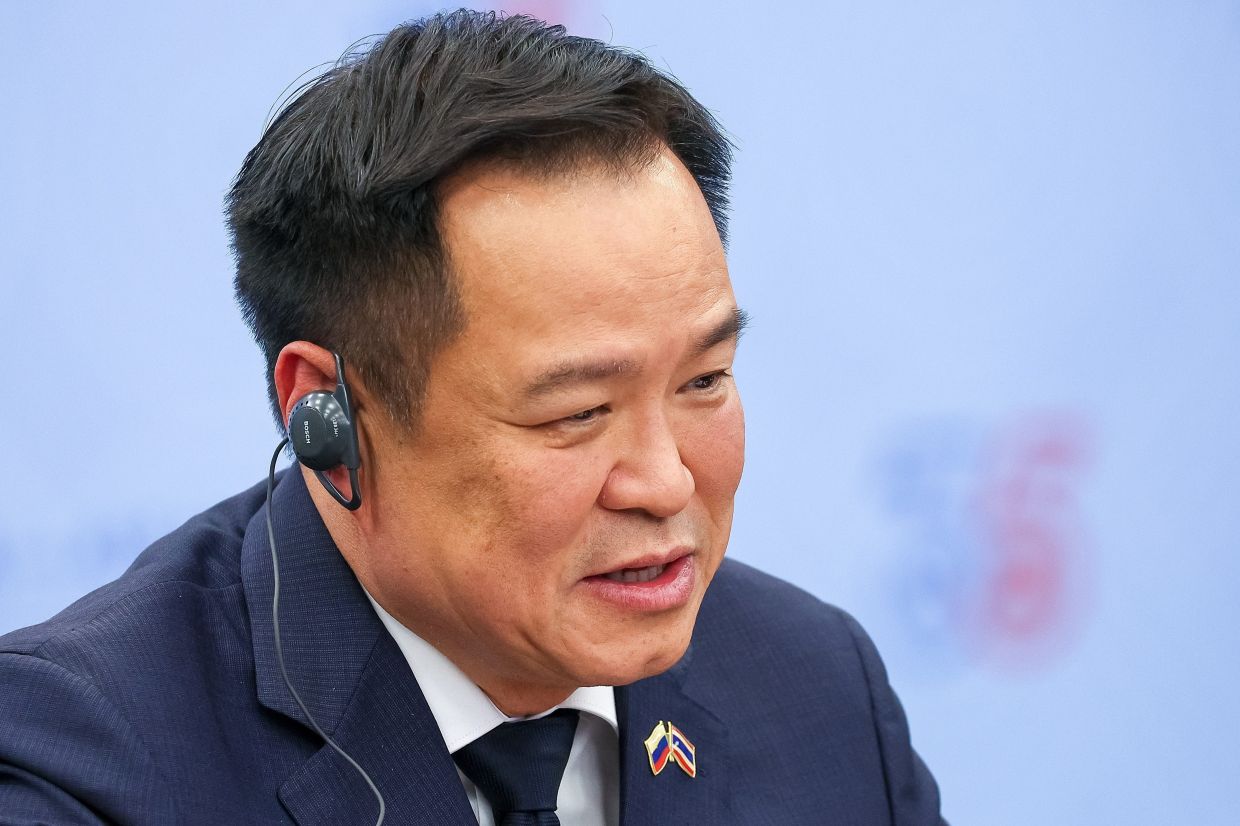
Bangkok entered a new political chapter on June 27 when Prime Minister Anutin Charnvirakul marked his first hundred days in office following his swearing-in on March 20. The milestone arrives just over nine months after he initially assumed the premiership in September 2025 when the Paetongtarn Shinawatra government collapsed, before consolidating his position through a February 2026 general election victory that strengthened his Bhumjaithai Party's parliamentary position.
Thailand's 59-year-old premier has earned qualified approval from political observers for maintaining relative stability and navigating an unexpected energy disruption that tested his nascent administration almost immediately. Yet beneath this surface calm lies growing scrutiny about whether his government possesses the vision and commitment to address the kingdom's stubborn long-term economic challenges, including anaemic growth, mounting household indebtedness, and demographic ageing that threatens prosperity.
Anutin's first major challenge materialised swiftly when Middle East tensions erupted into direct US-Israel military action on February 28, triggering widespread disruptions to international oil shipments through the Strait of Hormuz. The geopolitical shock rippled across Southeast Asia as energy supplies tightened and global oil prices spiked above US$100 per barrel for extended periods, exposing the region's precarious dependence on distant maritime corridors beyond its strategic control. Inside Thailand, panic buying overwhelmed petrol station networks, while fuel price increases sparked economic jitters throughout the supply chain.
To contain the immediate fallout, the Thai government deployed multiple stabilisation measures that demonstrated pragmatic crisis management rather than ideological commitment. The administration tapped Thailand's Oil Fuel Fund to subsidise consumer fuel costs, extended cheaper borrowing facilities to agricultural and industrial sectors dependent on energy inputs, and maximised electricity generation from coal-fired plants operating at full capacity. Simultaneously, officials pursued energy import diversification by negotiating expanded supplies from the United States, Malaysia, and Brunei—a shrewd hedging strategy that reduced reliance on any single source while strengthening regional economic ties.
Political science researchers tracking the government's performance have characterised its handling of the energy crisis as competent containment. Mathis Lohatepanont, a political science doctoral candidate at the University of Michigan, observed that Anutin's administration "managed to avoid further instability" despite disruptive supply shocks and price volatility. Critically, the government avoided the destabilising popular protests that often erupt when Thai households face sustained cost-of-living pressures—a significant achievement given the country's volatile recent political history marked by military interventions and abrupt government transitions.
Beyond crisis management, Anutin consolidated his political base through nationalist positioning on Thailand's contentious border dispute with Cambodia. His Bhumjaithai Party had secured the most parliamentary seats by appealing to nationalist sentiment and advocating a hardline stance on the maritime boundary controversy. As premier, Anutin followed through on this electoral mandate by maintaining military-led border security operations and unilaterally terminating the 2001 bilateral maritime agreement with Phnom Penh—a move that escalated the dispute to United Nations arbitration. This approach satisfied his core supporters while signalling continuity in Thai foreign policy despite government transitions.
Anutin also delivered visible rewards to his electoral constituency through the Thais Help Thais Plus programme, a subsidy initiative launched on June 1 that allows approximately 30 million eligible Thai citizens to purchase selected goods at 40 percent of retail prices, with government covering the remainder. With 176 billion baht (US$5.27 billion) allocated to this expansion, the scheme represents the administration's most tangible domestic achievement and has proven genuinely popular across income groups. However, academic observers acknowledge that while this consumption-stimulus approach provides immediate psychological relief from inflation pressures, it addresses only surface symptoms rather than underlying pathologies.
Chulalongkorn University political scientist Puangthong Pawakapan captured the analytical consensus when characterising Thais Help Thais Plus as a temporary palliative that "does absolutely nothing to solve the underlying economic crisis." This assessment reflects broader concerns that Anutin's government has prioritised short-term political maintenance over confronting Thailand's stubborn structural economic deficiencies. The kingdom's annual economic growth has not exceeded three percent over the past five years, a performance that International Monetary Fund projections suggest will worsen to just 1.5 percent in 2026—the slowest expansion rate across Southeast Asia. By comparison, Vietnam's economy is forecast to grow 7.1 percent, Cambodia 4 percent, and even Myanmar 3 percent despite ongoing civil strife.
These comparative figures carry particular significance for Malaysia and other developed Southeast Asian economies, as Thailand's economic stagnation represents a cautionary example of how political instability and failure to pursue structural reform can erode competitive advantages. Although Anutin has articulated aspirational goals around digital technology, artificial intelligence, and clean energy sectors, analysts observe a conspicuous absence of coherent implementation roadmaps or substantive policy frameworks. Instead, governmental energies appear consumed by routine administration rather than transformative initiatives capable of repositioning Thailand within regional economic hierarchies.
The absence of constitutional reform demonstrates this reticence most starkly. Nearly 60 percent of Thai voters—approximately 20 million citizens—endorsed constitutional change in a referendum conducted alongside the February election, seeking to replace the 2017 charter widely regarded as undemocratic because it was drafted under former coup leader Prayut Chan-o-cha. Yet despite this overwhelming popular mandate, Anutin's administration has displayed minimal momentum on constitutional revision, signalling through inaction rather than explicit rejection that comprehensive reform lies beyond its agenda. Stithorn Thananithichot of Chulalongkorn University's political science faculty argues that genuine reform-oriented governments signal their intentions through early substantive commitments; Anutin's conspicuous silence on this question "is by design rather than a matter of time."
For Malaysian observers and regional policymakers, Thailand's trajectory under Anutin presents a familiar Southeast Asian pattern: governments prioritising immediate political survival and popularity through subsidy schemes while deferring harder structural reforms that address productivity, education quality, or institutional modernisation. This approach may preserve short-term stability but typically condemns economies to mediocre long-term performance—precisely the condition now afflicting Thailand as faster-growing rivals capture investment and regional influence. Whether Anutin's administration can transcend this pattern during its remaining tenure remains the critical question determining Thailand's economic future and its competitive standing within Southeast Asia.

