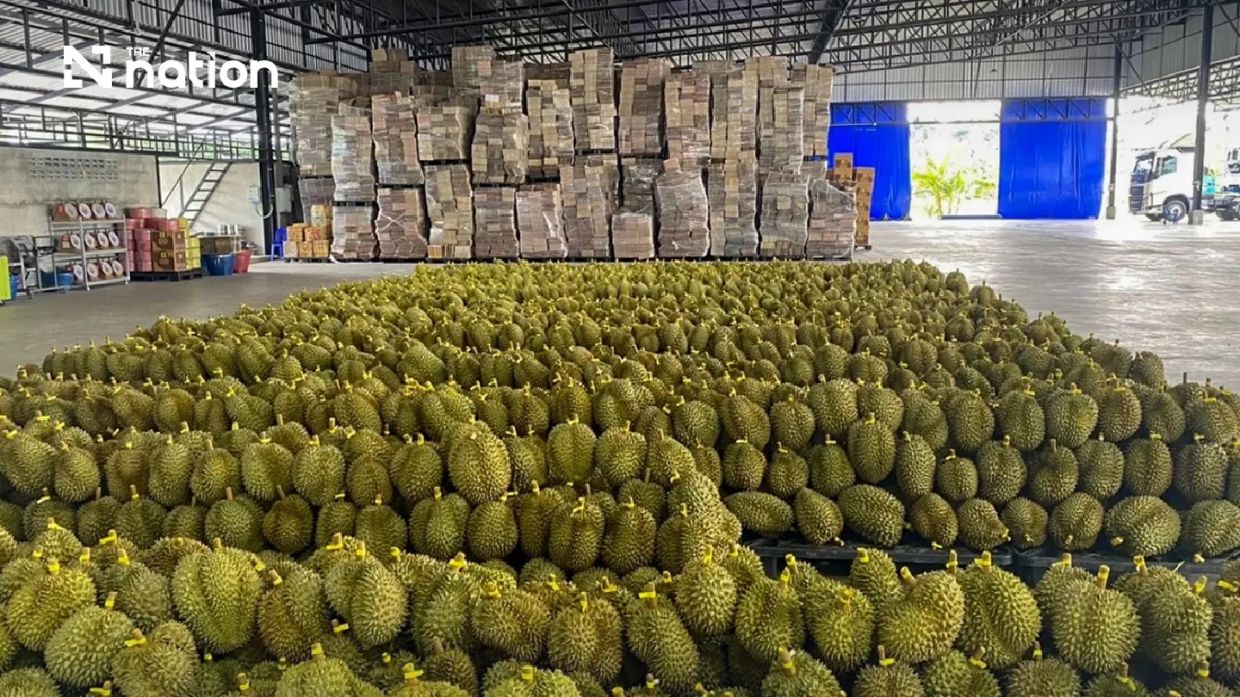
Thailand's position as a dominant player in the global durian market has been reinforced by a milestone achievement in exports to China, its largest single market. Fresh durian shipments to the People's Republic of China surpassed THB100 billion in value during the first half of 2026, with a corresponding volume exceeding 870,000 tonnes transported across the border. This represents the first occasion that first-half exports have crossed the THB100 billion threshold, reflecting both growing demand in China and the success of Thailand's revamped agricultural export protocols. The government has set an ambitious full-year target of THB150 billion, suggesting confidence that momentum will carry through the remainder of 2026.
The exceptional performance stems directly from a systemic overhaul of Thailand's durian export management architecture, initiated by Minister of Agriculture and Cooperatives Suriya Jungrungreangkit. During his initial 90 days in office, the minister moved aggressively to transform how Thai durians are managed, inspected, and certified for export. Rather than maintaining the traditional ad hoc problem-solving approach that had characterised previous frameworks, the reform establishes a comprehensive quality management system spanning the entire supply chain from production through to final certification. This shift has proven transformative, streamlining procedures and enabling faster processing without compromising rigorous quality oversight.
Central to the overhaul are the enforcement measures known as the "Four Nos", which represent a zero-tolerance approach to quality assurance. These stringent standards prohibit immature durians from entering the export pipeline, prevent contamination from fruit worms, eliminate false claims regarding agricultural origin, and ban the use of Basic Yellow 2 (BY2), a food colouring additive that had previously triggered rejections from Chinese buyers. These measures directly address historical challenges that undermined buyer confidence in Thai durians and threatened competitiveness in a market where quality control is paramount. The implementation of these standards reflects an understanding that meeting international sanitary and phytosanitary requirements is no longer optional but essential for maintaining market access.
Complementing the Four Nos framework is a sophisticated four-layer PLUS screening mechanism designed to identify and eliminate plant pests before durians reach overseas customers. This is integrated with science-based risk management protocols that employ data-driven analysis rather than subjective judgement to assess contamination and pest risks. Full traceability throughout the supply chain has been established, allowing regulators and importers to track individual shipments back to their source. The system also incorporates electronic phytosanitary certificates (e-Phyto), digitizing what was previously a paper-based certification process and enabling faster information exchange with Chinese regulatory authorities.
The structural changes involve unprecedented coordination among Thai government agencies. The Department of Agriculture serves as the primary driver, but the framework integrates the National Bureau of Agricultural Commodity and Food Standards (ACFS), the Department of Agricultural Extension, the Customs Department, agricultural departments in producing provinces, testing laboratories, private export operators, and farmers themselves. This multi-stakeholder approach ensures that quality standards are embedded throughout the chain rather than enforced only at checkpoints. Chinese regulatory authorities are also brought into the framework, creating direct engagement that accelerates problem resolution and builds mutual understanding of expectations.
For Malaysian stakeholders and Southeast Asian observers, Thailand's success offers instructive lessons about competing in quality-sensitive export markets. The durian trade exemplifies how regional agricultural producers face intense scrutiny from major importers, particularly China, which has become increasingly stringent about pesticide residues, contamination, and false labelling claims. Thailand's willingness to invest in systematic reforms rather than merely reactive problem-solving demonstrates an understanding that long-term market leadership requires institutional capability. The emphasis on traceability and digital certification also aligns with global trends toward blockchain and e-governance solutions in agricultural trade, positioning Thailand ahead of regional competitors in adopting future-ready systems.
The specific challenges that prompted Thailand's reforms resonate throughout Southeast Asia. Detection of Basic Yellow 2 in durian batches had previously caused significant disruptions to Thai exports, with shipments detained or rejected at Chinese borders. Cadmium contamination, linked to soil conditions or improper pesticide use, posed persistent health concerns. Seed borers and other pest infestations undermined buyer confidence. The emergence of false origin claims, potentially driven by producers in Thailand attempting to label produce from neighbouring countries as domestic, created distrust. By systematically addressing each of these vulnerabilities, Thailand has rebuilt credibility that had been eroded by sporadic failures in quality control.
Minister Suriya's framing of the achievement emphasises sustainability and systemic strength rather than short-term export volume alone. He has articulated a vision where quality frameworks produce benefits cascading through multiple stakeholders: farmers gain income stability through reliable market access, export operators become more competitive through reduced regulatory friction, and Thailand maintains its position as a premium supplier. This articulation matters because it reflects a maturation beyond viewing agricultural exports as merely extracting value from natural endowments. Instead, the minister positions quality management as foundational infrastructure supporting long-term competitiveness and farmer welfare.
The Department of Agriculture's transition toward a "Smart Regulator" model represents another significant dimension of the reform. Rather than relying on manual inspections and subjective decision-making, the department now employs science, technology, and quantified risk metrics to guide oversight. Information flows from production sources through packing houses and testing laboratories feed directly into e-Phyto issuance, creating an integrated information ecosystem. This reduces the burden on farmers and operators who previously faced duplicative inspections and arbitrary delays. For Chinese importers, the system provides transparency and predictability, as they can assess risks based on documented data rather than past reputation alone.
Looking ahead, the implications for Southeast Asian agricultural trade are substantial. China's importance as a market for tropical fruits means that standards established through Thai-Chinese negotiation often become de facto regional benchmarks. Other countries exporting durians, mangoes, and tropical fruits to China face pressure to adopt comparable quality assurance frameworks or risk losing market share. Thailand's THB100 billion milestone thus represents not merely a national achievement but a demonstration of how systematic quality governance can unlock market opportunities. For Malaysia, where agricultural exports contribute significantly to rural incomes, observing Thailand's approach offers valuable insights into competing effectively in demanding international markets without sacrificing producer interests.
The government's full-year target of THB150 billion assumes continued momentum through the second half of 2026 and reflects confidence that the systemic reforms are sustainable rather than dependent on temporary market conditions. Achieving this target would constitute a remarkable validation of the quality-first approach and would likely encourage other Thai agricultural sectors to adopt similar comprehensive frameworks. It would also position Thailand to influence how Asian agricultural trade develops, potentially shaping standards and expectations across the entire region for years to come.

