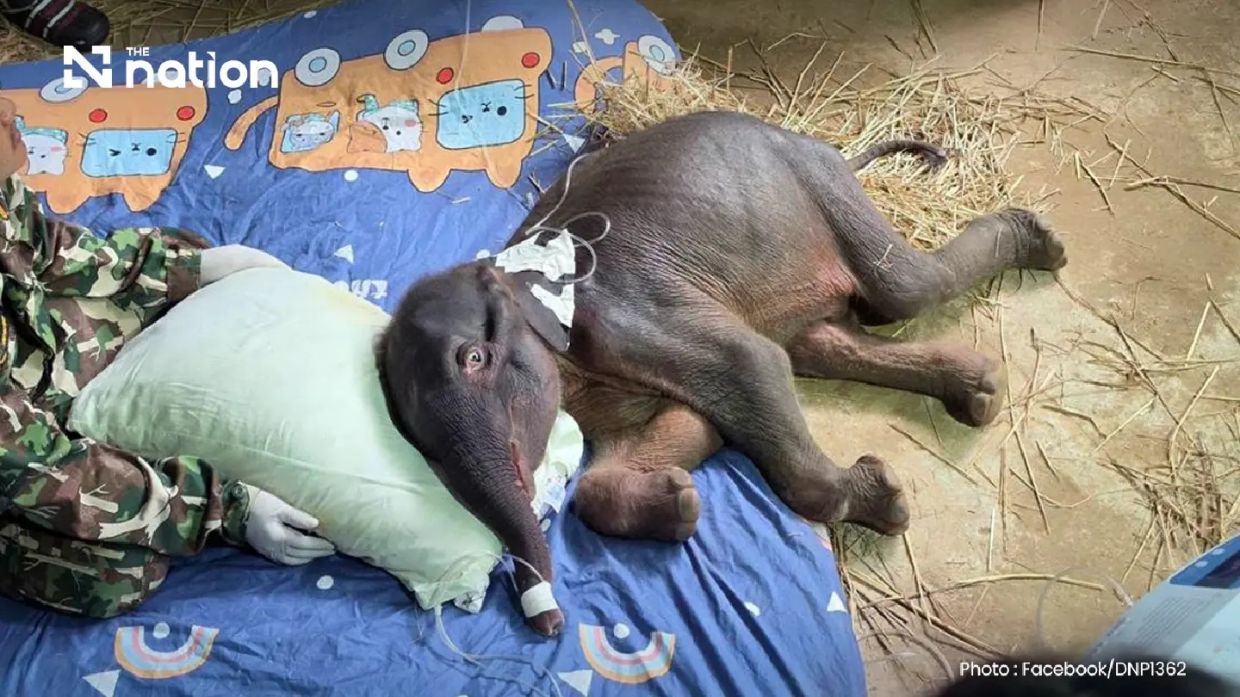
A young wild elephant separated from its herd in Thailand has died after a five-day rescue effort that captured the hearts of the nation. Jiew Sai Yok, discovered wandering alone near Huai Mae Nam Noi in Kanchanaburi province, succumbed to what veterinarians believe was acute kidney failure in the early hours of Tuesday, August 4. The Department of National Parks, Wildlife and Plant Conservation confirmed the death, acknowledging the collective heartbreak felt by the entire rescue team that had fought to save the calf's life.
The story began on July 30 when villagers spotted the distressed calf near the river's edge, prompting an immediate alert to authorities. The discovery itself presented serious logistical challenges, as the remote location could only be accessed by boat, and the terrain offered no clear passage for a young, weakened animal to have found its way there naturally. This sparked immediate concern among officials and veterinarians that the calf had become separated from its mother days earlier and was struggling for survival in harsh conditions.
When rescue teams arrived, the physical toll of abandonment was immediately apparent. The calf was severely dehydrated, covered in abrasions and blisters, and showed clear signs of prolonged distress. Its mouth bore sores and canker-like wounds, including a lesion roughly the size of a 10-baht coin, while dark discolouration around its navel suggested possible infection. The animal's eyes were inflamed from conjunctivitis caused by persistent insect irritation. Most alarming to the veterinary team was the calf's dark reddish-yellow urine, a clinical indicator of either severe infection or profound dehydration that demanded immediate intervention.
Despite these grave circumstances, authorities made the difficult decision to attempt rehabilitation rather than euthanasia. Officials transported the calf to Sai Yok National Park headquarters, where round-the-clock veterinary care was established. The team administered intravenous fluids and oxygen support while monitoring the animal's fluid intake and output. The calf showed some signs of resilience, accepting milk feedings of 350 to 500 millilitres every two to three hours, though the persistent diarrhoea and dark urine indicated underlying systemic complications that proved resistant to treatment.
The five-day battle to save Jiew Sai Yok reflected both the commitment of Thailand's wildlife professionals and the profound challenges facing wild elephant conservation in the region. Despite around-the-clock attention and aggressive medical intervention, the calf's condition deteriorated. The veterinary team observed the animal alternating between moments of apparent stability and worrying weakness, with attempts to stand proving increasingly futile. The underlying cause remained elusive until laboratory blood work suggested acute kidney failure, a condition that can develop rapidly and prove fatal in young animals already compromised by stress and malnutrition.
The circumstances surrounding the calf's initial separation from its herd remain somewhat mysterious. Officers speculated that the animal had been alone for approximately two days before villagers discovered it, suggesting that the mother elephant had either abandoned it deliberately—a possibility in cases where calves are born with defects—or had been unable to locate it after a forced separation. The timing of rescue, though swift by typical standards, may have already been too late to reverse critical physiological damage sustained during those crucial early days without maternal care.
Throughout the rescue effort, rescue personnel maintained vigils hoping that the herd would return to reclaim the calf. On the night of discovery, park staff heard the young elephant's repeated anguished cries for its mother echoing through the forest. No response came. Behavioural specialists understood that these vocalizations represented genuine distress, as elephant calves depend entirely on their mothers for survival, nutrition, and protection during their first years of life. The absence of any maternal response suggested either that the herd had moved considerable distances away or that the separation was permanent.
Veterinarians now plan to conduct a comprehensive necropsy to establish the precise cause of death and to investigate whether Jiew Sai Yok may have had congenital abnormalities affecting internal organ function. Blood test results have been preserved for further laboratory analysis. These findings will be valuable for understanding how wild elephants in the region respond to separation stress and malnutrition, and may inform future rescue protocols for similar situations. The examination will also help determine whether the calf had pre-existing conditions that made survival unlikely from the moment of separation.
For Malaysia and Southeast Asia more broadly, Jiew Sai Yok's death underscores the precarious state of wild elephant populations across the region. Thailand's wild elephants face constant pressure from habitat loss, as protected areas remain fragmented and increasingly isolated. Calves separated from herds—whether through natural disaster, human encroachment, or other causes—have slim chances of survival without immediate intervention, yet rescue efforts themselves carry no guarantee of success. The veterinary team's commitment demonstrates what resources and expertise can achieve, but also the hard reality that even the best efforts sometimes cannot overcome the physiological trauma of abandonment.
The incident also highlights broader conservation challenges affecting Thailand's elephant populations, which are estimated at fewer than 4,000 individuals in the wild. Unlike Malaysia, where wild elephant populations face different threats related to habitat fragmentation and human-wildlife conflict, Thailand's challenges include both poaching pressures and the stress of living in increasingly constrained geographic areas. International cooperation on elephant welfare and habitat protection remains crucial as populations decline across multiple Southeast Asian nations.
The Department of National Parks expressed deep gratitude for the work of all veterinarians and rescue personnel who dedicated themselves to Jiew Sai Yok's care. This recognition serves as an important acknowledgment that conservation efforts, even unsuccessful ones, represent vital investments in species survival and ecosystem health. The emotional toll on rescue teams when such efforts fail should not be underestimated, particularly given the intensive, hands-on nature of caring for a distressed wild animal over extended periods.
Jiew Sai Yok's story, though ending in tragedy, raises important questions about how Southeast Asian nations can better protect wild elephant populations before separation and abandonment occur. Habitat protection, anti-poaching measures, and community engagement remain fundamental strategies. The case also demonstrates why international standards for wildlife rescue and rehabilitation continue to evolve, informed by experiences gained through cases like this one. As elephant populations continue to decline, every lost calf represents not just an individual tragedy but a measurable impact on species recovery in a region where human and animal worlds increasingly collide.

