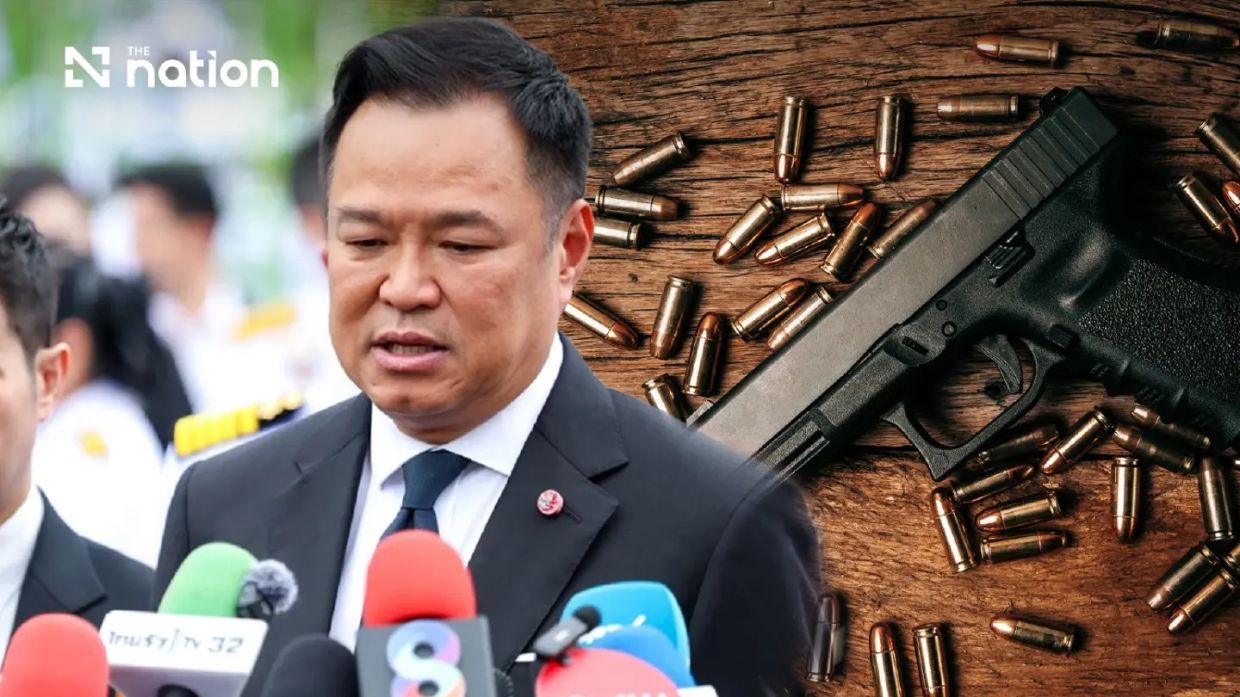
Prime Minister Anutin Charnvirakul has committed to strengthening Thailand's firearms legislation in the wake of a tragic mass shooting at Debsirin Nonthaburi School, signalling an aggressive crackdown on illegal weapons circulation. Following consultations with national police chief Pol Gen Kittharath Punpetch and a visit to the school premises, Anutin outlined a comprehensive strategy aimed at preventing future incidents through stricter enforcement and legislative amendments that would dramatically increase penalties for unlawful gun possession.
The Prime Minister's immediate focus centres on establishing widespread checkpoint systems and conducting surprise inspections across public spaces, vehicles, and residential areas to detect unauthorised firearms. Anutin made clear that the government's position is absolute: individuals found carrying weapons outside their homes without legitimate professional justification will face serious criminal charges. This zero-tolerance stance reflects Bangkok's determination to address what has become an ongoing concern regarding civilian firearms access in urban centres across Southeast Asia, where periodic shooting incidents have intensified public anxiety about personal safety.
An intriguing aspect of the government's approach involves resurrecting a voluntary surrender programme that previously allowed citizens to hand over illegal or unregistered weapons without facing prosecution. Anutin framed this initiative as a pathway for those currently in possession of unlawful firearms to regularise their situation, yet he simultaneously emphasised that weapons surrendered through official channels must be properly documented and destroyed. The dual message reflects the administration's understanding that coercive measures alone may prove insufficient; voluntary compliance mechanisms could prove valuable in reducing the overall stock of illegal firearms circulating throughout Thailand's population.
The Prime Minister categorically rejected emerging proposals that would permit educators to carry firearms for self-defence purposes, arguing that teachers lack the professional training and legal authority required for weapon deployment. This position directly contradicts suggestions from some quarters that arming school personnel could provide effective deterrence against would-be attackers. Anutin's firm stance aligns with international evidence suggesting that expanding civilian gun ownership, even among trusted professionals, typically correlates with increased overall weapons availability and unintended harm—a consideration particularly relevant for Malaysian policymakers observing Thailand's experience.
Crucially, Anutin stipulated that anyone discovered during home searches for unrelated offences while also in possession of illegal weapons will face compounded charges and enhanced penalties. This layered enforcement approach transforms firearms violations from isolated infractions into aggravating factors that multiply criminal liability. Such legislation would essentially ensure that illegal gun possession becomes exponentially more costly for violators, theoretically incentivising voluntary surrender and discouraging retention of unauthorised weapons.
The government's framework for legal firearm ownership has been significantly tightened through new storage and registration requirements. Weapons kept in private residences must now be registered with authorities, stored securely away from children's access, and subject to regular compliance inspections. Critically, both the registered owner and any individual who uses a weapon in committing an offence face criminal responsibility, establishing joint liability that extends accountability beyond the immediate perpetrator. This approach recognises that firearms-related harm frequently originates from weapons stored negligently or inadequately secured within family environments.
Regarding the underlying circumstances surrounding the shooting itself, Anutin cautioned the public and media against premature speculation, particularly concerning allegations that the shooter had experienced bullying. He stressed that police investigators must be permitted to complete their examination of facts without interference from unofficial commentary that could generate unnecessary public alarm or impede the investigation. This measured tone reflects an attempt to prevent the tragedy from igniting hasty policy responses disconnected from actual causation while simultaneously avoiding the sensationalisation that might encourage copycat incidents.
The Prime Minister's remarks signal a broader governmental commitment extending beyond the police and into the Department of Provincial Administration and other enforcement agencies, each receiving explicit directives to intensify firearms inspections. This whole-of-government approach acknowledges that gun control requires coordination across multiple institutional actors rather than relying solely on police capacity. For Southeast Asian observers, Thailand's model demonstrates both the necessity and complexity of implementing effective firearms regulation across territorially dispersed populations where enforcement capacity remains inconsistent.
An important dimension often overlooked in immediate policy responses involves the psychological and social factors contributing to school violence. While Anutin deferred detailed examination of bullying allegations pending investigation completion, his government's willingness to acknowledge such factors—even indirectly—suggests potential future interventions targeting school environments, mental health support systems, and peer conflict resolution mechanisms. Malaysia and other regional neighbours increasingly recognise that purely hardware-focused restrictions, whilst necessary, require complementary social and educational programmes.
The announcement carries implications extending well beyond Thailand's borders, as Southeast Asian nations grapple with rising civilian gun ownership and occasional mass casualty incidents. Malaysia, with its own strict firearms legislation and relatively low civilian gun ownership, can observe whether Thailand's enforcement innovations prove effective in reducing illegal weapons circulation. Thailand's experience with voluntary surrender mechanisms and checkpoint-based interdiction may offer valuable lessons for regional governments considering enhanced gun control frameworks.
Ahutin's resoluteness regarding the illegality of unauthorised firearms—his explicit statement that illegal guns can never become lawful and that possession carries unacceptable risk—establishes an unambiguous legal and moral position. This clarity should theoretically simplify enforcement, eliminate grey zones inviting judicial discretion, and send consistent messaging to the population. Whether such legislative clarity, combined with improved enforcement mechanisms and periodic amnesties for voluntary surrender, will substantially reduce Thailand's illegal firearms stock remains an open question that will unfold over months and years.

