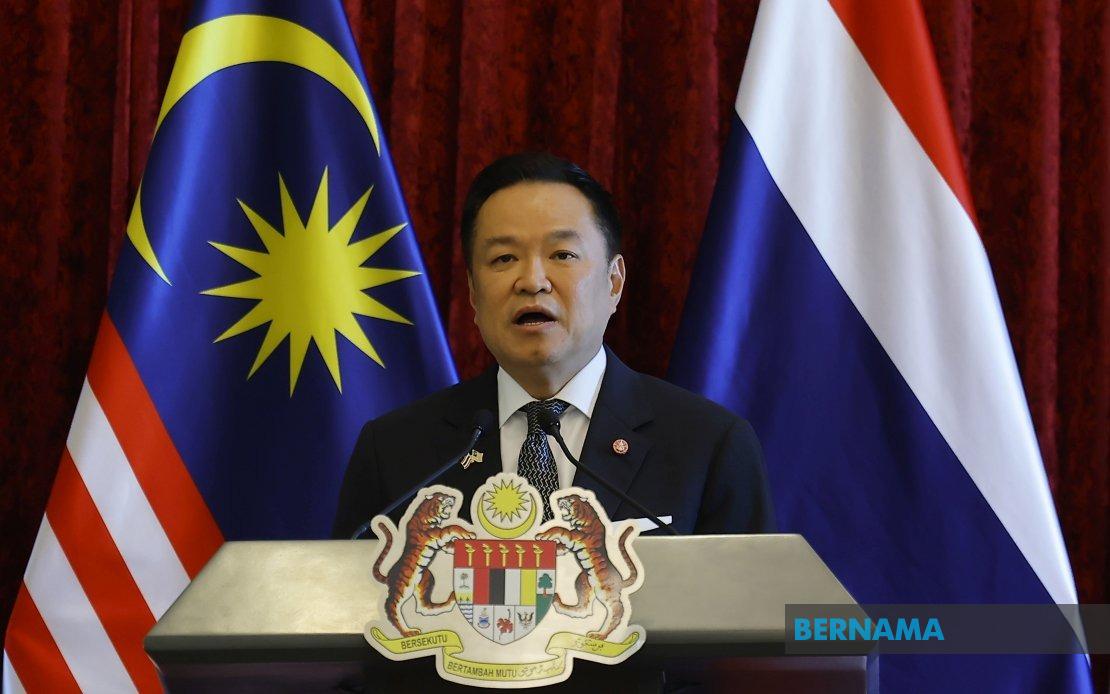
Thailand's Prime Minister Anutin Charnvirakul extended warm wishes to his Malaysian counterpart Datuk Seri Anwar Ibrahim ahead of the closely watched Johor state election scheduled for this Saturday, highlighting the cordial relations between the two neighbouring Southeast Asian governments. The gesture came during a joint press conference in Putrajaya, where Anutin concluded his remarks with a personal message of encouragement to Anwar's coalition ahead of the polls.
Anutin is in Malaysia for a two-day official visit at Anwar's invitation, marking his first trip to the country since his reappointment as Thailand's Prime Minister in March 2026. The visit underscores the importance both nations place on maintaining strong diplomatic and bilateral ties, with officials signalling a shared commitment to deepening cooperation across multiple sectors of mutual interest. Such high-level exchanges between neighbouring capitals serve to reinforce regional stability and demonstrate the interconnectedness of Southeast Asian leadership circles.
The 16th Johor state election represents a significant political test for Anwar's Pakatan Harapan coalition, with 172 candidates competing for 56 state assembly seats. The alliance, comprising PKR, DAP and Amanah, has fielded candidates across every constituency, fielding a carefully balanced slate that includes both seasoned political figures and fresh faces. This comprehensive representation signals the coalition's determination to retain control of the state and consolidate support across demographic and geographic lines in the prosperous southwestern peninsula.
Johor holds particular strategic importance within Malaysia's political landscape. The state has long served as a bellwether for national sentiment, and election results here often presage broader trends at the federal level. A strong performance by Pakatan Harapan would strengthen Anwar's political position domestically and reinforce his mandate to continue navigating Malaysia's complex coalitional politics. Conversely, any significant setback could embolden opposition forces and complicate his legislative agenda in parliament.
Anwar's characterisation of his meeting with Anutin as warm and exceptionally productive reveals the personal rapport between the two leaders. Anwar described the discussion in intimate terms, likening it to a gathering among longstanding friends rather than a formal diplomatic encounter. His remarks about Anutin's comfort level in Malaysia and his suggestion that the Thai leader return soon indicate genuine affection and suggest deepening personal relationships that often facilitate stronger state-to-state cooperation beyond official channels.
The timing of Anutin's visit deserves particular attention. Arriving just days before a critical state election demonstrates Thailand's tacit confidence in Anwar's political durability and the stability of his administration. For Malaysian observers, the visit signals that major regional players view Anwar's government as secure and capable, which may provide psychological reassurance to voters contemplating their electoral choices. International endorsements, particularly from neighbouring nations, can subtly influence domestic political calculations.
Bilateral relations between Malaysia and Thailand have historically encompassed security cooperation, trade, tourism, and people-to-people exchanges. The border regions host significant economic activity and cultural ties that bind the two nations closely together. Strengthening cooperation in these areas through regular high-level visits helps manage occasional tensions and ensures that shared challenges, from transnational crime to environmental management, remain priority concerns for both governments.
For Anwar, the visit provides an opportunity to project an image of national leadership respected on the regional stage. International engagement at this level demonstrates that Malaysia remains an important player in regional affairs and that its Prime Minister commands the confidence of neighbouring leaders. This international dimension adds another layer to domestic political positioning, as voters increasingly evaluate their leaders through a regional and global lens.
The focus on deepening cooperation across multiple areas reflects contemporary Southeast Asian diplomacy, where nations increasingly recognise that prosperity and security are interdependent. Malaysia and Thailand, despite occasional disputes over maritime boundaries and resource management, have generally chosen dialogue and cooperation over confrontation. This constructive approach has become a model for regional problem-solving and demonstrates the maturity of Southeast Asian statecraft.
As Johor prepares for polling day, the international attention directed toward Malaysia's electoral process—through visits like Anutin's—serves to reinforce the legitimacy of the democratic exercise itself. External recognition of Malaysia's democratic institutions, however implicit, strengthens public confidence in the integrity of the electoral system. For a country that has navigated significant political turbulence in recent years, such affirmation carries meaningful weight.
The symbolism of Anutin's visit extends beyond bilateral relations. It represents a broader message about regional stability and the continuation of democratic governance throughout Southeast Asia. When major regional leaders visibly support their counterparts during critical electoral moments, they implicitly affirm the value they place on democratic processes and peaceful transfers of power. This messaging resonates throughout the region and contributes to an environment where electoral competition remains bounded within constitutional frameworks.
Moving forward, the outcome of the Johor election will likely influence the trajectory of Malaysia-Thailand relations. A decisive victory for Anwar's coalition would provide him with greater domestic political capital to pursue initiatives involving Thailand, whether in trade negotiations, security arrangements, or development projects. Conversely, mixed electoral results might complicate his ability to commit resources to regional initiatives. Election outcomes thus have cascading effects that extend well beyond state or national borders in an increasingly interconnected region.

