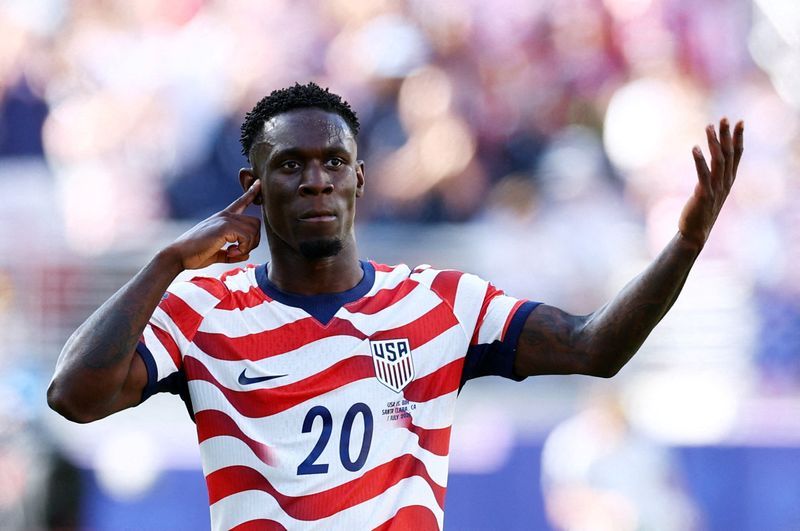
Folarin Balogun walks into the most consequential match of his soccer career on Monday carrying the weight of far more than sporting ambition. The 25-year-old American striker faces Belgium in a round of 16 clash that has become entangled with US presidential politics, immigration law and questions about national identity that extend well beyond the football pitch. The controversy surrounding his participation—and his dramatic reprieve from suspension—has transformed what should be a straightforward athletic competition into a broader referendum on what it means to be American.
Balogun's predicament began conventionally enough when he received a red card during the United States' previous match against Bosnia and Herzegovina for what appeared to be an inadvertent challenge. Under standard FIFA protocol, this suspension would have kept him sidelined for Monday's knockout encounter. Yet in a stunning reversal, FIFA announced on Sunday that it would suspend the ban entirely, allowing the player to feature despite the dismissal. The decision itself sparked immediate questions about process and fairness, but the broader context transformed the sporting matter into something altogether more complex.
The extraordinary twist emerged when President Donald Trump personally intervened, publicly requesting that FIFA President Gianni Infantino reconsider Balogun's case. This presidential involvement proved deeply ironic given Trump's well-documented political positions. The president has made ending birthright citizenship a cornerstone policy objective, repeatedly advocating for constitutional changes that would eliminate the automatic conferral of citizenship to children born on American soil. Yet here he stood, mobilizing his considerable political capital to support a player whose international career for the United States exists precisely because of birthright citizenship protections.
Balogun's own origin story embodies the very circumstances that Trump has criticized. Born in New York in 1998 after his Nigerian mother found herself stranded during a pregnancy-related medical complication, the young boy received US citizenship automatically through the 14th Amendment's citizenship clause. His mother, unable to fly while heavily pregnant, remained in New York until delivering her son. When she returned to Britain one month later, she took the newborn with her, and Balogun grew up entirely in London. He progressed through Arsenal's youth academy and represented England at various youth levels before a deliberate decision to commit to US Soccer in 2023. The irony of Trump championing the cause of someone whose very national status represents the birthright citizenship principle he opposes has not escaped observers and commentators.
Balogun's emergence as a breakout World Cup star has coincided with a significant generational shift in American soccer representation. For decades, the US men's national team operated with a distinctly narrow demographic profile. The arrival of players like Balogun, whose presence reflects immigration and diversity, represents a broader transformation of the sport in American culture. His three-goal tally had already established him as the tournament's genuine sensation, overshadowing even Christian Pulisic, who has long served as the sport's American face and primary commercial draw. While Pulisic remains favored by major sponsors, Balogun captured the popular imagination with performances that transcended traditional soccer demographics. His celebrations drew comparisons to LeBron James' iconic moves, earning recognition from the NBA superstar and cementing his status as a crossover sports figure.
The suspension reversal reignites intensifying political divisions over birthright citizenship at a particularly charged moment in American discourse. The timing proved especially significant because it occurred mere days after the Supreme Court handed Trump a stinging rebuke on his central policy initiative. Immigration advocates seized upon Balogun's situation as a compelling counternarrative to restrictionist arguments. The Miami Herald editorial board published a piece declaring that Balogun's career demonstrates how birthright citizenship functions as an opportunity mechanism rather than a loophole. Jorge Loweree, the managing director of programs at the American Immigration Council, characterized the case as demonstrating tangible benefits that citizenship policy provides to individuals and the broader American society. Such advocacy highlights how sporting achievement can mobilize political constituencies around contested policy questions.
The United States remains part of a minority global coalition on this citizenship question. Only 33 countries maintain unconditional birthright citizenship provisions, predominantly concentrated in the Western Hemisphere following 19th-century legal traditions. An 1898 Supreme Court decision established the constitutional foundation for this approach, interpreting the 14th Amendment as conferring automatic citizenship to all persons born within American jurisdiction. This places American law at the permissive end of global citizenship policy variations, a reality that shapes current political debates about whether such generosity serves national interests. Most peer democracies employ more restrictive citizenship-by-descent frameworks, creating a distinctive American approach that has become increasingly contested.
Public opinion data suggests substantial daylight between Trump's immigration restrictionism and broader American sentiment on this specific issue. A Reuters-Ipsos poll conducted earlier this year found that majorities of Americans opposed eliminating birthright citizenship, indicating that the policy commands significant democratic support despite elite advocacy for restriction. This disconnect between Trump's policy preferences and public sentiment adds another layer to the Balogun situation, potentially mobilizing voters and activists who view birthright citizenship as reflecting genuine American values. The emotional appeal of a young man overcoming circumstance to achieve excellence on sport's greatest stage appears to resonate more powerfully than abstract policy arguments.
While FIFA President Infantino confirmed receiving Trump's call, he vigorously denied that the president's intervention influenced the suspension reversal decision. The federation's official statement maintains that soccer considerations alone motivated the determination to overturn the red card. However, the apparent coincidence between Trump's high-profile intervention and FIFA's unusual about-face has generated skepticism among observers. Even if FIFA's formal justification rests on technical soccer grounds, the visual reality of presidential pressure followed immediately by a reversal creates an impression that transcends official explanations. This dynamic becomes particularly loaded given Trump's history of attempting to leverage his office for preferred outcomes in various contexts.
Balogun himself has navigated this unprecedented situation with apparent equanimity. When announcing his commitment to US Soccer, he emphasized feeling welcomed by American fans and facilities, citing a vacation to Orlando as transformative in recognizing the genuine enthusiasm the nation's soccer community possessed. After receiving his red card, his teammate Pulisic embraced him in a moment of solidarity captured internationally. Balogun subsequently pledged to channel his disappointment into supporting teammates during the critical Belgium match, demonstrating the professionalism expected of elite athletes. Yet his personal grace cannot entirely transcend the larger political meaning that others have ascribed to his presence and participation. Whether he wishes it or not, his performance on Monday will be interpreted through multiple political lenses.
The broader implication of the Balogun moment extends beyond soccer into fundamental questions about how nations construct identity and belonging. In an era of increasingly restrictive immigration politics across developed democracies, the sight of a player benefiting from birthright citizenship law, backed paradoxically by restrictionist political leadership, showcases the contradictions inherent in contemporary identity politics. For Southeast Asian observers, particularly those in Malaysia with its own complex immigration and citizenship questions, the American debate illuminates how soccer has become a vehicle for political expression. Balogun's World Cup journey encapsulates tensions between globalization, national belonging and democratic values that resonate across international contexts, making his Monday match something far more significant than a routine knockout round encounter.

