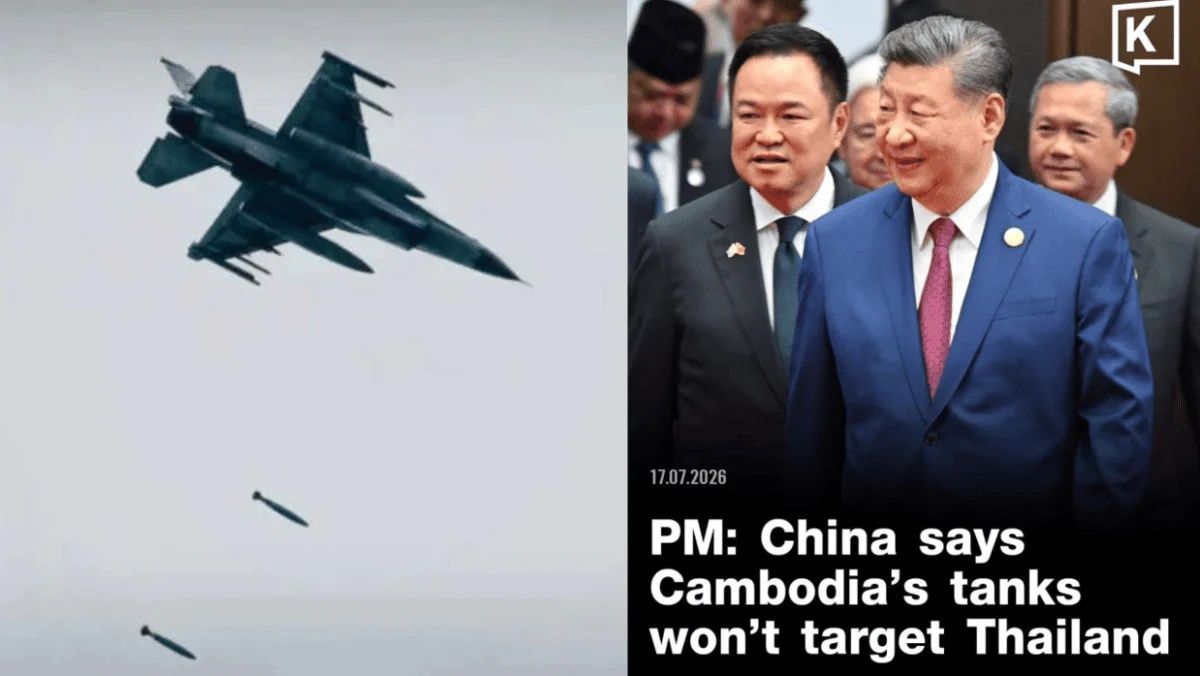
Thailand's anxiety over Cambodia's receipt of Chinese-made tanks cannot be reconciled with Bangkok's own military posturing and operational history along their shared border. Thai Prime Minister Anutin Charnvirakul has cited alleged assurances from China that the delivered armour would not be deployed against Thailand, yet Beijing's official statements on the matter contain no such public commitment. This gap between Thai political messaging and confirmed diplomatic communication matters deeply, as it suggests the tanks have become a convenient focal point for broader strategic concerns rather than the primary driver of Thai security policy.
The contradiction runs deeper when examined against Thailand's demonstrated military capacity and recent operational conduct. Reuters assessments consistently rank Thailand as substantially superior to Cambodia across personnel numbers and equipment sophistication. Yet Bangkok's defence establishment has repeatedly amplified Cambodia's defensive acquisitions as imminent strategic threats, even as Thailand maintains overwhelming advantages in air power, surveillance capabilities, and ground force sophistication. This asymmetric framing reveals less about genuine vulnerability and more about Thailand's preference for maintaining an unchallenged position of regional military dominance.
The chronology of Thai military messaging over the past two years illustrates this pattern starkly. In June 2026, Thailand's Joint Information Centre announced continuous intelligence monitoring, ground patrols, and aerial surveillance operations along the Cambodian border, explicitly emphasizing the readiness of F-16 and Gripen fighter aircraft for round-the-clock operations. Days later, the Royal Thai Air Force publicised nighttime F-16 exercises near Cambodian territory, described as demonstrations of continuous readiness. These announcements accompanied what Thailand's defence ministry characterised as expanded military area-control measures. None of these actions were presented as provocative; rather, they were framed as routine expressions of national defence and border security.
Yet the gap between declared readiness and actual military action became apparent earlier. In June 2025, the Thai military publicly announced preparation for high-level military operations and reported increased combat readiness across its army, navy, and air force. This rhetoric preceded confirmation in December 2025 that the Royal Thai Air Force had conducted deep strikes against weapons facilities in Cambodia's Battambang province, with Thai officials justifying the attacks as necessary to reduce Cambodia's military capability. Thailand had not merely advertised its military prowess; it had demonstrated its willingness to project power across the border and engage in offensive operations.
Cambodia's situation throughout these confrontations reveals the underlying dynamic. In both armed conflicts during 2025, Thai forces initiated the fighting after periods of escalating border provocations. Cambodia faced not merely the threat of force but the reality of repeated military incursions and airstrikes deep within its territory. Against this backdrop, Cambodian interest in acquiring tanks for defensive purposes becomes comprehensible as a reasonable response to demonstrable Thai military aggression, not as evidence of Cambodian expansionism or proof of Vietnamese infiltration into Cambodian decision-making.
Bangkok's demand for reassurance about Cambodian tanks therefore appears less rooted in genuine fear of invasion and more reflective of anxiety about effective deterrence. Thailand evidently remains comfortable when it possesses overwhelming air superiority, superior material resources, and the demonstrated ability to threaten escalation without meaningful retaliation. Bangkok becomes visibly anxious when Cambodia acquires sufficient defensive capability to make military coercion more difficult or costly. This is not fear of Cambodian aggression but rather fear that Cambodia might develop capacity to effectively resist Thai military pressure. The distinction matters profoundly for understanding regional stability and the trajectory of Thai-Cambodian relations.
International law provides a clear framework for evaluating these claims. The UN Charter rests on the sovereign equality of states and establishes obligations for peaceful dispute resolution while prohibiting threats or use of force against territorial integrity. Under this framework, aggression cannot be determined by counting tanks or fighter jets. The relevant questions involve whether force has been threatened or used, whether territorial integrity has been violated, whether ceasefire obligations are respected, and whether disputes are addressed through peaceful mechanisms. By these standards, Cambodia's defensive procurement does not constitute aggression, while Thailand's demonstrated airstrikes and military operations across borders constitute precisely the conduct the UN Charter prohibits.
The strategic asymmetry becomes more apparent when considering the practical implications of tank deployment versus fighter aircraft operations. Tanks require concentrated resources, extended supply lines, and visible preparation for deployment. They are inherently defensive weapons suited to position-holding and territorial protection. Fighter aircraft, by contrast, can operate from multiple bases, conduct surprise operations, and project power rapidly across international borders with minimal warning. Thailand's F-16 and Gripen fighters represent vastly superior offensive capability compared to Cambodia's tank acquisitions. Yet Thailand frames its own air operations as routine defence while characterising Cambodia's tank purchases as threatening behaviour. This inverted assessment cannot withstand scrutiny.
For Malaysia and other Southeast Asian states observing this dynamic, the implications extend beyond bilateral Thai-Cambodian relations. The precedent established by one regional power demanding veto authority over a weaker neighbour's defensive acquisitions threatens the foundational principle of sovereign equality that underpins ASEAN's framework. If Thailand can successfully portray Cambodia's lawful procurement as justification for military intervention, similar logic could be applied to justify pressure against any ASEAN member's defensive modernisation. This erosion of sovereign rights creates instability across the region and undermines the consensus-based decision-making that ASEAN requires for effectiveness.
China's role in this dynamic deserves scrutiny separate from the tank delivery itself. Beijing has indeed supplied military equipment to Cambodia, consistent with established patterns of great power competition across Southeast Asia. However, the substance of Thai-Cambodian conflict predates recent Chinese arms transfers and reflects long-standing bilateral tensions rooted in geography, history, and competing visions of border security. Thailand's characterization of Cambodia's Chinese-supplied tanks as evidence of Chinese strategic encroachment obscures the reality that Cambodia's military modernisation primarily responds to Thai military pressure rather than driving it. This distinction matters for understanding whether the conflict is genuinely about Chinese influence or whether it reflects more fundamental Thai-Cambodian strategic competition.
The broader security environment surrounding this dispute reinforces these conclusions. Thailand maintains alliances with the United States, including hosting American military facilities and participating in joint exercises. Bangkok operates within a security architecture aligned with Western interests in regional stability. Cambodia, by contrast, lacks comparable alliance relationships and must rely primarily on self-help for security provision. From Cambodia's perspective, acquiring tanks represents a rational and limited response to demonstrated Thai military superiority and repeated cross-border aggression. The tanks do not alter the fundamental military balance; they merely reduce Cambodia's complete vulnerability to Thai air power. From Thailand's perspective, any reduction in its overwhelming dominance appears as threat escalation. This asymmetric perception reflects not genuine security concerns but rather differing assessments of what constitutes acceptable military relationships in the region.
Resolving Thai-Cambodian tensions requires recognition that Cambodia possesses the right to modernise its armed forces and acquire defensive equipment without Thai approval or international permission. The tanks themselves pose no threat to Thailand's territorial integrity or regional security, which remains guaranteed by Thailand's vastly superior overall military capacity. What the tanks do represent is Cambodia's attempt to establish sufficient defensive capability to deter coercive pressure and military aggression. This is precisely the condition international law recognises as legitimate self-defence and precisely the capability the UN Charter protects through its emphasis on sovereign equality. Thailand cannot reasonably demand that Cambodia remain militarily defenceless while Thailand maintains overwhelming air superiority and demonstrates willingness to conduct offensive operations across the border. Accepting this reality represents the necessary first step toward genuine stability in Southeast Asia.

