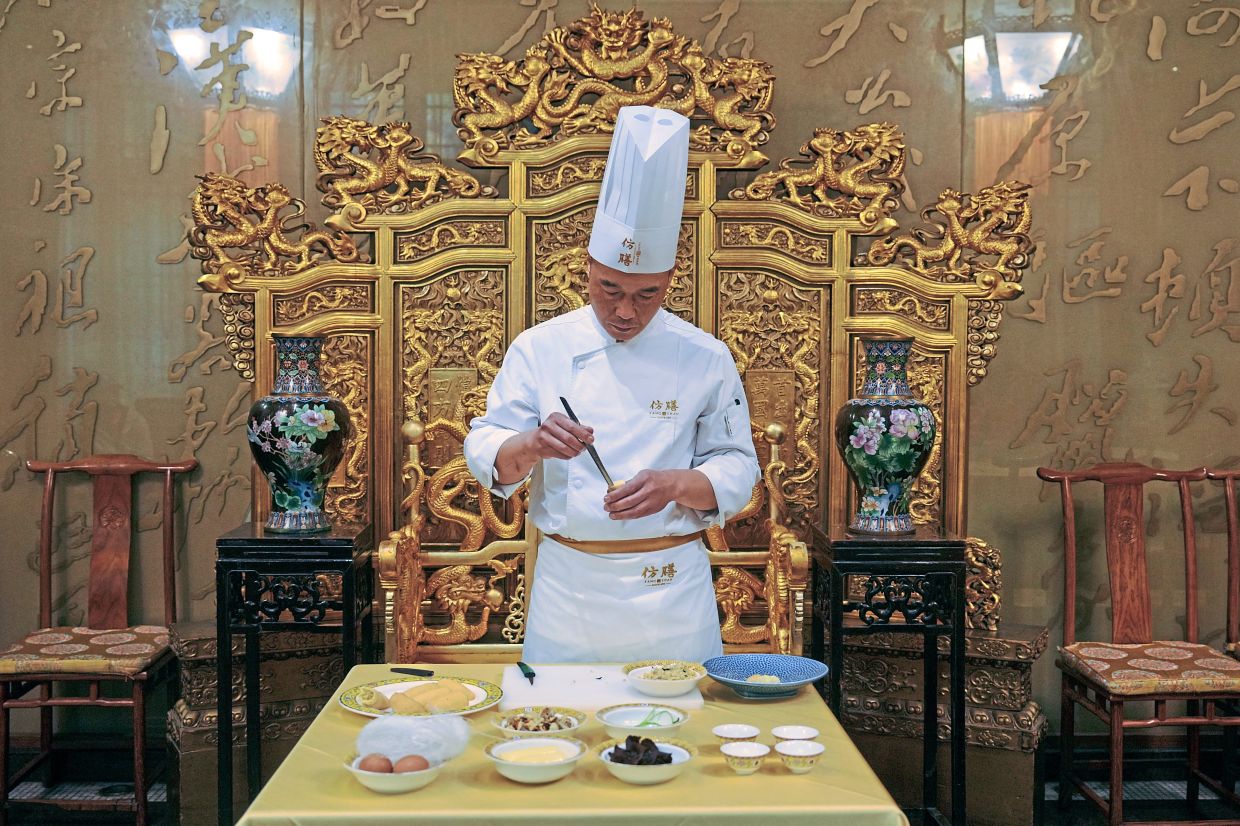
The culinary heritage of China's imperial court survives not in history books alone, but on dining tables across Beijing, where restaurants dedicated to preserving palace food continue to serve dishes steeped in centuries of tradition and ritual significance. At the heart of this culinary preservation effort stands Fangshan Restaurant, established in 1925 by former chefs who once served the Qing Dynasty emperors themselves. Located at Beihai Park—a sprawling garden where successive imperial dynasties conducted state affairs, performed sacred rituals and sought respite—the restaurant represents a living bridge between the elaborate food culture of emperors and the diners of today.
The origins of many imperial dishes reveal the deeply personal nature of palace cuisine. One celebrated creation, now known as the "dream pastry," emerged from a nocturnal vision allegedly experienced by Empress Dowager Cixi in the final years of imperial rule. The story, retold by chefs at Fangshan, describes how the empress mentioned her dream to her kitchen staff, only to be served the very pastry she had imagined at her next breakfast. Her delight was so pronounced that she rewarded the chef with a silver ingot, immortalising the dish with a name that captured the magic of its conception. Such anecdotes underscore how imperial cuisine transcended mere sustenance, becoming instead a vehicle for imperial authority, personal indulgence and the demonstration of the emperor's ability to transform wish into reality.
The term "Fangshan" itself translates as "imitating the imperial cuisine," reflecting the restaurant's explicit mission to reconstruct and maintain the culinary traditions that once graced the imperial table. Beyond Fangshan, several other Beijing establishments now offer their own interpretations of court cuisine, while the Palace Museum actively conserves artefacts associated with Qing Dynasty dining—from ornate serving vessels to intricately carved pastry moulds—ensuring that the physical dimension of imperial food culture remains accessible to researchers and the public. These efforts represent a conscious choice to preserve not merely recipes, but an entire system of meaning and ritual that distinguished court dining from ordinary meal preparation.
Imperial cuisine encompassed two distinct yet interconnected dimensions: the daily meals consumed by emperors and their families, and the elaborate ceremonial banquets that punctuated the court calendar. These occasions operated according to complex protocols that extended far beyond eating. During Qing Dynasty banquets, the consumption of milk tea marked the formal opening, establishing a ritualistic framework for everything that followed. The emperor wielded food and drink as instruments of political power, bestowing portions upon princes and officials who would then perform prescribed rituals of gratitude and deference before consuming their portions. The hierarchical structure embedded within these dining protocols reflected broader imperial systems of authority and obligation.
Sacrificial rituals occupied an equally crucial position within imperial food culture, governed by their own distinct rules and meanings. At the Palace of Earthly Tranquility, one of the most significant ceremonies involved the consumption of sacrificial pork—fatty meat boiled deliberately without seasoning or salt. The unseasoned preparation was not an oversight but rather a deliberate aesthetic and philosophical choice. Following the ceremonial consumption by the emperor, the meat would be distributed among court members, and receiving such offerings represented a profound mark of imperial favour. This practice of serving unseasoned foods extended back through centuries of Chinese tradition, rooted in classical texts such as the "Book of Rites," which described "grand stew"—a meat broth presented without added flavouring during sacred ceremonies.
The philosophical significance underlying this culinary restraint reveals much about how imperial courts understood food and ritual. Scholars of Chinese tradition note that the absence of seasoning carried deliberate meaning, evoking an imagined past of simpler, more austere cooking methods and thereby embodying ritual ideals of honouring antiquity and reconnecting with cultural origins. This tension between the elaborate complexity of imperial banquets and the austere simplicity of sacrificial meals demonstrates how Chinese court cuisine operated on multiple registers simultaneously, expressing both imperial magnificence and reverence for tradition. The choice to omit salt was not economical but profoundly symbolic—a culinary expression of spiritual principles.
Pastries occupied a particularly exalted position within the imperial culinary system, with the court maintaining entire institutions dedicated to their creation. Contemporary pastry chefs at Fangshan, such as Zhou Tong, continue to prepare delicacies descended from imperial recipes, including Cixi's dream pastry and intricate steamed corn buns. These chefs operate within a lineage of transmission stretching back generations, learning their craft through apprenticeship and mastery under senior practitioners who themselves inherited their knowledge from imperial-era mentors. This chain of direct transmission has proven crucial to preserving not merely written recipes but the embodied knowledge—the precise hand movements, intuitive understanding of texture and timing—that cannot be fully captured in documentation.
The commitment to traditional methods distinguishes imperial cuisine fundamentally from contemporary Chinese cooking. At Fangshan, electric kitchen equipment remains absent; chefs instead utilise hand-powered sieves to pulverise ingredients such as beans and custom-made copper pots for handling particular flours. This labour-intensive approach reflects a conviction that machines fundamentally alter the texture and mouthfeel that imperial pastries should possess. Zhou explains that while mechanical processing offers convenience, it destroys the "delicate graininess and sandy mouthfeel" that characterises authentic imperial pastries. During peak seasons, Fangshan's kitchen produces more than 200 pea flour cakes daily through such meticulous handwork—a testament to both the popularity of these dishes and the extraordinary commitment required to maintain traditional standards.
The training path for imperial cuisine chefs demands a complete intellectual and practical reorientation. When executive chef Fan Liangliang joined Fangshan as an apprentice, he discovered that his formal culinary school education had prepared him poorly for imperial cuisine's demands. The slower, more deliberate processes he encountered contradicted everything he had been taught about efficiency and contemporary technique. One particularly significant traditional method, known as "Nizihuo," involves mincing fish, shrimp or chicken into an extraordinarily smooth paste, which chefs then carefully reshape into decorative forms—frogs, birds, flowers—that transformed ingredients into edible art. Such innovations characterised imperial dining, where every dish needed to be not only nutritious and delicious but visually stunning and conceptually worthy of the imperial table itself.
Adaptation and evolution have necessarily shaped how imperial cuisine survives in the modern era. Rare ingredients such as bear paws, once featured in Qing Dynasty feasts, no longer appear on contemporary menus, replaced by more sustainable alternatives that preserve the spirit and presentation of original dishes. This pragmatic approach to preservation recognises that culinary traditions cannot remain frozen in time without becoming mere museum pieces; instead, they must evolve while maintaining fidelity to underlying principles. The historical record itself demonstrates that Chinese cuisine has always carried meanings extending far beyond the purely gustatory. Classical poets such as Du Fu transformed descriptions of modest dishes—cold noodles made with pagoda-tree leaves—into expressions of political loyalty and personal ambition, illustrating how food functioned as a medium for conveying complex cultural and philosophical ideas.
The fusion of Manchu and Han culinary traditions represents perhaps the most significant aspect of imperial cuisine as preserved at Fangshan. As the restaurant's chefs emphasise, the imperial court's dining culture synthesised the culinary practices of the Qing Dynasty rulers—themselves of Manchu origin—with those of China's Han majority population. This cultural synthesis occurred on the plate, with dishes and techniques drawn from both traditions coexisting and enriching one another. Understanding imperial cuisine therefore requires appreciating how food served as a mechanism for political integration and cultural expression, allowing the Qing court to claim legitimacy as rulers of all Chinese peoples. As scholars of culinary history increasingly recognise, preserving such traditions demands taking their historical contexts seriously rather than treating recipes as decontextualised technical formulae.
For contemporary visitors to restaurants like Fangshan, the experience of consuming imperial cuisine extends beyond satisfying hunger. Staff members actively narrate the historical stories embedded within each dish, transforming the meal into an encounter with China's imperial past. Diners consuming the dream pastry or other celebrated delicacies gain not merely food but also narrative—a connection to Empress Dowager Cixi, to Qing Dynasty court ceremonies, to the labour and knowledge of generations of chefs. In this way, culinary preservation becomes an act of cultural memory, allowing present-day consumers to participate, however briefly, in the sensory and intellectual world of the imperial court. The meticulous handwork, the symbolic meanings, the fusion of traditions—all these elements combine to make imperial cuisine far more than historical curiosity, but rather a living testimony to how food carries culture across time.

