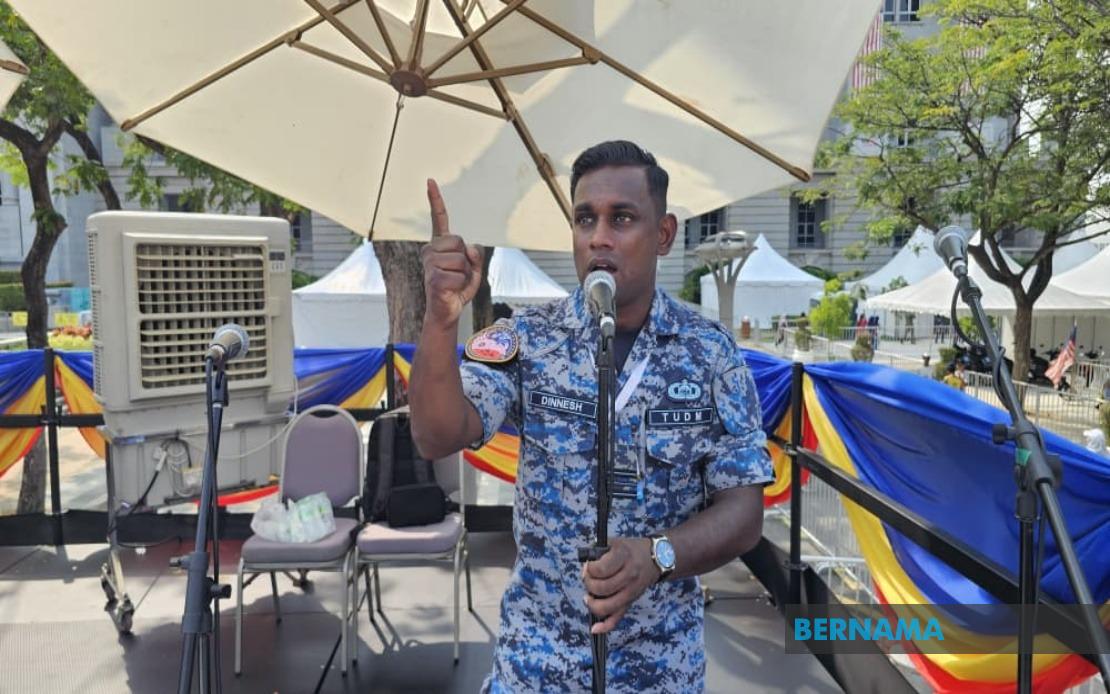
When fighter jets screamed across the skies above Dataran Putrajaya on Malaysia's 69th National Day, Major Dinnesh Nicolas Rene's voice became the crucial thread connecting the aerial theatre to thousands of spectators craning their necks skyward. As one of three air commentators orchestrating live narration of the RMAF's display, the 34-year-old officer transformed raw technical manoeuvres into compelling narrative, turning what might otherwise be distant, incomprehensible flyovers into moments of national pride and wonder. His role exemplified a dimension of national celebrations that often goes unrecognised: the meticulous work required to translate military precision into public spectacle.
The position of air show commentator demands far more sophistication than simply speaking into a microphone. A commentator must possess encyclopaedic knowledge spanning aircraft specifications, pilot identities, squadron insignia, formation protocols and the precise sequencing of each tactical display. This is not entertainment work that can be improvised on the spot. Rather, it requires the commentator to function as both technical expert and storyteller, understanding the mechanical and aeronautical dimensions deeply enough to explain them with authority whilst maintaining the emotional engagement of a live audience. The role sits at an intersection between military operations and public communication, requiring fluency in both domains simultaneously.
Dinnesh's path to air show commentary began in 2019 when he was selected to commentate at the Langkawi International Maritime and Aerospace Exhibition (LIMA), Malaysia's premier defence and aerospace showcase. That initial opportunity opened a professional avenue he has since pursued consistently, carrying the role through subsequent RMAF anniversaries and culminating in his selection for the National Day 2026 broadcast. His career trajectory within the RMAF Air Defence Control Division provided an ideal foundation. Having spent years analysing aerial operations from ground control stations, Dinnesh possessed intimate familiarity with the tactical and procedural dimensions that air shows attempt to demonstrate publicly. This operational background distinguishes him from a conventional broadcaster, granting him credibility when discussing why pilots execute specific manoeuvres and what significance each formation holds.
Yet operational knowledge alone proves insufficient. Preparation for major national events involves extensive coordination extending far beyond script development. Dinnesh meets repeatedly with ground controllers and pilots to verify every detail: which aircraft will participate, how many platforms will fly in formation, personal backgrounds of pilots, and the specific mottos representing each squadron. These meetings serve not merely informational purposes but establish synchronisation between commentators on the ground and aviators in the sky. Working alongside Major Neny Suhaida Ab Suki and Captain Muhammad Iqbal Nasrudin required careful coordination of commentary delivery to avoid redundancy whilst ensuring comprehensive coverage. He also liaises with security agencies and other event organisers, recognising that air shows operate within larger ceremonial frameworks where timing, messaging and protocol adherence carry significance beyond entertainment.
Protocol management intensifies substantially when the King and Prime Minister attend, as occurred during the National Day celebration. Commentators must develop acute sensitivity regarding what constitutes appropriate speech at each moment. Certain observations permissible during rehearsals become inappropriate during the live broadcast when the nation's highest officials are present. A commentator must navigate these nuances intuitively, understanding not merely the rules of engagement but their underlying rationale. This demands cultural awareness combined with strategic communication judgment. Dinnesh recognised that managing protocol essentially means filtering one's natural enthusiasms through the requirements of state ceremony, an exercise requiring restraint alongside passion.
The most underestimated challenge facing air show commentators involves physical vocal preservation. Unlike masters of ceremonies who operate in controlled acoustic environments, air commentators must project authoritative, energetic voices that penetrate the overwhelming decibel levels generated by fighter jet engines. The human voice becomes a tool operating under extreme stress, competing against ambient noise that might reach 140 decibels or higher. Maintaining vocal clarity, projection and emotional resonance throughout multiple rehearsals and the final performance represents an occupational hazard many spectators never consider. Dinnesh identified voice preservation as perhaps his greatest professional challenge, requiring dedicated management from preparation phases through broadcast day itself. The irony that the medium enabling his commentary—his voice—represents his most vulnerable asset underscores the physical dimensions of what superficially appears a purely verbal task.
Dinnesh manages this challenge through deliberate psychological preparation and emotional authenticity. He has developed a philosophy centring on genuine feeling as the prerequisite for authentic delivery. A commentator cannot convincingly convey excitement and national pride if experiencing only detachment toward the spectacle. After years observing fighter jets at close proximity, Dinnesh consciously maintains his sense of awe and wonder, recognising that this authentic emotional response translates through vocal performance to audiences. He approaches each air show as though experiencing it for the first time, refusing to permit familiarity to breed complacency in his presentation. This psychological stance—treating every performance as inherently significant regardless of how many previous shows he has commentated—informs his approach to voice management and delivery consistency.
The National Day air show commentary illustrates how Malaysia's military serves functions extending beyond operational defence capacity. The RMAF's aerial displays represent public diplomacy and national celebration mechanisms, requiring officers like Dinnesh to develop communication skills alongside their operational expertise. His work validates the principle that military forces operate within civilian contexts requiring sophisticated interpersonal and presentation abilities. The air show commentator becomes a cultural ambassador, interpreting military technology and capability to the general public in terms accessible yet respectful of operational realities. This role acquisition represents a form of defence force modernisation that emphasises institutional legitimacy through transparent public engagement.
For Malaysian audiences, Dinnesh's work exemplifies how National Day celebrations depend on countless individuals operating outside visible ceremonial roles. Whilst the King presides and pilots execute dramatic manoeuvres, commentators labour to ensure that spectators understand what they are witnessing and why it matters nationally. The quality of air show commentary directly influences public reception of aerial displays and, by extension, public perception of institutional capability and national pride. A commentator can transform technically impressive manoeuvres into emotionally resonant moments that strengthen national cohesion, or reduce them to incomprehensible spectacle. Dinnesh's preparation regimens and vocal discipline contribute significantly to ensuring the former outcome.
The 2026 National Day celebration benefited from his partnership with Suhaida and Nasrudin, distributing commentary responsibilities across three experienced voices and enabling more comprehensive coverage than any single commentator could achieve. This collaborative structure recognises that large-scale national events demand distributed attention, with multiple specialists ensuring no element of the aerial display passes unexplained. The selection of these three officers reflects institutional commitment to elevating commentary quality beyond basic narration toward genuinely informative, emotionally compelling public communication. Southeast Asian militaries increasingly recognise that institutional legitimacy depends partly on public communication excellence, and air show commentary represents a concentrated expression of this principle.
Looking toward future National Day celebrations, the model established through Dinnesh's and his colleagues' work suggests a template for professionalising military public engagement in Malaysia. Rather than treating commentary as secondary or improvised, institutions can elevate these roles into recognised specialisations requiring specific training and development. The RMAF's approach of drawing commentators from operationally experienced officers provides technical credibility whilst their communication skills generate public accessibility. This model balances institutional expertise with audience engagement in ways that strengthen both defence force legitimacy and public understanding of military capabilities. As Malaysia continues modernising its defence communications strategy, air show commentators like Major Dinnesh Nicolas Rene exemplify how personnel development in non-traditional military roles can enhance institutional effectiveness across multiple dimensions simultaneously.

