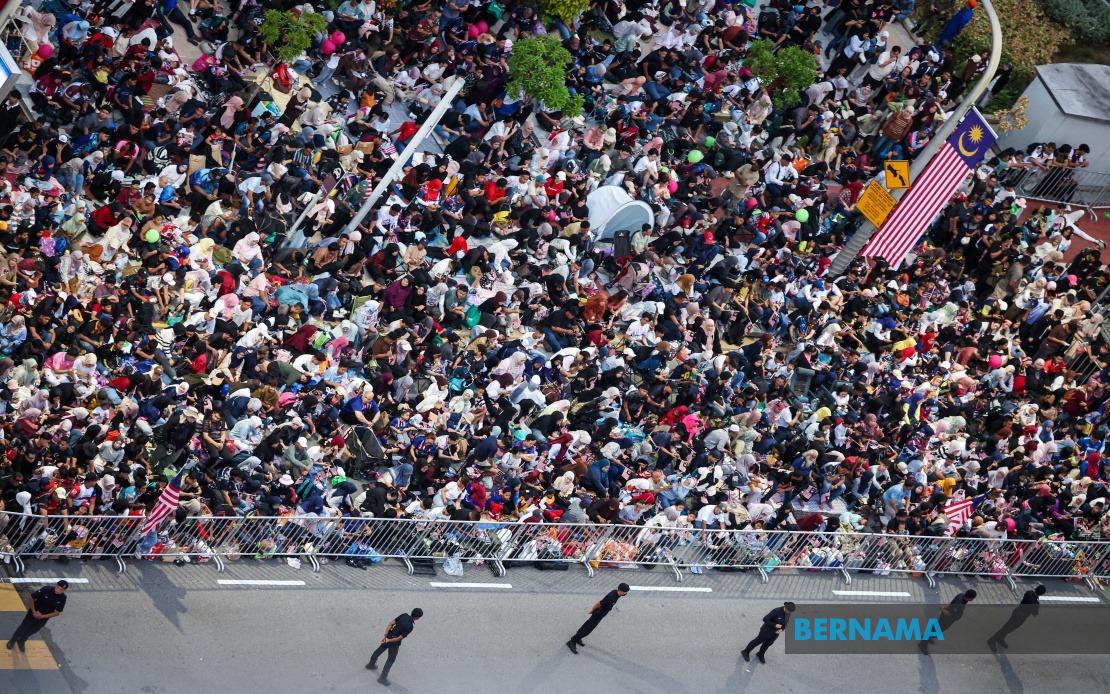
Hundreds of Malaysians descended on Dataran Putrajaya yesterday, determined to claim the best vantage points for this year's National Day festivities. The unprecedented enthusiasm saw crowds building throughout the evening, with some arriving as early as 5 pm and others staying through the night to guarantee their spots along the parade route for the 69th annual celebration scheduled to commence at 8 am.
The early arrival strategy reflects growing public appetite to witness Malaysia's most significant national commemoration in person, particularly following last year's crowds that left latecomers disappointed with distant views. This year's gathering carried added significance given the theme, "Malaysia MADANI: Kesejahteraan Dinikmati" (Malaysia MADANI: Shared Prosperity Enjoyed), which emphasises the government's development agenda and social welfare priorities across the region.
Among the earliest arrivals were creative professionals seeking to document the occasion. Mock Wei Qi, a 23-year-old freelance photographer, and his circle of friends positioned themselves strategically at 11 pm to capture cinematic content that could showcase Malaysia's distinctive character to international audiences. Their meticulous preparation underscores how younger Malaysians increasingly view national events through the lens of content creation and digital storytelling, recognising the parade as both a patriotic occasion and an opportunity to engage global viewership through compelling visual narratives.
Beyond the professional contingent, ordinary families embraced the adventure with enthusiasm rarely seen at public events. A couple known as As and Adib arrived with their children at 5 pm, having learned from previous years that early positioning proved essential to enjoying unobstructed sightlines. Their decision reflected a deliberate shift in family holiday planning, transforming the National Day experience from a potentially frustrating scramble into a well-orchestrated event. Such examples demonstrate how Malaysians strategically integrate national celebrations into school holiday activities, combining patriotic observance with family bonding.
The overnight camping phenomenon converted what might otherwise be tedious waiting into an unexpected recreational experience. Ahmad Azri Onn, accompanied by his wife and three children aged between ten and fifteen, discovered that the pre-celebration vigil offered unexpected benefits. Rather than perceiving the extended wait as an inconvenience, the family embraced it as an impromptu outdoor adventure that engaged their children with the national occasion in a memorable manner. Even inclement weather proved manageable; intermittent drizzle, rather than deterring the crowd, actually provided respite from afternoon heat and contributed to overall comfort during their extended stay.
The Dataran Putrajaya precinct witnessed its transformation gradually throughout the morning as the venue filled to capacity ahead of the official 8 am commencement. This progressive accumulation of spectators created a palpable sense of collective national spirit, with strangers united in anticipation of witnessing their country's patriotic tableau. The diversity of attendees—spanning age groups, professional backgrounds, and motivations—illustrated the enduring capacity of National Day to transcend demographic boundaries and unite Malaysians around shared civic pride.
The enthusiasm demonstrated at Dataran Putrajaya carries broader implications for public engagement with national events across Southeast Asia. As Malaysia's showcase celebration, the turnout signals renewed confidence in public gathering spaces and the importance Malaysians attach to experiencing landmark national moments communally rather than passively through media coverage. The willingness to camp overnight reflects a deeper investment in national commemoration than previous years, suggesting that the Malaysia MADANI messaging and economic optimism may be resonating with ordinary citizens.
For young people particularly, the National Day parade represents far more than ceremonial observance. It offers opportunities for creative expression, content production, and documentation that extends the celebration's reach far beyond physical attendees. As Mock Wei Qi's approach illustrates, this generation views national events as platforms for international storytelling, fundamentally reshaping how Malaysia projects itself globally through grassroots digital narratives.
The family-oriented demographics evident in the overnight campouts underscore how National Day functions as an anchor point in Malaysia's social calendar. Schools schedule their holiday breaks around this period, enabling families to participate in celebrations while children absorb national history and civic values through direct experience. Such intergenerational engagement proves crucial for maintaining continuity of patriotic consciousness and ensuring that younger Malaysians develop organic connections to their national identity rather than merely studying it academically.
As dawn broke at Dataran Putrajaya, the assembled crowd awaited the ceremonial proceedings that would mark 69 years since Malaysia's independence. The composition of this gathering—encompassing professional photographers, young families, retirees, and enthusiastic citizens from across the country—provided tangible evidence of the occasion's undiminished resonance in Malaysian public consciousness. Whether motivated by creative ambition, family tradition, or simple patriotic duty, the thousands who positioned themselves along the parade route demonstrated that National Day retains its capacity to mobilise Malaysians around collective celebration and shared identity.

