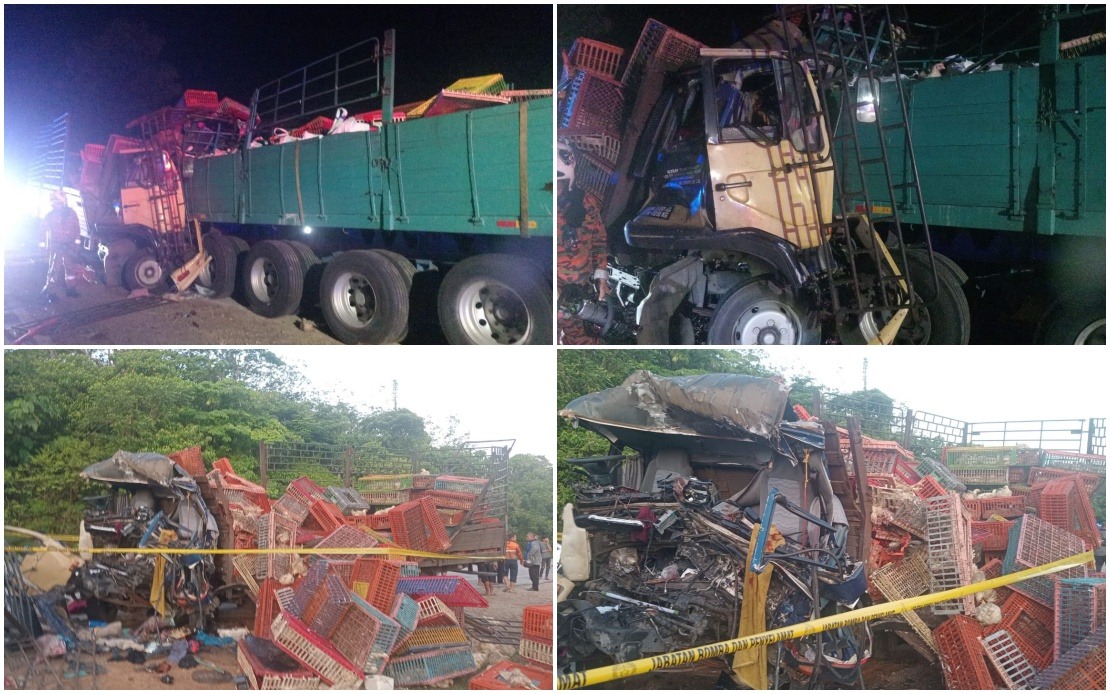
A tragic road accident in the early hours of Friday claimed three lives when a five-tonne lorry transporting chicken collided with a trailer positioned along the roadside on the East-West Highway in Tanah Merah, Kelantan. The collision, which occurred near the hamlet of Tanah Merah, highlighted the ongoing hazards faced by commercial drivers and passengers on Malaysia's major transport corridors, particularly during the overnight hours when visibility is reduced and fatigue becomes a significant factor.
The victims have been identified as Norazeman Abdul Aziz, 42, the operator of the lorry, alongside passengers Mohammad Zakwan Mohd Nor, 16, and Mohd Haikal Hanifah, 29. All three individuals were discovered trapped within the vehicle's cabin following the impact, necessitating an extensive rescue operation to remove them from the wreckage. The age range of the victims—spanning from adolescence to middle age—underscores how such incidents can devastate families across different generations within a single catastrophic event.
Emergency services received notification of the collision at 4:26 am through the NG999 emergency hotline, prompting a rapid response from regional fire stations. Personnel from the Kemahang Fire and Rescue Station and the Tanah Merah Fire and Rescue Station were mobilised to the scene, arriving at 4:41 am to confront the wreckage. The coordinated deployment of firefighting units from two nearby stations demonstrates the established protocols for managing major incidents along this critical highway corridor linking Peninsular Malaysia's east and west coasts.
Rescue efforts proved labour-intensive, requiring firefighters to undertake extraction procedures to liberate all three trapped occupants from the vehicle's compressed interior. The operation involved twelve firefighting personnel operating two engines, a substantial commitment of resources that reflected the severity of entrapment and the technical challenges inherent in vehicle extrication. Despite the swift response and professional intervention, all three individuals were certified deceased at the scene by personnel from the Ministry of Health, indicating the overwhelming force of the collision's impact.
The precise circumstances surrounding the collision remain under investigation by authorities. The presence of a stationary trailer on the roadside raises questions about visibility, warning markers, and roadside safety protocols. Whether the parked trailer was properly illuminated and demarcated, and whether the lorry driver experienced mechanical failure, loss of consciousness, or other factors contributing to the loss of vehicle control, will likely form part of the police investigation that commenced following the incident.
The Kelantan Fire and Rescue Department confirmed that responsibility for the bodies was transferred to police for further proceedings and formal investigation. This transition from emergency rescue to investigative phase represents a standard procedural step but also signals the beginning of a potentially protracted inquiry that may reveal systemic safety issues along the East-West Highway, a route infamous for its accident statistics and challenging driving conditions.
The East-West Highway, which traverses challenging terrain and connects the east coast states with the peninsular interior, has historically recorded elevated accident rates compared to other major Malaysian highways. The overnight timing of this collision aligns with a pattern of serious incidents occurring during late-night and early-morning hours when driver fatigue, reduced visibility, and lower traffic volumes paradoxically correlate with higher severity outcomes when accidents do occur. The presence of commercial traffic, including poultry transport vehicles operating on tight schedules, adds complexity to road safety dynamics on this route.
This incident resonates beyond Kelantan, carrying implications for the broader commercial transport sector across Malaysia and Southeast Asia. Poultry transport, a time-sensitive logistical operation requiring overnight deliveries to maintain product freshness, places operators under considerable pressure to maintain aggressive schedules. The human cost of such commercial imperatives merits examination by industry regulators, transport operators, and road safety authorities seeking to balance economic efficiency with worker protection.
For Malaysian road users and transport industry stakeholders, this tragedy underscores persistent vulnerabilities in highway infrastructure, driver welfare policies, and enforcement of fatigue management regulations. The involvement of a teenage passenger raises additional concerns about passenger safety practices within commercial transport vehicles and the adequacy of occupational health protocols for workers and associates engaged in overnight commercial operations. These considerations will likely feature in subsequent recommendations from accident investigation authorities and safety advocacy groups.

