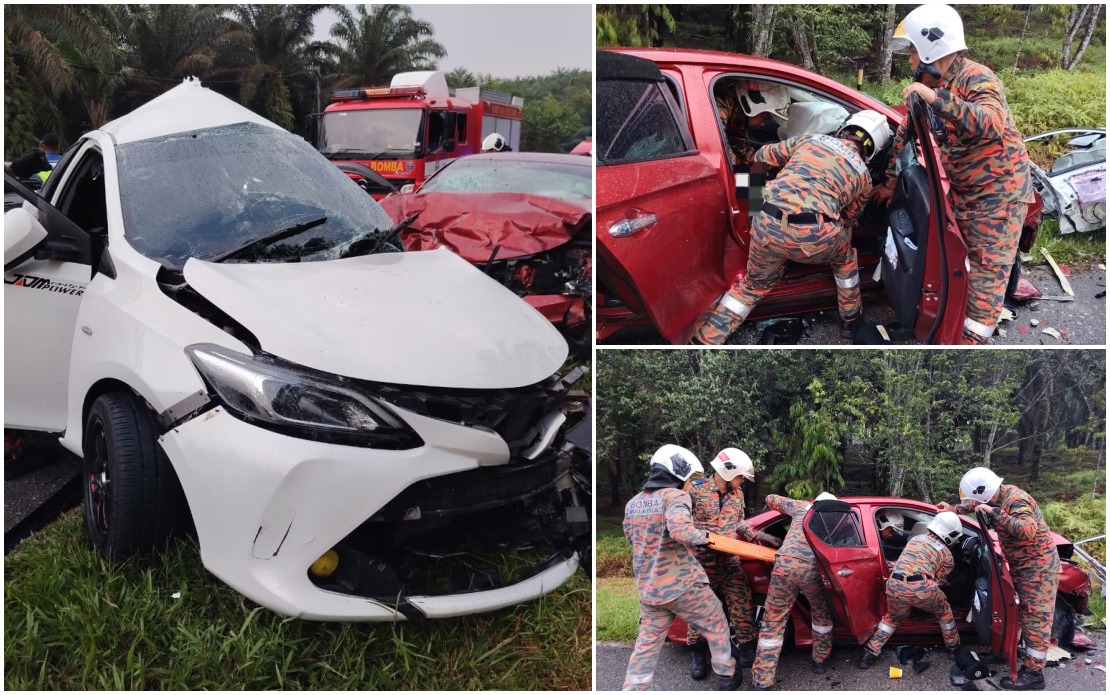
A collision between two sedans on a Kota Tinggi highway claimed three lives on Sunday afternoon, marking another fatal road incident in Johor's eastern district. Emergency responders discovered a Honda City and Toyota Vios entangled near a petrol station along Jalan Jemaluang in the Tanjung Leman vicinity, with all three occupants pronounced dead at the scene by Health Ministry personnel.
Firefighters received emergency notification at 5:05 pm and deployed an eight-member team from their nearest station, located approximately 45 kilometres away. Upon arrival at the crash site, rescue personnel found severe vehicular damage requiring specialist equipment to extricate the casualties. The operation progressed methodically, with rescue cutters employed to free trapped occupants before bodies were transferred onto stretchers for handover to law enforcement authorities. The entire emergency response concluded by 6:59 pm.
Victims included a 21-year-old man and 20-year-old woman travelling together in the Honda City, alongside a 31-year-old male driver of the Toyota Vios. The age demographics reflect patterns increasingly observed in Malaysian road fatalities, where younger drivers and passengers feature prominently in collision statistics. The proximity of the incident to a commercial establishment along a busy regional corridor raises questions about traffic management and visibility at the specific location.
Kota Tinggi district police, under Superintendent Othman's command, confirmed that investigation into the collision had commenced immediately following the emergency response. Standard protocols for fatal traffic incidents have been initiated, encompassing scene examination, witness statements, and preliminary vehicle inspection. The police statement indicated that comprehensive findings would be released once investigators completed their initial assessment phase, a timeline typically spanning several days as authorities reconstruct circumstances preceding impact.
This incident underscores ongoing road safety challenges within Johor, where highway collisions remain a significant public health concern. Tanjung Leman's location on a major arterial route connecting populated centres creates elevated traffic volumes, particularly during afternoon peak hours when this crash occurred. The intersection of commercial establishments, residential areas, and through-traffic patterns at such locations frequently generates accident blackspots unless specifically managed through enhanced enforcement or infrastructure modifications.
Despatch coordination between fire and rescue services and medical authorities proved critical in this incident, demonstrating the importance of integrated emergency response protocols. However, the fatality outcome highlights that even rapid emergency service activation cannot prevent deaths when collision forces exceed human survivability thresholds. Investigation findings will likely focus on determining whether speed, visibility, vehicle condition, or driver error contributed to impact severity.
For Malaysian motorists, this tragedy reinforces road safety fundamentals that remain inadequately observed. Defensive driving techniques, appropriate speed selection for traffic and weather conditions, and constant vehicular awareness represent basic precautions that could prevent collisions of this nature. The involvement of two distinct vehicles suggests potential misjudgement in overtaking manoeuvres, crossing decisions, or lane navigation—errors frequently identified in fatal multi-vehicle crashes on Malaysian highways.
The incident's timing during late afternoon hours aligns with documented peak-risk periods when driver fatigue and reduced visibility coincide. Petrol station proximity, while providing emergency assistance accessibility, also indicates the crash occurred near a commercial zone where traffic patterns may be less predictable, with vehicles entering or exiting fuel station access points creating intersection hazards. Such locations require heightened driver vigilance regardless of speed limits posted.
Regional road safety initiatives have struggled to demonstrate measurable impact on fatality reduction, despite enforcement campaigns and public awareness efforts. This Kota Tinggi collision joins dozens of similarly fatal incidents occurring monthly across Malaysian highways, suggesting that interventions to date have not adequately addressed behavioural and systemic factors driving collision frequency. As investigation details emerge, they may provide insights applicable to broader road safety policy discussions affecting the peninsula.

