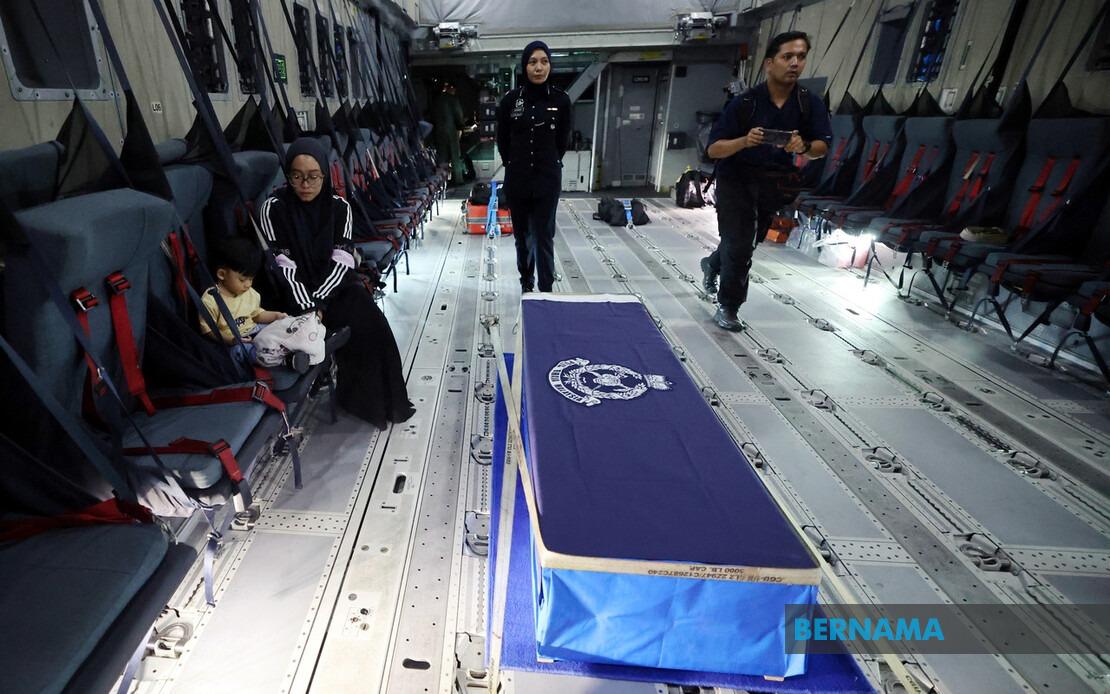
Three members of the Royal Malaysia Police lost their lives in a tragic electrocution accident in Beaufort, Sabah, with their remains now returned to their families across the country. The incident, which occurred outside Weston Police Station at 5.50 pm on August 6, claimed the lives of Corporal Mohamad Nur Hafiz Ibrahim, Constable Muhammad Raimi Ismarubee, and Corporal Chiu Teck Siong. Following post-mortem examinations conducted at Queen Elizabeth Hospital, the three bodies were transported by military and police aircraft to their respective hometowns on the evening of August 7, marking a somber conclusion to the repatriation process that began immediately after the fatal incident.
The logistics of returning the three officers to their families involved coordinated efforts between the Royal Malaysian Air Force and the Royal Malaysia Police Air Operations Force. An RMAF aircraft departed from Kota Kinabalu International Airport at 7.10 pm carrying two of the deceased—Corporal Mohamad Nur Hafiz Ibrahim and Constable Muhammad Raimi Ismarubee—with a planned route taking the aircraft first to RMAF Air Base in Kuantan before proceeding to RMAF Air Base in Gong Kedak, Terengganu, where the officers' families reside. This routing, while extending the journey, ensured that both personnel from the northern peninsula regions could be brought home efficiently. The coordination between multiple air bases underscores the formal protocols observed in repatriating fallen police officers, reflecting the respect afforded to those who perish in the line of duty.
Corporal Chiu Teck Siong's repatriation followed a different path, as his body was transported to the Royal Malaysia Police Air Operations Force base in Kota Kinabalu before being flown to Sarawak aboard a police aircraft. The separate routing accommodated the geographical distance and cross-state nature of bringing Chiu back to his home in Sarawak, highlighting the logistical challenges of repatriating officers from such geographically dispersed regions of Malaysia. Despite the different routes, both the military and police aviation services worked in parallel to ensure that all three families received their loved ones within the same timeframe, demonstrating institutional coordination during a crisis.
The three deceased officers represent different generations and backgrounds within the force. Corporal Chiu Teck Siong was 40 years old and based in Sarawak, while Corporal Mohamad Nur Hafiz Ibrahim, at 29, hailed from Kelantan in the northeast. Constable Muhammad Raimi Ismarubee, the youngest of the three, was just 26 and from Terengganu. Their diverse origins—spanning from Sarawak to the peninsula's east coast—reflect the national character of Malaysia's police service and the far-reaching impact of the tragedy across multiple states. The loss represents not merely individual tragedies but a significant blow to the police fraternity nationwide, as colleagues across the country grapple with the circumstances that led to such a sudden loss of life.
Electrocution incidents at police stations, while rare, present serious workplace safety concerns that warrant examination. The fact that the tragedy occurred outside Weston Police Station suggests that the officers may have been engaged in routine duties or maintenance activities when the incident happened. Such accidents raise questions about electrical safety protocols, infrastructure maintenance standards, and training requirements for personnel working in and around police facilities. The proximity of the incident to an active police station, a government facility that should maintain strict safety standards, adds another layer of concern to the tragedy and may prompt a review of safety procedures at police installations across the country.
The immediate response following the electrocution, including the prompt post-mortem examinations at Queen Elizabeth Hospital completed by noon on August 7, demonstrates the established procedures for handling officer fatalities. The Forensics Department's release of the bodies at approximately 2.56 pm enabled same-day repatriation, minimizing the period during which grieving families waited for their return. This efficiency in administrative processes, while acknowledging the tragic circumstances, reflects institutional preparedness for such contingencies. The medical examination process, conducted at one of Sabah's leading medical facilities, ensures that all facts pertaining to the incident are properly documented for official records and potential investigations.
The electrocution incident in Beaufort represents a significant workplace safety tragedy within Malaysia's law enforcement establishment. As officers conduct their duties in service to the public, incidents such as this underscore the various hazards that personnel may encounter beyond the more visible security threats. Workplace safety in government facilities, particularly those housing critical services like police stations, requires constant vigilance and regular maintenance to prevent such tragedies. The incident may prompt broader institutional reviews of electrical safety standards and maintenance protocols across Royal Malaysia Police facilities nationwide.
The repatriation of the three officers also highlights the human cost of service within Malaysia's security forces. Beyond the statistical count of casualties, each death represents a family losing a breadwinner and colleagues losing comrades. The coordinated response involving both military and police aviation services demonstrates the institutional networks of support that mobilize when such tragedies occur. These networks extend beyond the initial crisis response to include ongoing support for bereaved families, investigations into the incident's causes, and potential implementation of preventive measures to avoid similar incidents in the future.
For the broader Malaysian security and civil service sectors, the incident serves as a reminder of the importance of workplace safety across all government facilities. While dramatic security incidents often dominate headlines, the mundane but critical issue of occupational health and safety requires consistent attention and resources. The deaths of these three officers, occurring not in confrontation with criminals but in an electrical mishap, underscores that protecting those who serve the public must include protecting them from preventable workplace hazards. Moving forward, this tragedy may catalyze more rigorous safety audits and upgraded infrastructure in police facilities throughout Malaysia and Sabah in particular.

