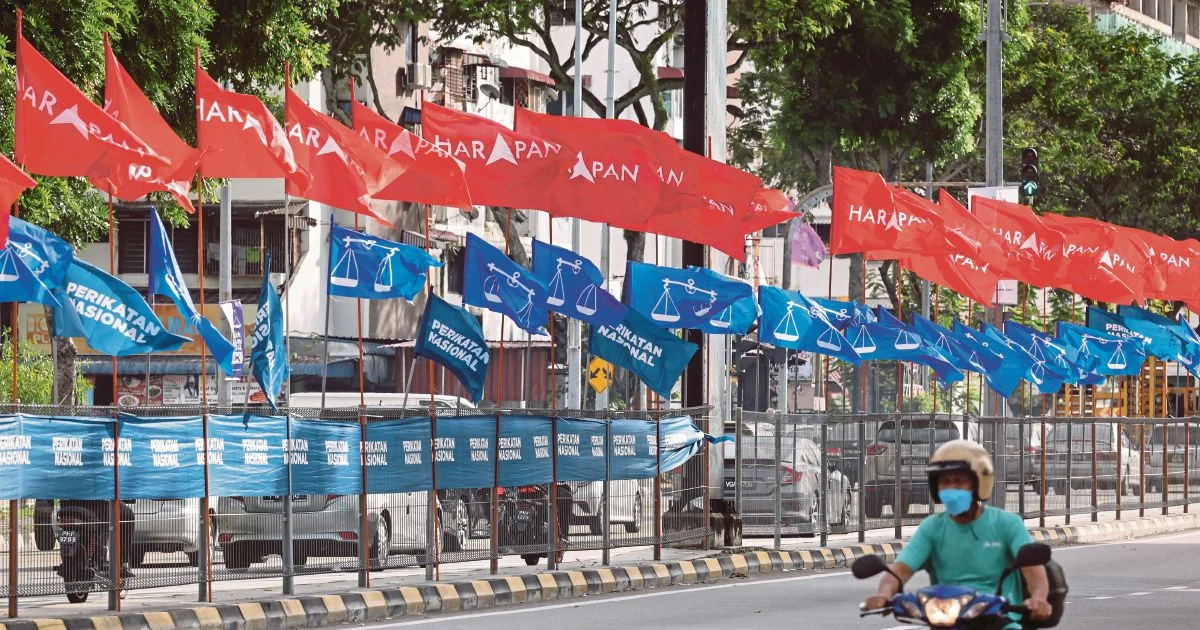
The Johor state election scheduled for next month will witness an unprecedented three-way contest across more than half of the electoral landscape, as Barisan Nasional, Pakatan Harapan and Perikatan Nasional jostle for dominance. With simultaneous campaigns across 33 of the 56 available seats, the upcoming polls promise to be among the most competitive and unpredictable the state has experienced in recent memory.
This broad deployment of three major coalitions signals a significant shift in how Malaysian electoral politics is shaping up at the subnational level. Unlike previous Johor elections where contests were largely bipolar, the emergence of PN as a serious contender has fractured the political terrain into multiple battlegrounds. The concentration of three-way fights in 33 seats suggests that no coalition can claim overwhelming dominance across the entire state, and each will need to engineer carefully targeted victories in their respective strongholds to secure an overall majority.
Barisan Nasional enters the contest with the advantage of long-standing institutional machinery and a network of traditional supporters across Johor, Malaysia's most developed state economy. The coalition's historical dominance in the state provides a foundation of loyal voters, though this advantage has been tested in recent electoral cycles. BN will likely focus on consolidating its traditional Malay Muslim and rural constituencies while attempting to recover ground lost to competing coalitions in urban centres.
Pakatan Harapan's participation in 33 simultaneous contests reflects the opposition alliance's strategy to present itself as a credible alternative government at both the federal and state levels. The coalition's campaign messaging will centre on its record in federal government and promises of reform, though it faces the challenge of mobilising voters in areas where local sentiment may favour incumbent or alternative administrations. PH's performance in Johor will carry implications beyond the state itself, serving as a barometer for the coalition's electoral appeal across Malaysia.
Perikatan Nasional's aggressive presence in 33 seats demonstrates that the coalition, anchored by the Islamist party Parti Islam Se-Malaysia, has succeeded in establishing itself as a significant political force. PN's regional support base and ideological appeal have allowed it to penetrate constituencies across the state, positioning itself as a third option for voters dissatisfied with either BN or PH. The coalition's expansion into competitive three-way contests suggests growing organisational capacity and electoral confidence.
The remaining 23 seats where fewer than three coalitions are competing likely represent either BN strongholds, opposition strongholds, or areas where one coalition has determined its prospects are insufficient to warrant significant resource allocation. These uncontested or two-way battles provide both a foundation for coalition performance and a measure of relative electoral strength. Where candidates run unopposed by major coalitions, victory margins may exceed the narrow pluralities expected in three-way fights.
For Malaysian voters and observers, the prevalence of three-way contests carries significant practical implications. Vote splitting becomes a critical factor when ballots are divided among multiple credible alternatives, potentially allowing candidates with modest vote shares to secure narrow victories. This dynamic can produce distorted results where plurality rather than majority support determines seat allocation, raising questions about representation and mandate legitimacy.
The Johor election takes on national significance given the state's economic importance and large population base. As Malaysia's second-largest state by population and home to critical manufacturing, port and petrochemical sectors, Johor's governance trajectory influences the broader regional economy. A coalition victory in the state could reshape momentum heading into potential future federal elections, while a fractured result might necessitate complex post-election negotiations.
Political analysts will scrutinise the contest as a test of voter sentiment in Malaysia's most ethnically and religiously diverse states outside Selangor and Kuala Lumpur. The distribution of three-way contests across different demographic regions will reveal whether voting patterns are fragmenting along ideological, performance-based, or identity-based lines. Results in Johor may offer insights into whether Malaysian politics is stabilising into a permanent three-coalition system or whether voters are still searching for a dominant force.
The campaign period will likely witness intense competition for undecided and swing voters, with each coalition deploying substantial financial and personnel resources across the 33 contested seats. Ground operations, campaign materials, and candidate selection will receive unprecedented scrutiny as coalitions attempt to maximise their gains in what amounts to a three-way scramble. The electoral outcome will depend substantially on which coalition best mobilises its grassroots machinery in these tight contests.
Both the timing and scale of this three-way contest position the Johor election as a consequential exercise in Malaysian democratic politics, one that will influence not only the state's governance but also the broader trajectory of national political coalitions as they prepare for eventual federal-level contests.

