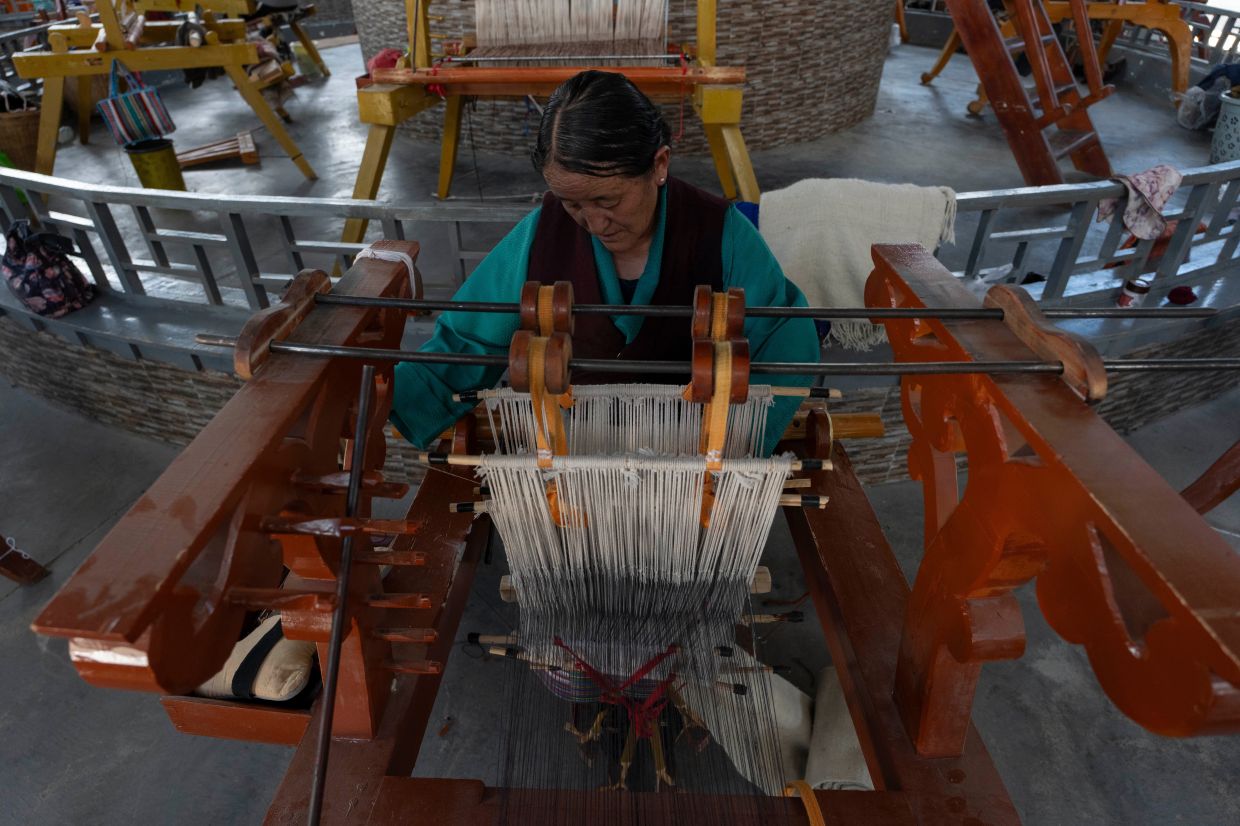
In a workshop nestled on the Tibetan plateau at 3,700 metres above sea level, more than a dozen artisans sit methodically at wooden looms, their hands moving in rhythmic precision as they manipulate wooden shuttles through dense rows of wool yarn. The repetitive yet intricate work produces Pulu, the traditional woollen fabric that has wrapped around the bodies of Tibetan people for over a thousand years, serving as both practical garment and cultural touchstone for a highland civilisation increasingly pressured by modern economic forces.
This preservation effort centres on the Ethnic Huaji Handwoven Cooperative in Shannan, where founder Pasang has transformed what could have been a dying craft into a functioning social enterprise. Since establishing the cooperative in 2008, Pasang has built an operation that now employs more than 100 local residents, deliberately including people with disabilities who might otherwise struggle to find meaningful work in the region's limited job market. What began as one man's determination to prevent the erasure of his heritage has evolved into a significant employer and cultural institution, demonstrating how traditional crafts can generate genuine economic benefit when supported by committed leadership and market access.
Pasang's personal journey illuminates the precariousness these skills faced just decades ago. He learned weaving from his parents during a period when the knowledge was vanishing rapidly—fewer than 10 people in the entire region still possessed mastery of Zeter, the cooperative's signature product. Zeter represents the finest expression of Pulu tradition, crafted from exceptionally soft wool harvested from the neck and back regions of sheep raised in the high-altitude pastures surrounding Shannan. The specialized sourcing and labour-intensive processing required to transform this premium material into yarn makes Zeter substantially more challenging to produce than ordinary Pulu, yet Pasang recognised both its historical significance and its potential commercial value.
The historical prestige attached to Zeter underscores why Pasang views his work as culturally essential rather than merely economically viable. During the Ming dynasty, Zeter was sufficiently prized that it functioned as tributary material presented from Tibet to the Chinese imperial court—a testament to its exceptional quality and the technical sophistication required to produce it. This imperial connection, combined with the fabric's superior lightness, softness and delicacy compared to standard Pulu, positioned Zeter as an elite product even centuries ago. Understanding this heritage helps explain why Pasang has invested such energy in preventing its extinction; he is not simply preserving a craft but maintaining a link to his people's historical achievement and cultural standing.
The cooperative's physical space reflects this historical consciousness deliberately. Wooden statues of Tibet's 7th century King Songtsen Gampo and his Chinese bride, Princess Wencheng, occupy the workshop's central position, surrounded by the looms where modern artisans practice ancient techniques. According to Tibetan tradition, Princess Wencheng introduced weaving methodologies to the plateau when she married the king, establishing a cultural narrative that weaving itself represents a synthesis of Tibetan and Chinese civilisation. Pasang articulates this integration thoughtfully, viewing the fabric's evolution not as cultural dilution but as genuine fusion. This framing proves politically significant in contemporary China, where such narratives of historical unity serve official interests while simultaneously allowing craftspeople like Pasang to claim legitimacy for their preservation efforts.
Recognition of Zeter and Pulu as intangible cultural heritage at the national level has provided institutional validation for the cooperative's mission. This designation offers both cultural legitimacy and practical benefits, potentially opening pathways to government support and tourism revenue. However, the cooperative operates primarily through market mechanisms rather than subsidy, with sales concentrated within Tibet although customers increasingly come from other Chinese regions. The showroom adjacent to the weaving workshop displays finished products—scarves, shawls, jackets and bags—marketed to consumers willing to pay premium prices for authentic handwoven textiles. This business model creates genuine economic incentive for younger Tibetans to learn the trade, addressing the otherwise elusive question of how traditional crafts survive in cash-based modern economies.
The human dimension of this enterprise emerges clearly through stories like that of Tsering Yangchen, an 80-year-old woman who has worked at the cooperative for seven years. She relocated from another county specifically to join the workshop after struggling to secure employment elsewhere—a pattern likely repeated across many rural and elderly workers in the region. The cooperative provided her not merely with income but with purposeful activity and community connection. She describes Pulu with evident affection as something her community has always worn, emphasising the fabric's pure wool composition and everyday utility. Her perspective reveals how craft production can function as social infrastructure, providing dignity and engagement for demographic groups often marginalised in modern labour markets.
The cooperative's deliberate inclusion of people with disabilities represents another dimension of its social function beyond simple preservation of technique. By creating accessible employment opportunities within the workshop environment, Pasang has extended the cooperative's impact beyond cultural maintenance into genuine social welfare provision. This dual mission—economic inclusion combined with heritage preservation—distinguishes the Ethnic Huaji operation from purely commercial enterprises and positions it as a model potentially relevant across rural Asia where traditional industries have collapsed yet no adequate alternative employment exists.
The sustainability of such efforts remains uncertain. While the cooperative has achieved genuine scale and market presence, the long-term viability of handcrafted luxury textiles depends on maintaining sufficient consumer demand and cultural transmission across generations. Whether younger Tibetans will embrace weaving as their parents and grandparents did, or whether broader economic integration will pull them toward different aspirations and careers, presents an unresolved question. Pasang's vision of preventing extinction through employment and education offers a pragmatic approach, yet ultimately depends on whether weaving can remain economically competitive and culturally valued as Tibet continues its rapid transformation.

