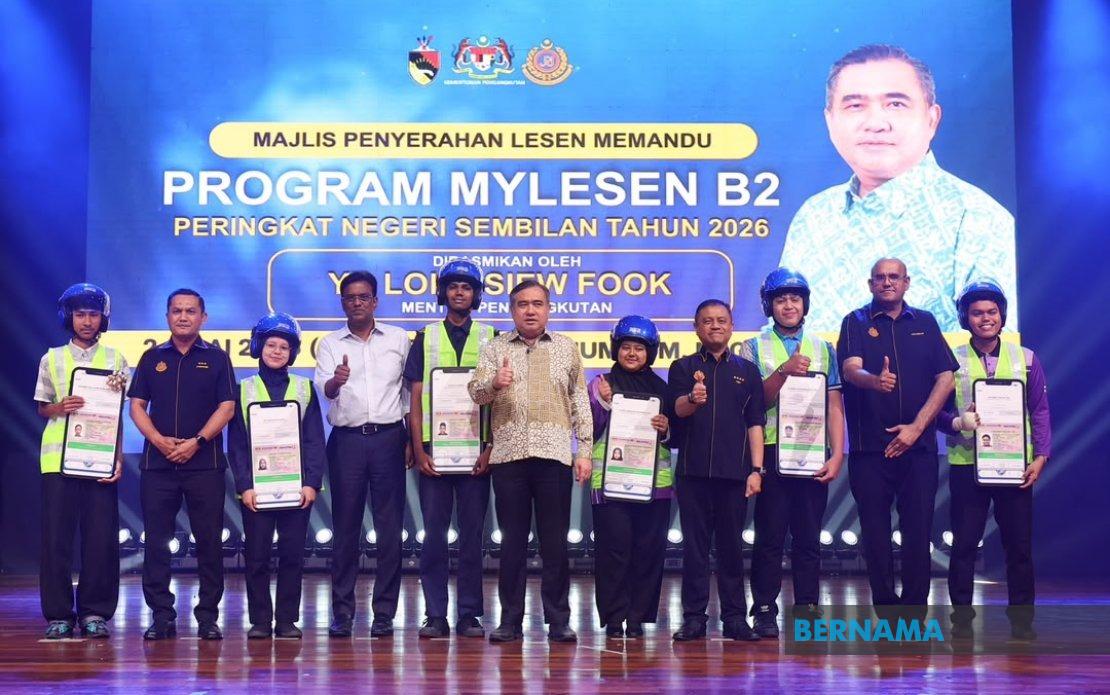
Transport Minister Anthony Loke delivered a sobering message to young motorcyclists in Negeri Sembilan this week, reminding them that obtaining a motorcycle licence through the government's MyLesen B2 Programme carries serious responsibilities beyond the freedom of the open road. Speaking at the presentation of driving licences to programme participants, Loke made clear that the free qualification represents a privilege tied directly to lawful and prudent riding behaviour, not an invitation to dangerous stunts or competitive speeding on public thoroughfares.
The minister's intervention reflects growing concern about motorcycle safety in Malaysia. According to figures he cited, approximately 60 per cent of annual road fatalities involve motorcyclists and pillion riders, with the vast majority of victims younger than 30 years old. This demographic concentration underscores why the government has targeted young riders through public awareness campaigns, and why Loke chose to emphasise personal responsibility during the licence ceremony itself rather than simply distributing credentials and moving on.
The MyLesen B2 Programme has expanded significantly since its inception in 2023. Negeri Sembilan's allocation increased to 2,300 participants for the current year, more than double the 1,000 places available previously. As of the announcement, 1,979 individuals had secured their Learner's Driving Licence, while 1,879 had completed training modules and passed competency assessments to receive their Probationary Driving Licence. Nationally, the scheme has already benefitted more than 100,000 recipients, indicating that this is now a substantial government initiative with meaningful reach across Malaysian communities.
For many young Malaysians, the free licence opens genuine pathways to economic advancement. Loke highlighted how motorcycle accessibility improves employment prospects, supports further education participation, and enhances socioeconomic mobility through reliable transportation. In a country where many regions lack comprehensive public transit networks, motorcycle ownership represents a practical solution for commuting and opportunity access. The government's subsidy of licencing costs removes a financial barrier that might otherwise exclude lower-income youth from legal riding.
Yet this expanded access comes with a governance challenge: ensuring that recipients use their licences responsibly rather than as a gateway to dangerous behaviour. Illegal motorcycle racing remains a significant social problem in Malaysia, particularly among younger riders who treat public roads as impromptu racetracks on weekends and evenings. The phenomenon is not merely a traffic violation issue; it creates genuine public safety hazards for other motorists, pedestrians, and the riders themselves, while also fostering broader perceptions of youth delinquency in communities.
The government's response to this challenge is legislatively escalating. Loke announced that Parliament has now passed the Road Transport (Amendment) Bill 2026, which introduces substantially stiffer penalties for illegal racing and speed testing across all vehicle categories. Under the new framework, those apprehended by the Road Transport Department or police face not merely fines but potential imprisonment for these offences. By elevating illegal racing from a minor violation to a serious criminal matter, the legislation signals that the government views this behaviour as a priority enforcement target requiring deterrent-level consequences.
This legislative approach reflects lessons learned from years of motorcycle-related incidents and fatality trends. Earlier education campaigns and standard traffic fines have proven insufficient to deter persistent offenders within youth demographics. Imprisonment clauses serve both as individual deterrents and as a broader social signal about acceptable behaviour boundaries. The government clearly believes that young riders will modify conduct if convinced that consequences extend beyond monetary penalties to criminal records affecting future employment and mobility.
Loke's message directly addressed three specific behavioural expectations. First, he insisted that weekend leisure time should not become occasions for illegal racing, implicitly acknowledging that many offences occur during non-school hours when enforcement becomes more challenging. Second, he explicitly linked safe riding to compliance with traffic laws, suggesting these are not separate concerns but interdependent aspects of responsible mobility. Third, he mandated use of SIRIM-certified safety helmets, connecting individual protection standards to legal requirements rather than treating helmet use as an optional precaution.
The Road Transport Department, which oversees licence issuance and enforcement, has positioned itself as a central actor in this safety architecture. Director-General Datuk Aedy Fadly Ramli's presence at the ceremony, alongside senior departmental officials, demonstrated institutional commitment to the MyLesen B2 Programme and its safety messaging components. The Department faces complex implementation challenges: monitoring compliance among a rapidly growing licence holder population while maintaining proportionate enforcement that educates rather than merely punishes.
For Malaysian readers and policymakers, the broader context matters considerably. This initiative represents a government attempting to balance multiple objectives simultaneously—expanding youth opportunity and mobility access while maintaining road safety standards and controlling illegal behaviour. The tension between these goals manifests in the requirement that young riders accept both privilege and constraint as bundled concepts. The free licence is generous; the responsibility attached to it is non-negotiable.
Regionally, Malaysia's approach to youth motorcycle licensing reflects broader Southeast Asian challenges with transport accessibility and safety. Many countries in the region face similar demographic pressures, with young populations requiring affordable mobility solutions while grappling with limited public transit infrastructure. Malaysia's combination of subsidy (removing financial barriers) with toughened enforcement (raising legal consequences) offers a potential model worth monitoring for its effectiveness in other developing economies facing comparable transport and safety dilemmas.
The success of this integrated approach—combining expanded access, safety messaging, and legislative deterrence—will ultimately depend on implementation consistency and sustained commitment. Loke's presence at the licence ceremony sent important symbolic signals to both recipients and the broader public about government priorities. However, translating ministerial exhortations into changed behaviour requires sustained enforcement, community reinforcement, and perhaps most importantly, cultural shifts in how young riders perceive the relationship between personal freedom and collective safety on Malaysian roads.

