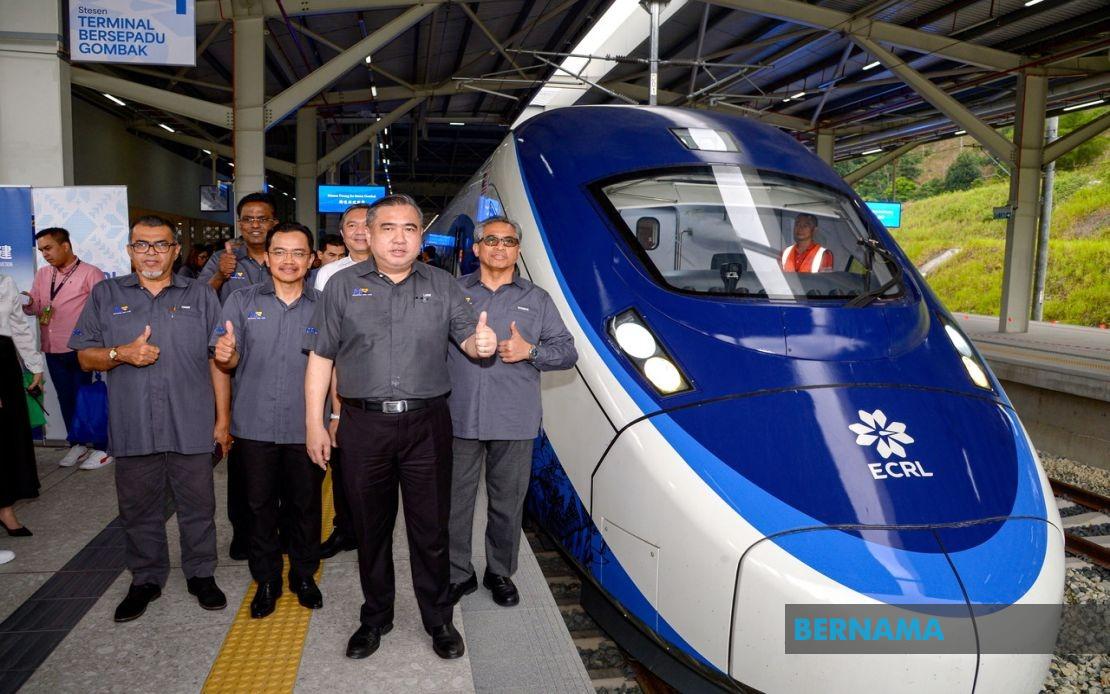
Transport Minister Anthony Loke Siew Fook has set an ambitious December target for the East Coast Rail Link Phase 1 to begin commercial operations between Kota Bharu and Gombak, marking a significant acceleration of the originally scheduled January 2027 startup. The announcement, made during the launch of the Comprehensive Inspection Train and System Integration Testing at Gombak Integrated Terminal Station, represents a four-year advancement in the project timeline and reflects the government's determination to deliver this long-awaited regional connectivity infrastructure.
The expedited schedule hinges critically on the successful completion of rigorous testing and commissioning protocols, with no allowances for shortcuts in safety verification. Loke emphasized that Malaysia Rail Link Sdn Bhd and the main contractor China Communications Construction Company Ltd must intensify coordination to achieve this compressed timeline. The minister stressed that this acceleration is conditional upon the smooth progression of System Integration Testing and Fault-Free Run protocols, underscoring that operational commencement remains subordinate to comprehensive safety clearance.
A key component of the acceleration strategy involves streamlining the typically lengthy certification process. Loke revealed discussions with the Land Public Transport Agency to identify efficiency measures within testing and approval procedures. The minister noted that regulatory certification customarily requires two to three months, but officials are exploring mechanisms to compress this duration while maintaining rigorous safety standards. This administrative innovation reflects broader efforts to balance project urgency with institutional accountability.
The technical foundation for acceleration rests on extensive pre-delivery testing completed in China. Train sets and electrical locomotives underwent comprehensive factory assessments before shipment to Malaysia, providing confidence that abbreviated local testing phases remain feasible without compromising safety. System Integration Testing, commencing this month, will validate the interaction between electrical systems, signalling infrastructure, and operational controls. Subsequently, Fault-Free Run procedures scheduled for September will subject the first train sets to 8,000-kilometre trial operations under Land Public Transport Agency supervision, simulating real operational conditions without passenger loading.
Loke's characterization of the acceleration effort as driven by careful risk assessment rather than politically motivated deadline-chasing attempted to address inevitable skepticism about compressed timelines in major infrastructure projects. He emphasized that completing all preliminary tests and securing regulatory approval remains mandatory before Fault-Free Run implementation, dismissing suggestions that acceleration implies circumventing safety protocols. The minister's stated personal concern about operational risk served as rhetorical assurance of genuine safety prioritization, though such commitments require substantiation through actual implementation practices.
Phase 1 of the East Coast Rail Link currently stands at 95.08 per cent completion as of July, according to official progress metrics. This advanced completion status provides material foundation for the accelerated operational timeline, distinguishing this initiative from projects where compressed schedules require simultaneous construction acceleration and testing compression. The proximity to physical completion suggests that testing and certification phases represent the primary scheduling variables, offering realistic scope for timeline optimization.
The broader East Coast Rail Link program encompasses sequential implementation phases, with Phase 2 extending service from Gombak to Port Klang scheduled for December 2027 completion and January 2028 operational commencement. This phased approach enables revenue generation from the Kota Bharu-Gombak section while construction proceeds on southern extensions, creating incremental return on invested capital and demonstrating project viability to stakeholders and the public.
For Malaysian commuters and the broader transportation ecosystem, the potential December launch holds significant implications. The service will establish direct rail connectivity between Kelantan and the Klang Valley, reducing travel times and offering alternatives to congested road corridors. Regional integration through enhanced east-west rail infrastructure supports broader economic objectives of relieving traffic congestion, reducing transportation-related emissions, and facilitating commerce between the east and west coasts. For Kelantan particularly, the railway connection represents a transformative development in regional accessibility and economic positioning within the national transportation network.
The involvement of senior government officials, including Chief Secretary to the Government Tan Sri Shamsul Azri Abu Bakar in his capacity as Malaysia Rail Link chairman, alongside Chinese Ambassador Ouyang Yujing, underscores the project's cross-border significance and political investment. The Chinese government's substantial role through CCCC and the participation of CCCC president Zhang Bingnan reflects the East Coast Rail Link's integration within broader Belt and Road Initiative frameworks, though the project predates current political configurations and represents long-standing Malaysian-Chinese transport cooperation.
Operational success hinges not only on technical completion but also on institutional coordination among multiple agencies. The Land Public Transport Agency's expanded role in expediting certification processes represents a meaningful governance innovation, suggesting that regulatory agencies possess flexibility to optimize timelines when political will aligns with operational feasibility. However, such flexibility requires careful calibration to prevent genuine safety compromises disguised as administrative streamlining.
Sustainability considerations extend beyond the December launch milestone to long-term operational viability and passenger adoption. Successfully establishing frequent, reliable service with competitive pricing relative to alternative transportation modes will determine whether the accelerated launch translates into transformative regional connectivity. Initial operational performance will significantly influence subsequent phases, affecting both public confidence and investor enthusiasm for comprehensive network completion.
The December 2024 target, if achieved, would position Malaysia as demonstrating meaningful project delivery capabilities in major infrastructure development. Conversely, further delays would perpetuate perceptions of implementation challenges that have historically affected Malaysian transport megaprojects. The forthcoming months will thus prove decisive not only for this specific initiative but for broader assessments of the government's capacity to execute complex, multinational infrastructure programs according to revised timelines.

