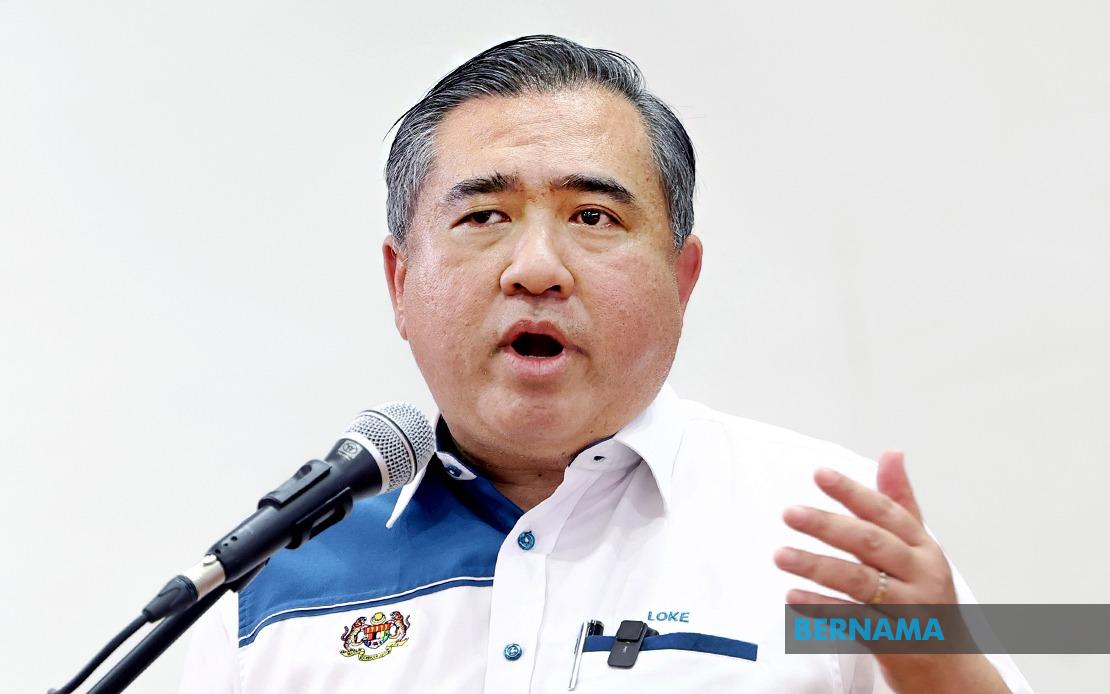
Transport Minister Anthony Loke has directed the Road Transport Department to take enforcement action against motorcyclists found riding without helmets during the ongoing Johor state election campaign, drawing on video evidence that has circulated widely on social media. The directive underscores a broader commitment to uniform road safety enforcement irrespective of the political complexion of those breaking the law, a principle Loke has maintained consistently across multiple election cycles.
The announcement comes after footage emerged showing campaign workers from Pakatan Harapan, including members of the Democratic Action Party, riding motorcycles without proper safety equipment during the Johor campaign. Loke's decision to pursue enforcement against members of his own political coalition represents a notable test of his stated commitment to impartial application of traffic regulations. The Transport Minister emphasised that the Ministry of Transport regards the issue with considerable seriousness and that no exemptions would be granted based on party affiliation or campaign status.
Loke's public stance reflects a longer trajectory of advocacy on this specific issue. Nearly six years earlier, during the Slim by-election campaign, the Transport Minister had raised similar concerns involving Barisan Nasional figures who were captured riding motorcycles during campaign activities without wearing helmets. At that time, Loke stressed that while campaigning on motorcycles was entirely permissible under Malaysian law, riders carried an obligation to comply with mandatory helmet requirements and to model responsible road behaviour for the public. That earlier intervention established the conceptual framework within which his current directive operates.
The enforcement action highlights the intersection between electoral activity and public safety compliance in Malaysia. Election campaigns, particularly at the state level, often involve intensive motorcycle-based outreach, with campaign workers traversing constituencies on two-wheelers to distribute materials and engage voters. The visibility of such activities, combined with their frequency during election periods, creates particular opportunities for violations to occur and for such breaches to gain public attention through social media channels. Loke's intervention acknowledges this dynamic while insisting that campaign schedules and electoral urgency do not override foundational safety obligations.
Road safety enforcement in Malaysia has historically grappled with inconsistent application and political sensitivities during election periods. The Transport Minister's explicit commitment to enforce without political distinction addresses a longstanding credibility gap in traffic law implementation. By signalling a willingness to act against his own coalition members, Loke seeks to establish that road regulations function independently of the electoral calendar and the political interests at stake. This approach contrasts with perceptions that enforcement may be selectively applied or temporarily suspended during sensitive political moments.
The Road Transport Department faces the practical challenge of operationalising this directive while maintaining proportionality and consistency in enforcement. JPJ officers conducting campaign-related traffic operations must balance the need to identify and summon violators against potential perceptions of political targeting or selective enforcement. The existence of video evidence, which Loke referenced as the basis for the enforcement action, provides a documented foundation that reduces discretionary judgment in individual cases. However, the department will need to develop clear protocols for identifying, locating, and processing offenders captured in such footage.
From a public health and safety perspective, helmet non-compliance remains a persistent challenge in Malaysian road safety policy. Motorcyclists constitute a disproportionately vulnerable segment of road users, and helmets are proven to reduce fatal injury risk substantially. The casualisation of helmet-wearing as a matter of campaign expedience or political convenience undermines safety messaging targeted at the general population. When highly visible public figures and political campaign workers appear without helmets, the visibility of such conduct can normalise non-compliance among viewers who may conclude that safety regulations are negotiable depending on context or status.
The timing of Loke's enforcement directive coincides with an intensifying Johor state election campaign, where campaign visibility and voter engagement remain paramount for all contesting parties. The announcement may create incentives for heightened compliance across the board, as campaign organisations recognise that enforcement will proceed without political exception. Alternatively, the directive could be perceived by some as selectively targeting opposition-aligned workers if enforcement patterns demonstrate asymmetry in practice. Maintaining genuine neutrality in implementation will therefore be critical to the credibility of the enforcement effort.
Loke's personal position as DAP secretary-general adds another layer to the significance of his directive. His willingness to commit to enforcement against coalition members, including those from his own party, represents a test of whether party loyalty or principle takes precedence when they diverge. The Transport Minister has explicitly stated that he will not compromise this position even when it implicates his own campaign colleagues. Such declarations carry weight only insofar as subsequent implementation demonstrates genuine commitment rather than selective or symbolic enforcement.
The broader regulatory environment in Malaysia provides a foundation for such enforcement. Road safety laws, including the mandatory helmet requirement, do not contain exemptions for campaign personnel or political purposes. Loke's framing of the issue emphasises this universal applicability—that road safety rules recognise Malaysian citizens and traffic participants but not political parties or electoral status. This principle aligns with international road safety norms and with Malaysia's obligations under road safety frameworks that emphasise universal compliance regardless of circumstance or status.
For Malaysian voters and the general public, the enforcement action carries symbolic importance beyond its immediate practical impact on campaign workers' behaviour. Road safety compliance functions as a marker of institutional accountability and of whether rules apply universally or selectively depending on who breaks them. By insisting on uniform enforcement during an election period, when selective application would be least surprising, Loke's directive addresses a fundamental public expectation that government authority should function impartially.

