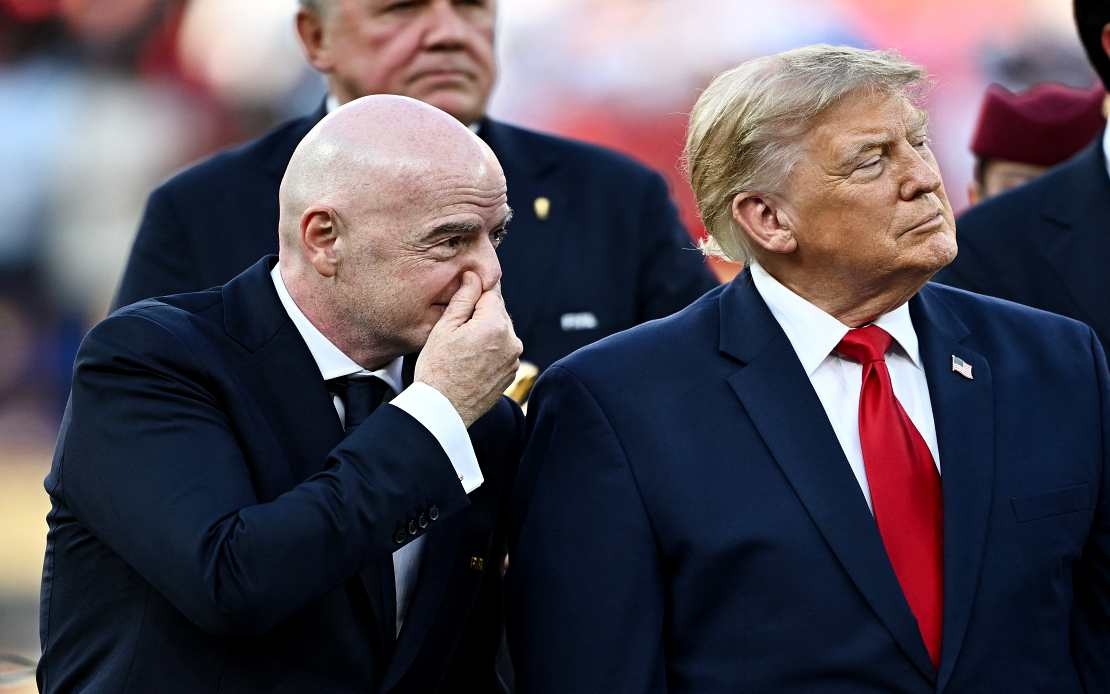
United States President Donald Trump has moved to bolster FIFA President Gianni Infantino in the face of mounting international criticism, describing him as an outstanding and irreplaceable leader whose stewardship has transformed professional football's fortunes. Trump's public endorsement came after major continental football bodies issued an open letter questioning Infantino's judgment and calling for an independent probe into FIFA's handling of a complex commercial arrangement that threatened to reshape the sport's governance.
The controversy centres on FIFA's proposal to monetise its commercial and media rights through a novel structure known as the FIFA Forward Enterprise. The plan involved selling approximately 20 per cent of shares in this new entity to private investors, a move designed to generate US$4.2 billion in capital for the International Federation of Football Associations. This valuation effectively placed FIFA's overall commercial portfolio at roughly US$20 billion, representing an extraordinary concentration of football's most valuable commercial assets in the hands of private equity interests.
Leadership from the Union of European Football Associations, the Asian Football Confederation, and the Confederation of North, Central American and Caribbean Football jointly declared their opposition to the arrangement, questioning both the process and the wisdom of surrendering control over FIFA's most lucrative revenue streams. These three continental bodies represent the sport's largest markets and wield substantial influence over FIFA's decision-making, making their unified stance a significant threat to Infantino's authority and position.
Trump, speaking through his Truth Social platform, dismissed the concerns levelled against Infantino and instead highlighted his stewardship of the most commercially successful World Cup tournament in history. The US president asserted that FIFA had expanded its profitability by a factor of four under Infantino's leadership, and warned that the organisation would forfeit any prospect of matching such financial success if it abandoned the president. For Malaysian and Southeast Asian football stakeholders, Trump's intervention underscores how FIFA's internal power struggles intersect with broader geopolitical considerations, particularly as the United States increasingly scrutinises international sporting bodies.
Infantino convened an emergency session with FIFA's executive committee in early August as the controversy intensified and his political position within the governing body weakened considerably. During these closed-door meetings, the FIFA president acknowledged errors in his management of the FIFA Forward Enterprise project and secured a vote of confidence from the assembled leadership. This proved a critical moment for Infantino, as the loss of support from any major confederation could have triggered further defections.
The commercial proposal itself revealed the growing tensions between FIFA's ambitious financial objectives and the sport's established stakeholders. By partnering with private investors—including reports that suggested involvement from Joshua Kushner's foundation, the brother of Jared Kushner who serves as Trump's son-in-law—FIFA appeared intent on securing development capital without burdening member federations. Yet this approach fundamentally threatened the autonomy of continental confederations that have traditionally guarded their own media rights and commercial relationships.
UEFA's response proved particularly consequential. The European body announced that its entire membership would boycott all FIFA-sanctioned competitions unless the federation completely withdrew the commercial proposal. This boycott threat represented an existential challenge to FIFA, as UEFA represents the world's wealthiest and most influential confederation. The prospect of European clubs and national teams refusing to participate in FIFA tournaments, including World Cup qualifiers, would have devastated the organisation's credibility and finances.
Confronted with this unified opposition from its largest revenue-generating regions, FIFA ultimately capitulated. Infantino announced the abandonment of the FIFA Forward Enterprise commercial rights sale, effectively shelving the entire proposal. This reversal represented a significant tactical defeat for the FIFA president, demonstrating that even his significant accumulated power could be constrained when multiple continental confederations coordinated their resistance. For regional observers, the episode illustrated the complex balancing act required to manage FIFA's sprawling governance structure.
Trump's defence of Infantino appears strategically motivated. The US president's emphasis on the World Cup's financial success under Infantino's tenure, coupled with his warning about FIFA's diminished prospects without him, suggests an interest in maintaining stability within FIFA leadership. This stance aligns with broader American engagement with international sporting governance, where the Trump administration has previously intervened in disputes affecting US commercial interests. Malaysian football administrators monitoring FIFA's trajectory should recognise that internal confederation disputes increasingly attract external political attention from major powers.
The resolution of this crisis has left unresolved questions about FIFA's long-term financial strategy and governance model. While Infantino retained his position and secured the withdrawal of the controversial commercial proposal, the episode exposed the limitations of top-down decision-making within FIFA. The need to balance development ambitions with stakeholder autonomy will shape FIFA's direction going forward, particularly as confederations in Asia, Africa, and North America seek greater influence over the sport's commercial evolution.
For Malaysian football interests specifically, the outcome carries implications for how FIFA structures competition scheduling, revenue distribution, and development funding. As a member of the AFC, Malaysian football depends partly on FIFA's allocation of development resources and tournament opportunities. The political dynamics revealed in this dispute—particularly the assertiveness of larger confederations and the intervention of external political actors—suggest that future FIFA decisions will reflect complex negotiations between continental bodies rather than unilateral presidential authority.
The Infantino crisis ultimately demonstrates that even FIFA's most powerful leader must accommodate the fundamental interests of major confederations. While Trump's public backing provided psychological support for the embattled FIFA president, the substantive reversal came from recognising that UEFA's collective power—backed implicitly by AFC and CONCACAF concerns—remained decisive. This balance of power will continue shaping FIFA's strategic choices, including investment priorities, competition formats, and governance structures that affect football's development across Southeast Asia and the wider region.

