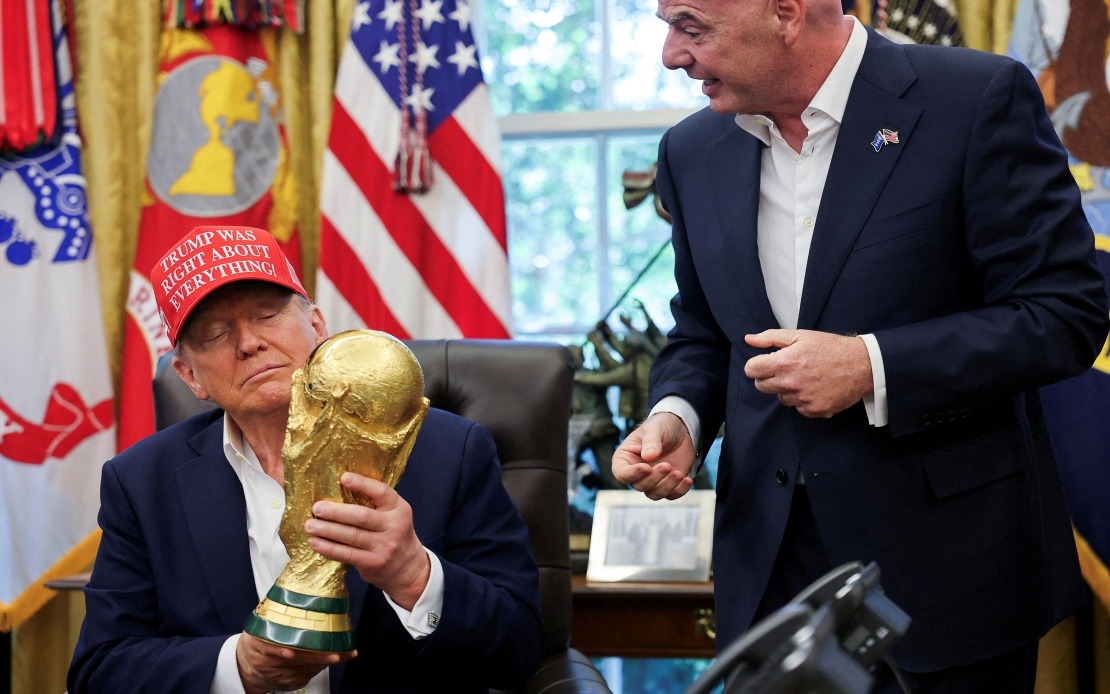
US President Donald Trump sought to ease tensions with Spain on Sunday, publicly declaring that he maintains cordial relations with Prime Minister Pedro Sanchez despite having imposed a sweeping trade ban on the European nation just weeks earlier. The president made his conciliatory statement to reporters in Istanbul following Spain's 1-0 World Cup final victory against Argentina, signalling a dramatic reversal in tone from his earlier caustic criticism of Madrid.
Trump extended his congratulations to Spanish officials, characterising their football team as exceptional and describing the World Cup final itself as both "exciting" and "a great event." When questioned about his reaction to Argentina's defeat, the American leader brushed aside suggestions that he felt disappointed, instead offering measured praise for Spain's performance. He acknowledged that while the Iberian nation had ultimately "played better," the match had remained closely contested throughout, presenting a more measured assessment than his previous inflammatory rhetoric.
The shift represents a striking departure from Trump's scathing condemnation of Spain delivered just days earlier at a NATO summit in Ankara, Türkiye. At that gathering, Trump had levelled blistering attacks against Madrid, denouncing the country as a "wasted cause" and a "terrible partner in NATO." His grievances centred on Spain's refusal to grant American military forces unfettered access to Spanish military installations during the Iran conflict, and Madrid's unwillingness to commit to the NATO defence spending target of five per cent of gross domestic product.
The severity of Trump's earlier position became evident when he issued a comprehensive directive to cut off all commercial relations with Spain, including suspension of official visits. His language had been particularly harsh, instructing aides to sever diplomatic engagement entirely and characterising Spain as a nation of "hopeless, bad people." This represented one of the most aggressive stances Trump had adopted toward a fellow NATO member, suggesting a genuine breakdown in the bilateral relationship at that moment.
Such dramatic reversals in diplomatic posture are not uncommon in international relations, particularly when personal or celebratory events provide opportunities for de-escalation. The World Cup final victory gave Trump an opening to reset the narrative without appearing to capitulate on underlying policy disagreements. By praising Spain's sporting achievement, he could demonstrate magnanimity while potentially laying groundwork for future negotiations on defence spending and base access arrangements.
For Malaysia and other Southeast Asian nations observing US-European relations, these oscillations carry practical implications. American reliability as a strategic partner depends partly on consistency in diplomatic engagement. When a major power rapidly reverses course on substantial issues like military base access and defence spending commitments, it raises questions about the predictability of its foreign policy positions. Regional powers must account for volatility when calibrating their own diplomatic strategies.
Spain's position within NATO and its relationship with Washington reflects broader tensions within the Atlantic alliance regarding burden-sharing and strategic priorities. The alliance has repeatedly pressured member states to increase defence expenditure, with many falling short of commitments. Spain's reluctance to meet the five per cent target, combined with restrictions on American military movements within its territory, challenges Washington's vision for alliance cohesion and operational flexibility.
The dispute also highlights competing visions of European strategic autonomy. Spain and other European NATO members increasingly assert independent foreign policy prerogatives, particularly regarding engagement with Middle Eastern conflicts. This occasionally creates friction with American objectives, as Madrid's cautious approach to Iran policy demonstrates. The tension between European preferences for diplomatic solutions and American emphasis on military deterrence continues to generate friction within the alliance.
From a Malaysian perspective, the unpredictability Trump demonstrates in managing ally relationships carries lessons for regional states navigating great power competition. Smaller nations require stable frameworks for engagement with major powers; sudden policy reversals create uncertainty and complicate long-term strategic planning. The incident suggests that relationships even between established allies can be subject to dramatic shifts based on rhetoric and symbolic gestures rather than substantive policy shifts.
The World Cup final incident also demonstrates how non-political events can provide convenient moments for diplomatic recalibration. Sports victories offer neutral ground where leaders can express cordiality without explicitly retreating from previously stated positions. Trump's approach allowed him to appear gracious while deferring concrete decisions about trade resumption or military cooperation to future negotiations. This pattern of using symbolic gestures to manage international relations reflects broader patterns in contemporary diplomacy.
Whether Trump's Sunday conciliatory remarks foreshadow genuine rapprochement or merely represent tactical positioning remains uncertain. The underlying disputes over defence spending and military base access persist regardless of friendly statements about football matches. Spain and the United States will ultimately need to resolve these substantive disagreements through formal diplomatic channels, not through comments made during sporting events.
For the international community, including regional organisations like ASEAN, the lesson is clear: even mature, institutionalised relationships between major powers can prove volatile and subject to rapid reinterpretation. Nations seeking stable partnerships must build relationships that transcend personality-driven diplomacy and rest instead on clearly defined mutual interests and formalised agreements that prove resilient to political changes and rhetorical fluctuations.

