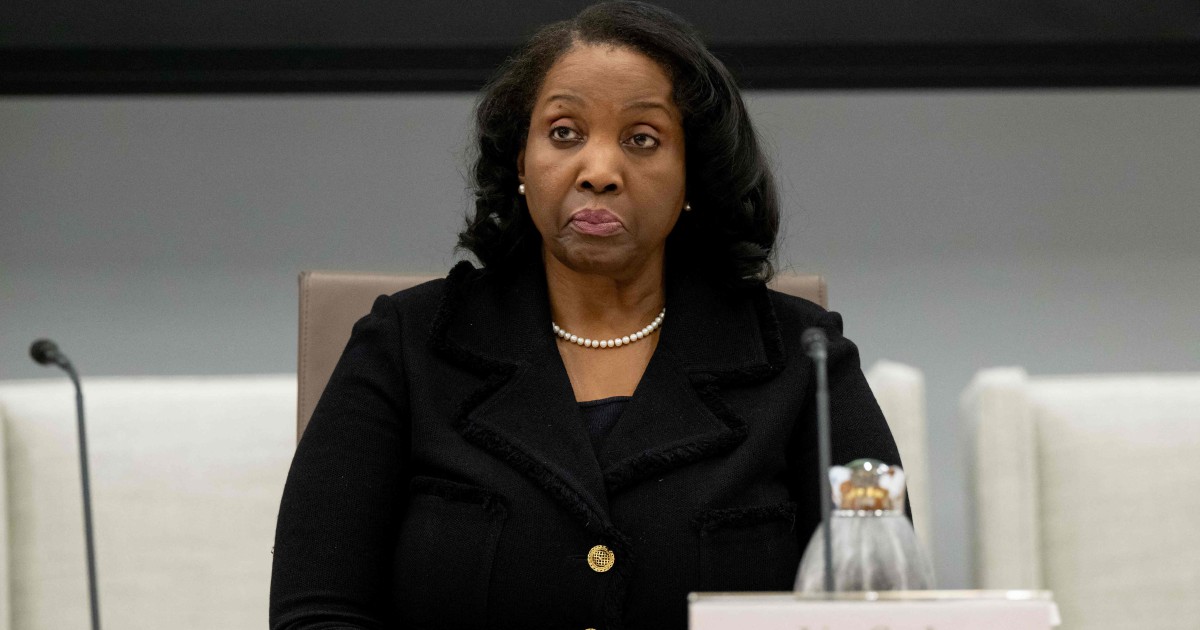
US President Donald Trump is pressing ahead with plans to oust Federal Reserve Governor Lisa Cook over allegations connected to mortgage fraud, signalling a renewed confrontation with the central bank's leadership. White House correspondence reviewed by international media outlets on Friday revealed the administration's determination to pursue the removal despite a significant legal reversal in June, when the Supreme Court rejected an earlier attempt to dismiss Cook from her position.
The Trump administration's persistence in challenging Cook's tenure underscores deepening tensions between the executive branch and the Federal Reserve, an institution traditionally insulated from direct political interference. Cook, an economist and voting member of the Federal Reserve's policy-making committee, has become the focus of controversy following the emergence of allegations related to mortgage fraud connected to her personal financial dealings.
The Supreme Court's June decision represented a major blow to Trump's initial removal strategy, yet the White House's continued pursuit indicates the administration believes alternative legal pathways or procedural mechanisms remain viable. This renewed offensive suggests the Trump team has recalibrated its approach, likely consulting new legal arguments or administrative procedures to circumvent the earlier judicial obstacle. The targeting of Cook reflects the broader Trump administration philosophy of exerting greater executive control over regulatory bodies and independent agencies.
Federal Reserve governors typically serve fourteen-year terms and cannot be easily removed from office, a structural safeguard designed to insulate monetary policy from electoral cycles and short-term political pressures. The high threshold for removal—generally requiring a showing of cause deemed serious enough to warrant termination—has historically made it an exceptionally rare occurrence. Trump's aggressive pursuit of Cook's removal therefore represents an extraordinary intervention in the central bank's autonomy, testing the limits of presidential power over monetary policymakers.
For Malaysian and Southeast Asian observers, the implications extend beyond internal US governance dynamics. The Federal Reserve's decision-making substantially influences global interest rates, currency valuations, and capital flows throughout the region. Political pressure on Federal Reserve governors that affects their judgment or independence could theoretically shift the trajectory of monetary policy in ways that ripple across emerging market economies, including Malaysia. Regional central banks closely monitor Federal Reserve signals when setting their own policy rates and managing exchange rate considerations.
The allegations against Cook specifically relate to mortgage fraud circumstances, though details remain subject to ongoing legal and administrative examination. These claims have provided the Trump administration with a substantive rationale—beyond mere policy disagreement—for pursuing removal, distinguishing this effort from naked political disagreement with her positions on interest rates or banking regulation. However, critics argue that weaponising criminal allegations for political purposes fundamentally undermines the independence that makes central banking effective across different administrations.
Cook's background as an academic economist with expertise in labour economics and monetary policy brings a particular perspective to Federal Reserve deliberations. Her presence on the board reflects efforts to incorporate diverse economic viewpoints into rate-setting decisions. The potential removal of any governor creates intellectual representation concerns and raises questions about which voices get heard during consequential policy debates affecting employment, inflation, and financial stability.
The White House's renewed initiative comes amid broader Republican messaging about Federal Reserve accountability and questions about the institution's independence. Proponents of executive oversight argue that unelected officials wielding vast economic power should face higher scrutiny. Critics counter that the independence principle exists precisely because short-term political calculations often conflict with sound long-term economic stewardship, and that politicising the Federal Reserve ultimately damages economic credibility and effectiveness.
The legal terrain for Cook's removal remains uncertain following the Supreme Court's June decision. The administration must now navigate revised procedural requirements, potentially demonstrating cause through administrative hearings or revised legal arguments that satisfy constitutional and statutory provisions governing Federal Reserve governance. The outcome will likely establish precedent for future executive attempts to influence central bank personnel decisions.
From an international perspective, sustained political attacks on Federal Reserve leadership create uncertainty about the consistency and independence of American monetary policy, potentially affecting how trading partners and investors view dollar-denominated assets and US economic stewardship. Central bank credibility depends substantially on perceptions of institutional autonomy, and visible political interference can gradually erode confidence in policy consistency.
The Cook removal effort also reflects deeper questions about institutional checks and balances in American governance. The Federal Reserve occupies a constitutionally ambiguous space—neither purely legislative nor executive nor judicial—operating under delegated authority that Congress granted decades ago. Determining appropriate boundaries for presidential influence over such entities remains contested, with legitimate competing perspectives about democratic accountability versus operational independence.

