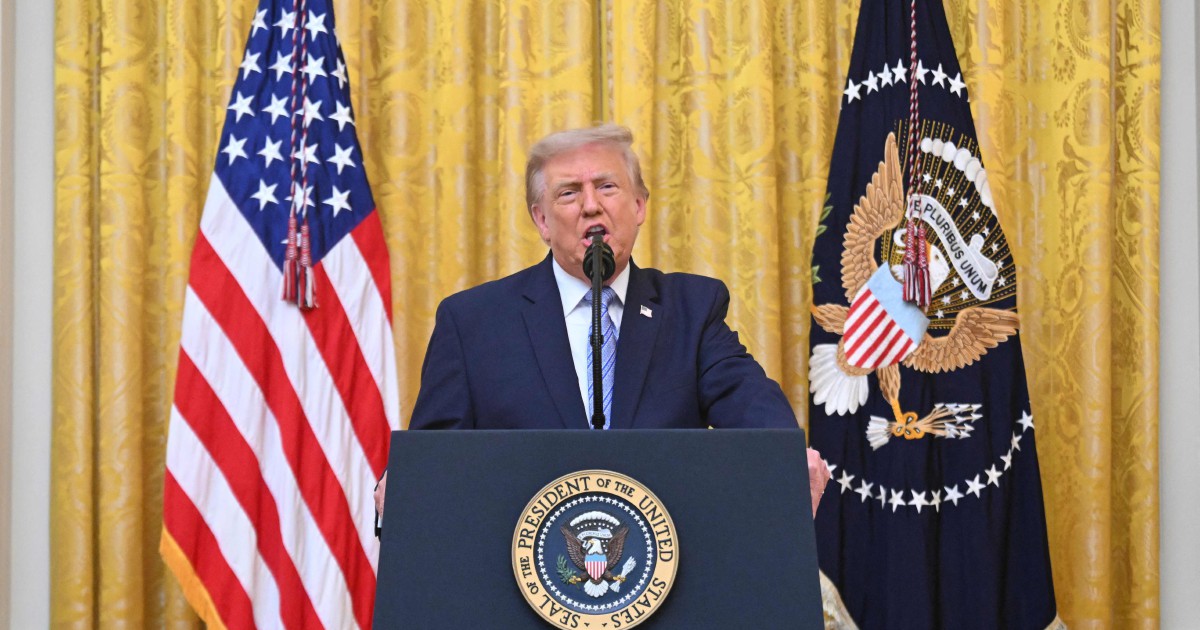
US President Donald Trump has resurrected a series of election-integrity claims that have already been rejected by courts, election officials, and independent fact-checkers, alleging during a Thursday address that foreign adversaries perpetrated systematic interference in the 2020 presidential race. His remarks renewed focus on narratives that have been extensively investigated and found to lack credible evidence, yet continue to circulate within certain political circles and among his supporters.
The President specifically charged that China orchestrated the theft of millions of American voter files during the 2020 contest, an assertion for which no substantive proof has emerged despite multiple inquiries. Alongside this claim, Trump suggested that Venezuela possessed the technical capability to manipulate American voting machines, a proposition that election security experts and government agencies have characterised as implausible given the decentralised nature of US voting systems. These allegations represent a continuation of rhetoric that has defined Trump's discourse around the 2020 election outcome for more than three years.
For Malaysian and Southeast Asian observers, these developments underscore broader global concerns about election integrity and foreign interference in democratic processes. Nations across the region, including Malaysia, have grappled with their own challenges around misinformation, electoral fraud allegations, and foreign influence operations. The persistence of unproven election claims in a mature democracy like the United States raises important questions about how democracies globally must fortify institutional defences against both genuine interference threats and unfounded but widespread false narratives.
Courts across the American legal system, including judges appointed by Republican administrations, have dismissed dozens of lawsuits challenging the 2020 election result. These judicial determinations were grounded in a careful examination of evidence presented by Trump's legal team. The Trump campaign ultimately produced no credible documentation establishing either Chinese theft of voter data or Venezuelan manipulation of voting infrastructure. Election officials from both parties, along with Trump's own Department of Homeland Security officials, certified that the 2020 election was secure and fraud-free.
The reemergence of these claims carries particular significance given their circulation across social media platforms and conservative news outlets, where they resonate powerfully among portions of the American electorate. Research into information behaviour suggests that repeated exposure to false claims, even when debunked, can entrench belief in those falsehoods among receptive audiences. This dynamic has consequences not merely for domestic American politics but for global perceptions of democratic resilience and institutional credibility.
Election security professionals have long maintained that American voting systems possess robust safeguards precisely because they operate through decentralised, mostly paper-based mechanisms that resist large-scale digital manipulation. Each state manages its own elections, and in many jurisdictions, voters mark paper ballots that serve as the official record. This architectural approach represents a deliberate safeguard against the type of centralised control that foreign manipulation would require. Experts have noted that compromising American elections would demand coordination across multiple states and local jurisdictions, a feat of extraordinary complexity that remains theoretically implausible.
Venezuela's technical capacity to interfere with American voting systems deserves particular scrutiny. The country faces severe economic and technological constraints that would render a sophisticated cyberattack against American infrastructure extraordinarily difficult. Moreover, no credible intelligence has surfaced demonstrating Venezuelan involvement in American electoral interference. The inclusion of Venezuela in Trump's allegations appears to draw from broader geopolitical tensions between the US government and the Maduro administration, rather than from concrete evidence of electoral interference.
China's alleged theft of voter files presents a similarly murky claim. While Chinese espionage operations targeting American government and private sector databases have genuinely occurred, no evidence has linked such activities to stolen voter records or interference in the election itself. The conflation of general cybersecurity threats with specific election fraud represents a characteristic feature of these narratives—drawing connections between real geopolitical dangers and invented electoral scenarios.
The durability of these claims despite overwhelming institutional rejection illuminates a troubling feature of contemporary political discourse in democracies worldwide. In Malaysia and other Southeast Asian nations experiencing their own debates over electoral integrity, the American example demonstrates how resistant false narratives can prove to factual correction and institutional authority. The challenge facing democracies involves not merely preventing genuine fraud but also constructing social and informational environments where false claims lack credibility, a task proving far more difficult than initially appreciated.
Trump's Thursday remarks occurred within a political context where election integrity remains a contested issue among portions of the American electorate. Polls consistently demonstrate that substantial numbers of Republicans express doubt about the 2020 election's legitimacy, despite the absence of evidence supporting such concerns. This erosion of confidence in electoral institutions, whether justified or not, carries consequences for democratic participation and social cohesion. As democracies globally confront similar challenges—from voter confidence to foreign interference to misinformation—the American experience offers cautionary lessons about the fragility of consensus around democratic procedures.
Moving forward, election officials, courts, and news organisations will likely continue confronting these same claims. The repetition of debunked allegations, particularly by a former and current president, complicates efforts by authoritative institutions to establish shared facts. For observers in Malaysia and across Southeast Asia, the American trajectory underscores the importance of protecting institutional integrity, maintaining public confidence in electoral processes, and cultivating media literacy sufficient to distinguish credible information from baseless conspiracy theories.

