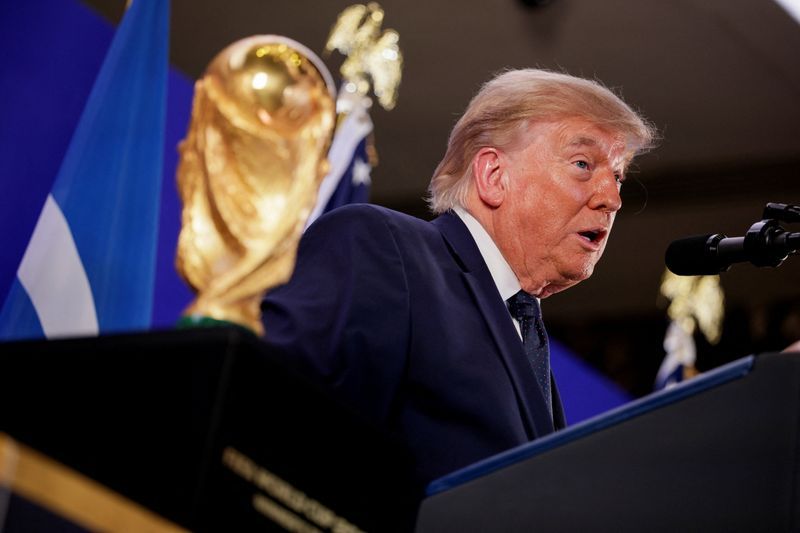
Donald Trump is set to make another high-profile appearance at the World Cup final on Sunday between Argentina and Spain in New York/New Jersey, cementing his influence over one of global sport's biggest events. FIFA President Gianni Infantino has invited the U.S. President to sit alongside him during the match and present the trophy to the winners, a role Trump previously filled at the Club World Cup. The invitation underscores the unusually close relationship between the American leader and football's governing body, a partnership that has defined much of this tournament's narrative beyond the pitch.
Trump's prominent position at the final comes just days after he publicly disclosed that he had petitioned Infantino to overturn a red card issued to U.S. striker Folarin Balogun, an admission that ignited widespread criticism over fair play and the integrity of football's officiating processes. The revelation placed FIFA in an uncomfortable spotlight, forcing the organisation to issue statements insisting that Trump exerted no influence over the eventual decision to suspend Balogun's ban. This controversy has become one of the defining moments of the tournament, raising uncomfortable questions about political interference in sport at the highest level and whether hosting privileges carry undue influence.
The relationship between Trump and Infantino reached a new crescendo at a lavish reception held Friday in Trump Tower in Manhattan, where FIFA opened an office last year. Before approximately 300 guests, including Brazilian football legend Ronaldo and various FIFA dignitaries, Infantino publicly praised Trump's role in ensuring the tournament's success. The FIFA chief declared that the World Cup would not have achieved such remarkable heights without Trump's involvement, comments that appeared to cement a partnership built over frequent White House visits and shared promotional ambitions. Trump reciprocated the praise, remarking that the United States had proven itself to be genuinely passionate about soccer, a statement that glossed over decades of relative indifference toward the sport in American popular culture.
The tournament itself has shattered attendance records in what organisers describe as its biggest iteration to date, a success that Trump has repeatedly claimed credit for facilitating. The United States, co-hosting alongside Canada and Mexico, has hosted matches across major cities and drawn international audiences at unprecedented levels. Yet this sporting triumph has been overshadowed by controversy surrounding Trump's immigration policies and travel restrictions affecting several nations. A year before the tournament commenced, American cities grappled with serious concerns about reassuring international fans wary of entering the country given the political climate and existing travel bans that had affected Muslim-majority nations.
Trump's involvement extended beyond diplomatic niceties to include threats to relocate matches away from Democratic-controlled cities, a move FIFA promptly rejected by clarifying that such decisions remained exclusively within the governing body's purview. The political undercurrents flowing through the tournament reflected broader tensions within American society, with sports serving as an arena where these divisions became increasingly visible. On Friday, Trump suggested that if the United States were to host the tournament again, it should do so without including Mexico and Canada, a comment that struck many observers as dismissive of the collaborative framework that FIFA had established for the current edition.
Trump's calculated pursuit of high-visibility sporting moments over the past eighteen months reflects a broader strategic effort to access venues where his core supporters congregate. His approval ratings during his second presidential term have faced persistent headwinds, prompting the administration to seek platforms offering maximum exposure and friendly audiences. His appearance at the Ryder Cup in New York last year generated the roaring ovations he sought, with American golf fans providing the enthusiastic reception that reinforced his connection with affluent, predominantly Republican sports audiences. These carefully orchestrated appearances represent an attempt to rehabilitate his public image among sympathetic constituencies whilst maintaining the spotlight he has long cultivated.
However, his reception at other sporting venues has proven decidedly more mixed. At Game 3 of the NBA Finals last month, Trump encountered sustained booing from the crowd, a stark reminder that his presence at major sporting events remains deeply polarising. Similarly, his attendance at last year's U.S. Open men's tennis final at Flushing Meadows caused significant disruption, with international spectators delayed entry well into the match due to presidential security protocols. These experiences illustrate the challenges facing broadcasters and event organisers attempting to navigate the complexities of Trump's participation in high-profile sporting occasions without alienating portions of their audiences.
Fox Sports, the American broadcaster for Sunday's final, faces particular challenges in managing Trump's presence at the event. The network relies upon a world feed for match coverage, meaning that editorial decisions about camera placement and on-screen time remain partially outside their control. Play-by-play announcer John Strong acknowledged this dilemma, noting that the broadcaster cannot determine whether television coverage will cut away to Trump sitting alongside Infantino during the match, nor can they predict when such moments might occur. This uncertainty reflects broader complications arising from Trump's politicised presence within a sporting context designed for global consumption.
The polarisation surrounding Trump's appearance at the final encapsulates a fundamental challenge facing international sports governance in an increasingly divided geopolitical landscape. Strong observed that Trump generates no neutral reactions among viewers; segments of the American audience anticipate his presence with enthusiasm, whilst others regard it with resignation or frustration. This bifurcation mirrors wider fault lines within American society and internationally, where Trump functions as a lightning rod for competing visions of nationalism, immigration, and global engagement. The World Cup, traditionally conceived as a unifying global spectacle, has become entangled with these contentious political dynamics.
Looking beyond Sunday's final, Trump's ambitions for American football appear oriented toward securing hosting rights for the 2038 World Cup, a goal that his cultivation of FIFA leadership directly serves. The award of the current tournament to the United States, Canada, and Mexico during Trump's first presidential term in 2018 represented a significant diplomatic achievement that he continues to leverage. By positioning himself as indispensable to FIFA's commercial and operational success, Trump has effectively inserted himself into the organisation's future planning processes. Whether FIFA will entrust the 2038 tournament to the United States again, and whether Trump's continued political prominence will influence that decision, remains an open question that reflects the increasing entanglement of global sport with domestic political considerations.

