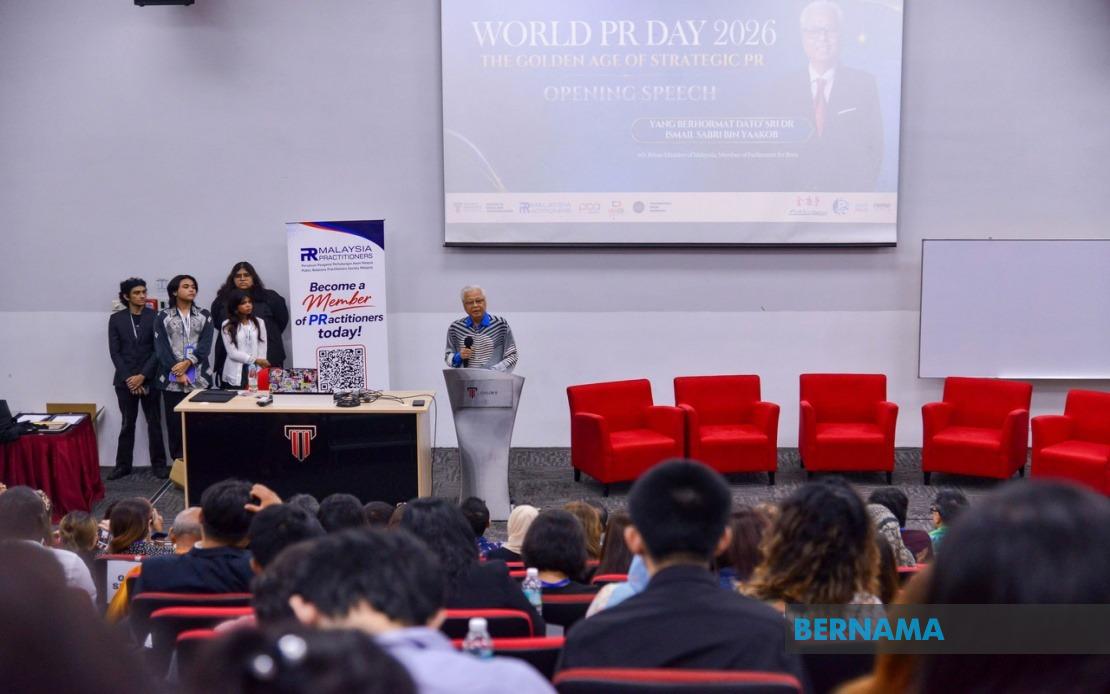
Integrity and transparent communication have become the most valuable assets for organisations navigating the modern business landscape, according to former Prime Minister Datuk Seri Dr Ismail Sabri Yaakob, who made the remarks while launching the World PR Day 2026 celebration at Taylor's University in Subang Jaya on July 16. Speaking to journalists after the event, he argued that contemporary challenges extend beyond conventional economic rivalry, emphasising instead that institutions now succeed or fail based on their capacity to establish genuine trust through credible and honest messaging.
The measurement of organisational success has fundamentally shifted in recent years. Where companies and institutions once gauged their standing primarily through financial results and operational metrics, the contemporary benchmark now incorporates a far broader assessment of reputational health. According to Ismail Sabri, an organisation's true value emerges from how it communicates during both periods of triumph and times of difficulty. This distinction becomes crucial when public scrutiny intensifies during crises or controversies, moments when stakeholders demand clarity and authenticity from leadership.
Ismail Sabri drew a stark generational comparison to illustrate the magnitude of this transformation. He contended that if the twentieth century represented an era defined by economic competition among nations and corporations, the twenty-first century has inaugurated a fundamentally different competitive landscape centred on trust. Unlike economic contests that are measured in production volumes or market share, trust competition operates through the quality and consistency of communication across digital platforms where millions of interconnected individuals consume information instantaneously. Without a foundation of integrity underpinning every message, organisations face rapid erosion of credibility.
The public relations profession itself has undergone profound metamorphosis, he observed. Practitioners have moved beyond their traditional function as mere information distributors, roles that dominated earlier decades. Today's PR specialists operate as strategic architects, actively shaping how organisations and their leaders are perceived and understood by the public. This expanded remit demands not only communication expertise but also deep understanding of brand psychology, crisis management, and narrative construction in an environment where perceptions crystallise within hours of an event occurring.
Drawing on his tenure as Prime Minister during the COVID-19 pandemic, Ismail Sabri provided concrete illustration of communication's power. The pandemic forced unprecedented daily interaction between government leadership and media, with new restrictions and procedures requiring constant explanation to a confused and anxious public. He underscored that this period revealed communication as far more than bureaucratic necessity—it became a critical tool for policy implementation. Without skillful explanation of why restrictions existed and how they protected public health, even well-designed policies could falter as populations grew sceptical or resistant. The experience crystallised his conviction that transparent, consistent messaging directly determines whether government initiatives succeed or collapse under public doubt.
However, Ismail Sabri acknowledged that the same digital connectivity enabling rapid information spread simultaneously amplifies the dangers of misinformation. He called on PR professionals to develop sophisticated competency with artificial intelligence systems, particularly tools that rapidly analyse public sentiment and emerging social media trends. This technological capability has become essential for understanding how messages resonate across diverse population segments. Yet he warned that such technological adoption must remain anchored to fundamental human values and ethical principles. Deploying AI simply to manipulate perception without regard for truthfulness would ultimately undermine the trust that organisations seek to build.
The proliferation of digital threats presents perhaps the greatest challenge to trust-building communication in the current era. Fake news, deliberately altered content, deepfake videos, and the sheer overwhelming volume of competing information have created an environment where ordinary citizens struggle to distinguish reliable facts from sophisticated fabrications. This problem extends beyond entertainment or minor misinformation—deliberate disinformation campaigns now threaten political stability, public health decisions, and social cohesion. The accessibility of content creation tools means that manipulative material can be produced cheaply and distributed globally within minutes, outpacing fact-checking efforts.
Recognising these escalating risks, Ismail Sabri voiced strong support for the Malaysian government's initiative to develop an AI Governance Bill designed to establish clear ethical standards and accountability mechanisms for artificial intelligence deployment. Such legislation becomes increasingly urgent as AI capabilities advance and applications multiply. The bill specifically aims to address digital misconduct, establish boundaries around AI misuse, and create consequences for those weaponising technology to spread falsehoods or manipulate public opinion. For Malaysia and other Southeast Asian nations grappling with digital governance challenges, developing robust regulatory frameworks represents a pragmatic response to threats that technical solutions alone cannot adequately address.
The implications of Ismail Sabri's remarks resonate particularly strongly for Malaysian organisations and government institutions. As the nation develops its digital economy and businesses increasingly compete for consumer attention online, reputational management through authentic communication becomes strategically decisive. Multinational companies operating in Malaysia must demonstrate that their local operations adhere to integrity-based communication standards. Similarly, government agencies implementing public programmes must invest in clear, consistent messaging that builds public confidence rather than breeding suspicion. The COVID-19 experience demonstrated both the effectiveness and limitations of crisis communication—transparency accelerated public cooperation while contradictions or perceived evasiveness bred vaccine hesitancy and policy resistance.
For PR practitioners and corporate communications leaders across Southeast Asia, the message carries concrete professional implications. The traditional model of PR as spin or reputation repair has yielded to a more demanding paradigm requiring alignment of actions and words. Organisations cannot sustain trust through clever messaging alone if their actual conduct contradicts their stated values. This demands integration of PR expertise into strategic decision-making from the outset, rather than relegating communications to damage control. Companies must view their PR teams as ethical guardians who can alert leadership when proposed actions might damage long-term credibility, even if they generate short-term advantage.
The digital transformation also mandates that PR professionals develop genuine technical literacy around AI, data analytics, and algorithmic systems. Understanding how algorithms determine what information reaches different audience segments becomes as important as understanding traditional media relations. Yet this technical sophistication must serve human values rather than replace them. The most effective communicators will be those who leverage technological capabilities to understand stakeholder concerns more deeply, respond more quickly to emerging issues, and craft more resonant messages—all in service of honest, value-aligned narratives rather than manipulation.
As organisations worldwide confront unprecedented challenges around disinformation, polarisation, and institutional trust deficits, Ismail Sabri's emphasis on integrity-grounded communication offers both a philosophical framework and practical imperative. The transition from economic competition to trust competition represents not merely a change in marketing strategy but a fundamental reordering of how organisations create sustainable value. In Malaysia and throughout Southeast Asia, institutions that master this transition—combining authentic communication, ethical AI deployment, and consistent alignment between words and actions—will build the durable stakeholder relationships necessary to thrive in an increasingly digital, sceptical, and interconnected world.

