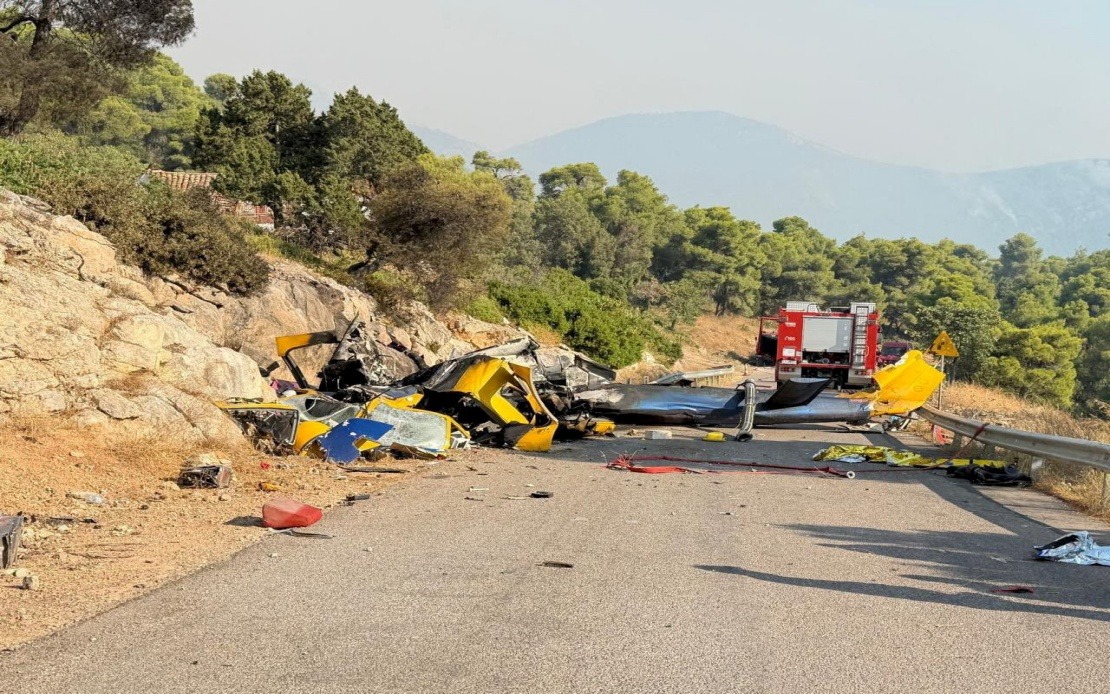
Greece suffered a tragic setback in its battle against devastating wildfires when two firefighting helicopters collided in mid-air on Sunday near the coastal town of Psatha in western Attica, killing two crew members and leaving two others injured. The fatal incident unfolded as the nation grappled with multiple large-scale fires spreading rapidly across the region, compounding already stretched emergency response capabilities.
Fire Service spokesperson Vassilis Vathrakogiannis announced at a press conference that a Danish pilot and a Greek firefighting coordinator had perished in the accident. The two survivors included a British pilot and another Greek firefighting coordinator, with one of the survivors sustaining injuries from the impact. Each helicopter carried a crew of two personnel, meaning all four occupants were directly affected by the collision, though the circumstances surrounding the exact moment of impact remain under active investigation.
The two Bell helicopters were operating as rental aircraft specifically contracted to support Greece's aerial firefighting operations against the expansive wildfire consuming large portions of Attica and the neighbouring Boeotia region. These helicopters represented critical resources in the country's firefighting arsenal, capable of delivering water and fire retardant to areas inaccessible by ground crews. The loss of both aircraft simultaneously represents a significant operational setback for Greek emergency services already stretched thin by the scope of the crisis.
Authorities have launched a comprehensive investigation into the collision, though preliminary findings have not yet been released to the public. The helicopters crashed in the vicinity of Psatha, a coastal area, triggering an immediate search and rescue operation that successfully located and assisted the survivors. Greek officials have stated that determining the precise cause and circumstances of the mid-air encounter will require detailed analysis of flight data, radio communications, and eyewitness accounts from ground personnel monitoring the firefighting operations.
The tragedy highlights the inherent risks faced by aviation personnel engaged in emergency response operations, particularly in challenging environmental conditions. Firefighting helicopter crews operate under extreme pressure, often flying in low visibility, turbulent air conditions created by intense heat, and complex terrain that demands precise coordination between multiple aircraft. The incident raises critical questions about spacing protocols, communication systems, and weather conditions that existed at the moment of collision.
Greece's wildfire crisis has intensified dramatically in recent weeks as the Mediterranean nation contends with prolonged heat waves, critically dry conditions, and strong winds that accelerate fire spread across the landscape. These meteorological factors create a perfect storm for rapid fire propagation, transforming contained incidents into raging blazes that consume thousands of hectares within hours. The combination of environmental stress and operational urgency places extraordinary demands on emergency personnel and equipment.
The broader context of Greece's wildfire emergency extends beyond immediate operational challenges to encompass long-term climate and environmental concerns affecting the entire Mediterranean region. Rising temperatures and changing precipitation patterns have extended the wildfire season and intensified the severity of individual fires, trends that threaten not only Greece but also countries throughout Southeast Europe and the Mediterranean basin. For Malaysia and other Southeast Asian nations, the Greek experience offers cautionary lessons about preparing for increasingly extreme weather events and their cascading effects on emergency services infrastructure.
The incident serves as a sobering reminder of the human cost associated with environmental disasters and the sacrifices made by emergency responders. The Danish pilot and Greek coordinator who lost their lives were performing essential work to protect communities and infrastructure from advancing flames. Their deaths underscore the necessity for continued investment in aviation safety protocols, crew training, and technological systems designed to prevent such tragedies during high-stress emergency operations.
Greece's response to this accident will likely include enhanced investigation protocols and potential review of aerial firefighting coordination procedures currently in use. The European Union and international aviation safety bodies may examine whether lessons from this collision should be incorporated into regional emergency response frameworks. For countries in Southeast Asia experiencing their own wildfire challenges, particularly during monsoon transitions and drought periods, the Greek experience provides valuable insights into the integration of aerial resources within broader emergency management systems.
Looking ahead, the loss of both helicopters compounds Greece's firefighting resource shortage during a critical period of active wildfire operations. The temporary reduction in aerial capacity may necessitate reallocation of remaining resources, potentially prioritizing certain threatened areas over others and creating difficult strategic decisions about resource deployment. Insurance and contractual issues surrounding the destroyed helicopters may also delay replacement and redeployment of similar aircraft to Greek firefighting operations.

