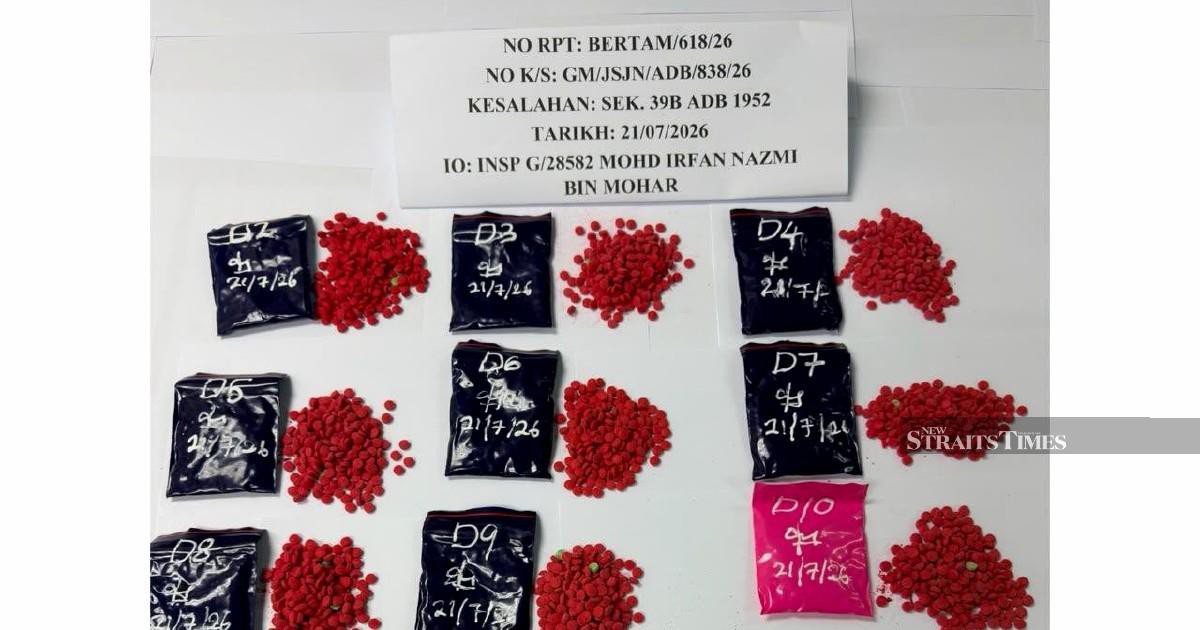
Drug enforcement authorities in Gua Musang have apprehended two Myanmar nationals in a dramatic roadside interception, recovering a substantial cache of 6,000 yaba pills estimated to be worth approximately RM60,000. The arrest underscores the persistent challenge of stimulant drug trafficking through Malaysia's northern corridors, where transnational criminal networks continue to exploit porous supply routes connecting the Golden Triangle region to domestic and regional markets.
The operation unfolded when police initiated a pursuit of the suspects' vehicle, culminating in their capture and the seizure of the contraband. This development reflects intensified enforcement efforts by the authorities, who recognise the escalating threat posed by methamphetamine-based tablets flowing from Myanmar and Thailand into Malaysian territory. Yaba, commonly known as "crazy medicine," has become a significant public health concern across Southeast Asia, particularly among younger demographics susceptible to addiction.
Gua Musang's location in Kelantan positions it as a critical juncture in the region's drug trafficking infrastructure. The district sits along major transportation arteries connecting Thailand and Myanmar to Peninsular Malaysia, making it a natural chokepoint for law enforcement and simultaneously an attractive conduit for smugglers. The seizure represents one of numerous interceptions documented in recent months, indicating both the volume of illicit substances attempting entry and the dedication of narcotics units to disrupting these flows.
The valuation of RM60,000 reflects the street-level retail economics of methamphetamine distribution in Malaysia, where individual yaba tablets command prices ranging from RM10 to RM15 depending on location and purity. This pricing structure makes the drug particularly attractive to traffickers seeking high-profit ventures with relatively modest upfront capital investment. The Myanmar connection remains central to understanding yaba availability within Malaysia, as the vast majority of seized specimens originate from clandestine laboratories operating in border regions controlled or tolerated by armed groups seeking revenue generation.
Myanmar's ongoing internal conflicts and limited state capacity in remote areas have transformed portions of the country into de facto narcotics production zones. The 2021 military coup further destabilised governance structures, allowing criminal enterprises to operate with minimal interference. Consequently, trafficking organisations have expanded production capabilities, with yaba emerging as a preferred export commodity owing to its high potency-to-weight ratio and substantial profit margins. Intelligence assessments suggest output from these facilities has multiplied over the past five years.
The pursuit methodology employed during this operation illustrates evolving police tactics in confronting mobile drug distribution networks. Rather than conducting static checkpoint operations, authorities increasingly employ dynamic enforcement incorporating vehicle tracking, predictive intelligence, and coordinated multi-agency responses. This approach reflects recognition that stationary border control measures alone prove insufficient against sophisticated smuggling operations utilising varying routes and concealment methods.
For Malaysian society, yaba prevalence poses multifaceted challenges extending beyond immediate public health concerns. Addiction cycles generate secondary consequences including criminal activity, fractured family structures, and strain on rehabilitation infrastructure already operating at capacity in several states. The Peninsular Malaysia drug rehabilitation landscape lacks adequate capacity for stimulant addiction treatment, with many facilities historically specialising in opioid management. The surge in yaba consumption thus requires resource reallocation and development of evidence-based interventions addressing methamphetamine's distinct neurobiological pathways.
Regional cooperation remains essential for addressing transnational yaba trafficking comprehensively. Malaysia's enforcement agencies maintain operational partnerships with Thai counterparts, particularly through the Thailand-Malaysia border security framework established under successive memoranda of understanding. However, Myanmar's fragmentary governance structure complicates collaborative efforts, as no unified authority exercises reliable control over production regions. Several drug trafficking organisations operating in Myanmar's border areas maintain independent relationships with regional military commanders, complicating international interdiction efforts and creating jurisdictional ambiguities.
The Gua Musang seizure contributes to documented trends showing consistent yaba transit through Malaysian territory toward Singapore and Brunei, where retail values escalate significantly due to market scarcity and enforcement severity. The relationship between Myanmar production capacity, Thai distribution networks, and Malaysian transit corridors forms an integrated ecosystem that national-level enforcement, absent coordinated regional intervention, struggles to disrupt effectively. Intelligence analysts suggest current enforcement efforts intercept perhaps 10-15 per cent of total flows, indicating the magnitude of ongoing trafficking.
Looking forward, Malaysian authorities face escalating pressure to enhance interdiction capacity while simultaneously strengthening demand-reduction programming. Recent initiatives emphasising community engagement and early intervention show promise but require sustained funding and political commitment. The Myanmar nationals' apprehension represents operational success at the tactical level, yet broader strategic challenges remain unresolved absent more comprehensive regional coordination and support for Myanmar's post-conflict state-building efforts that might eventually expand governmental control over production territories.

