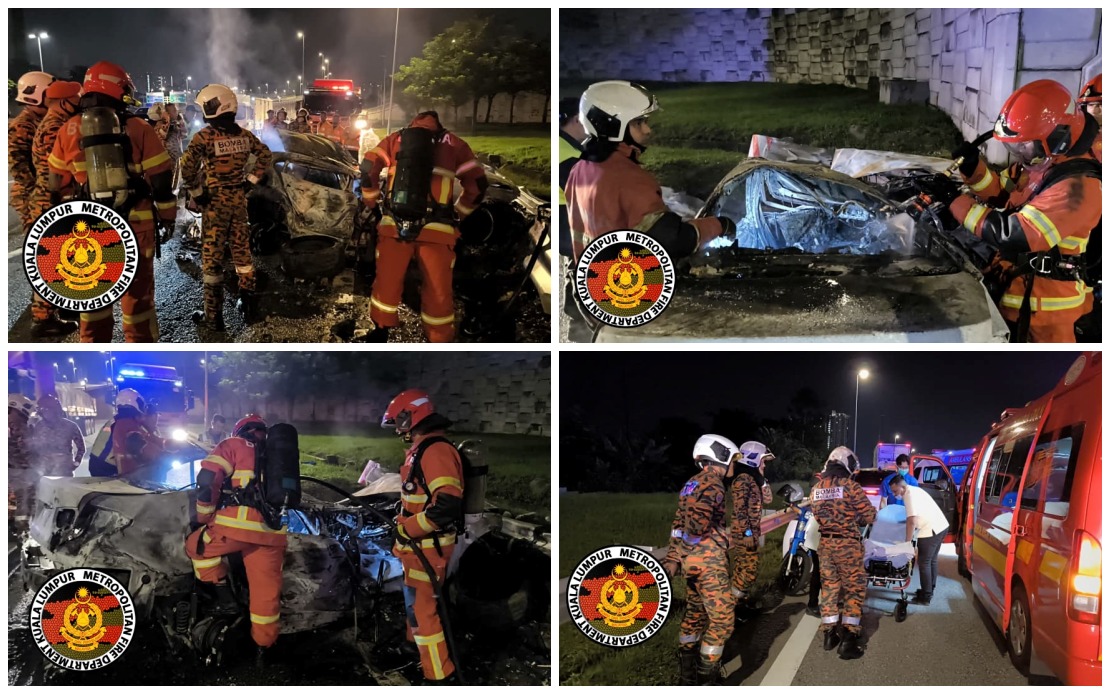
A tragic accident on the Duta-Ulu Kelang Expressway claimed the lives of two young Malaysian university students in the early hours of Thursday morning, when their vehicle caught fire following a loss of control near the Jalan Kuching exit ramp. The incident underscores continuing road safety concerns on major expressways serving the Klang Valley, where high speeds and heavy traffic patterns create hazardous conditions during peak and off-peak periods alike.
The BMW 328i Sport was traveling northbound from Jalan Duta toward Selayang when the driver, a 22-year-old enrolled at Queensland University of Technology in Australia, apparently exceeded safe speeds before the vehicle began to skid. The automobile struck the left-side road divider with sufficient force to trigger an immediate fire that engulfed the passenger compartment. According to ACP Mohd Zamzuri Mohd Isa, head of the Kuala Lumpur Traffic Investigation and Enforcement Department, both victims were unable to escape the burning wreckage and were pronounced dead at the scene.
The deceased front-seat passenger was identified as a 21-year-old student attending Sunway University in the Selangor metropolitan area. The identities of the victims have been established through preliminary investigation, though formal identification will rely on DNA analysis due to the severe burns sustained in the post-collision fire. Both young men were Malaysian nationals whose deaths have sent shockwaves through the university communities and families affected by this sudden loss.
A third occupant in the vehicle, a 20-year-old male student from Singapore, managed to exit the burning car and was transported to Kuala Lumpur Hospital for treatment of minor injuries sustained during the crash. The survivor's account is proving invaluable to investigators seeking to reconstruct the exact sequence of events leading to the accident. Traffic police have prioritized obtaining a detailed statement from the young man as they work to establish whether mechanical failure, driver error, adverse weather conditions, or other contributing factors played a role in the tragedy.
The Traffic Investigation and Enforcement Department has initiated a comprehensive investigative process that extends beyond the immediate scene. Officers are reviewing closed-circuit television recordings from nearby installations along the expressway corridor, which frequently capture traffic incidents and vehicle movements during critical moments. This footage may provide visual confirmation of the vehicle's speed, trajectory, and condition immediately before impact, offering objective evidence to supplement witness statements and physical evidence collected from the wreckage.
The case has been formally classified under Section 41(1) of the Road Transport Act 1987, which addresses fatal accidents and establishes the legal framework for thorough investigation and potential criminal proceedings. This provision is invoked in incidents where loss of life occurs in connection with vehicle operation on public roads, and it mandates comprehensive inquiry into causative factors and circumstances. The classification reflects the severity of the offense and the need for a rigorous examination of how and why the accident occurred.
Officers stationed at the scene have appealed for assistance from members of the public who may have witnessed the accident or possess dashcam recordings documenting the moments preceding the collision. Such visual evidence has increasingly become crucial in traffic investigations, as vehicle-mounted cameras frequently capture details invisible to human observers and provide an objective record of traffic conditions and driver behavior. Members of the public are encouraged to contact the Traffic Police Station at Jalan Tun H.S. Lee or any nearby station with relevant information.
This incident highlights persistent challenges surrounding expressway safety in Malaysia's rapidly expanding road network. The DUKE expressway, a vital arterial connection linking the northern suburbs to the city center and federal territories, carries substantial daily traffic volumes that create a complex environment where split-second driver errors can produce catastrophic consequences. Speed-related accidents remain a leading cause of fatalities on Malaysian expressways, particularly during evening and early morning hours when visibility diminishes and traffic patterns shift.
For students and their families, the tragedy serves as a sobering reminder of the importance of defensive driving practices and strict adherence to posted speed limits, regardless of time of day or apparent road conditions. University communities across Malaysia have increasingly focused on road safety awareness among student populations, recognizing that young drivers aged 18-25 face disproportionately high accident risks. The incident will likely prompt renewed discussions about driver education, vehicle safety features, and the consequences of traveling at excessive speeds on expressways designed for high-volume throughput rather than recreational driving.
The investigation into the DUKE crash will continue in coming days and weeks as forensic analysis of the vehicle wreckage proceeds and additional witness statements are collected. Traffic authorities will examine whether road design factors, signage clarity, or maintenance conditions contributed to the accident's severity. The outcomes of this investigation may inform future safety recommendations for expressway operators and guidelines for traffic management authorities tasked with protecting road users on Malaysia's expanding toll expressway network.

