Hanoi police have brought formal charges against two women involved in a major food smuggling operation that circumvented Vietnam's strict poultry import restrictions. The investigation, concluded on June 19, uncovered a sophisticated scheme to import frozen chicken feet from disease-affected countries under false pretences and distribute them illegally across Vietnamese markets, generating illicit profits worth more than VNĐ347 billion or approximately US$13 million.
The two accused are Nguyen Thi To Loan, 47, who directly managed ABF Food Import-Export JSC in Ninh Binh Province, and Trang Tuyet Ngoc, 45, an official with An Binh Group's assistant department. Both individuals have admitted to all charges levelled against them by investigators. The case highlights growing concerns about food supply chain integrity in Southeast Asia, where organised smuggling operations can undermine consumer safety and circumvent legitimate commercial channels.
Between 2023 and 2026, the operation imported 339 containers of frozen chicken feet into Vietnamese territory. The shipments originated from countries experiencing active poultry disease outbreaks, making them subject to strict regulatory frameworks designed to protect public health. Vietnamese customs regulations explicitly prohibit domestic sale of such products; they may only legally enter the country for processing and subsequent re-export to third nations. By falsifying documentation and declaring the shipments as goods destined solely for processing and re-export, the conspirators evaded these safeguards.
However, the chicken feet never left Vietnam. Instead, Loan orchestrated the diversion, instructing Ngoc to systematically distribute the frozen poultry throughout the domestic market. Over the three-year period, more than 10,000 metric tonnes were channelled to food service businesses—restaurants, catering companies, and wholesale distributors—across multiple provinces including Hanoi, Cao Bang, Ninh Binh, and Quang Ninh. This widespread distribution meant thousands of consumers unknowingly purchased and consumed products that should never have reached the domestic food supply.
The magnitude of the operation becomes apparent when examining the financial dimensions. The total declared value of imported goods exceeded VNĐ347 billion, yet authorities detected that no corresponding import duties had been paid. This additional dimension reveals how the smuggling scheme generated profits through dual mechanisms: avoiding legitimate taxation while capturing market share from licensed importers who complied with regulations and paid required levies.
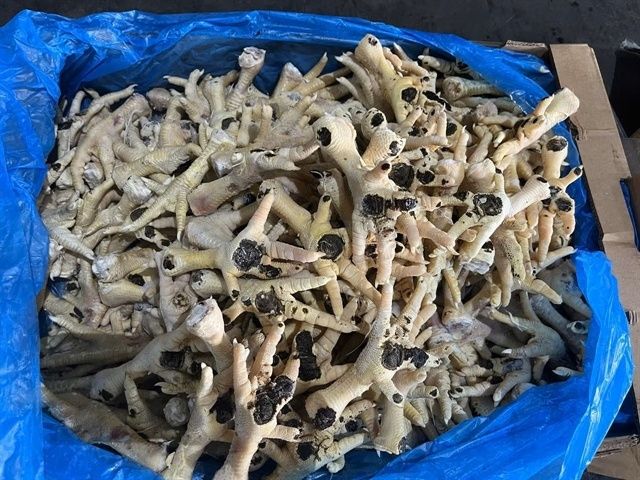
Police raids on cold-storage facilities connected to the operation exposed the true scale of the illegal distribution network. At the An Viet 2 freezer facility located within Hanoi's Quang Minh Industrial Zone, inspectors discovered over 1,000 metric tonnes of frozen chicken feet in storage. Critically, approximately 260 metric tonnes had already expired and displayed visible contamination—mouldy surfaces and foul odours—yet the evidence suggests these degraded products were being staged for further distribution to unsuspecting buyers. This revelation raises serious questions about consumer health risks.
A second raid at THL cold-storage warehouse in Lang Son Province in northern Vietnam yielded an additional 1,030-plus metric tonnes of frozen chicken feet. Combined with the Hanoi facility findings, police recovered more than 2,000 metric tonnes during the enforcement operations. The discovery of such substantial quantities underscores the operation's sophisticated logistics capacity and suggests the conspiracy involved multiple warehousing locations, likely coordinated distribution schedules, and established commercial relationships with retailers and food service operators.
The presence of expired and contaminated products proves particularly troubling from a public health perspective. Chicken feet, typically destined for restaurants and food processing enterprises, are commonly used in broths, stews, and prepared dishes throughout Vietnamese and wider Southeast Asian cuisine. Distribution of degraded poultry products creates obvious risks of foodborne illness outbreaks. The authorities' discovery that mouldy products appeared staged for sale indicates an intentional disregard for consumer welfare and willingness to profit from health hazards.
Under Vietnamese law, both suspects face charges of smuggling pursuant to Article 188 of the 2015 Penal Code. The formal charges represent the culmination of investigative work but signal merely the opening phase of judicial proceedings. Vietnamese criminal procedures typically involve preliminary hearings, court reviews of evidence, and opportunities for the accused to mount legal defences, though both individuals have already confessed.
The investigation remains active and expanding in scope. Hanoi police are currently working to identify the broader network of co-conspirators—the drivers, warehouse operators, retailers, and food service businesses that participated knowingly or negligently in distributing smuggled goods. Authorities are also examining the roles of various organisations that may have facilitated or benefited from the scheme. This ongoing phase suggests additional arrests and charges may follow as investigators trace the commercial networks that enabled such large-scale distribution.
This case carries significant implications for food safety governance throughout Southeast Asia. Vietnam, like most regional nations, maintains strict quarantine regulations on poultry products from disease-affected countries as core pandemic prevention and food security policy. The sophisticated nature of this smuggling operation—involving false documentation, multiple storage sites, and established distribution channels—reveals vulnerabilities in enforcement capacity. Malaysian importers and food safety officials should note that regional smuggling networks capable of moving tens of thousands of tonnes across borders pose direct risks to neighbouring countries' food supplies if not effectively intercepted at entry points.
The operation's success in evading detection for three years underscores the importance of strengthened customs coordination, intelligence-sharing between nations, and enhanced cold-chain monitoring systems across Southeast Asia. The substantial financial rewards—over US$13 million—create powerful incentives for organised criminal networks to develop sophisticated schemes circumventing poultry restrictions. Effective response requires not only prosecuting individual offenders but systematically dismantling the commercial infrastructure that makes such operations profitable.