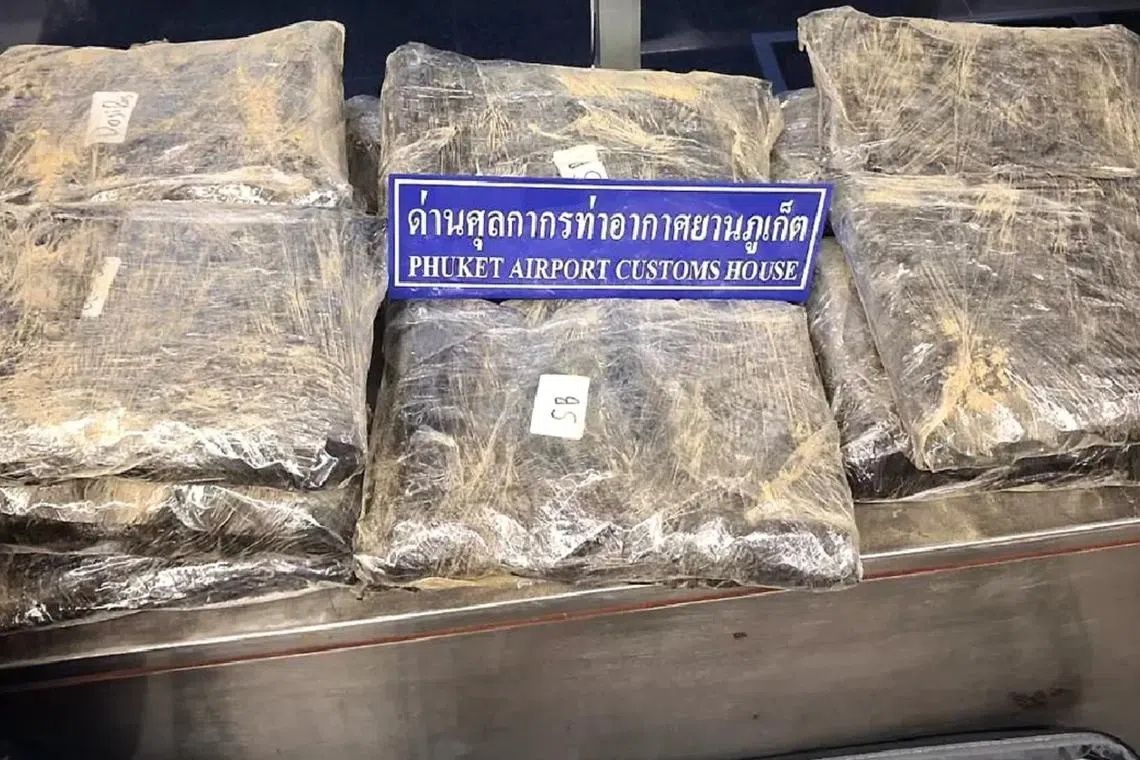
Authorities at Phuket International Airport have arrested two women in separate incidents on the same day after discovering approximately 32 kilograms of cannabis concealed in their checked baggage. The operations, carried out by officers from Phuket Airport Customs House working alongside Sakhu Police Station personnel within the international departures terminal, represent the latest enforcement action against drug smuggling attempts through Thailand's busiest regional airport.
The first suspect, 18-year-old Filipino national Levannah Chelsea Guzman, was detained at approximately 11am after customs staff inspected her black Pierre Cardin wheeled suitcase. Inside the luggage, inspectors discovered 14 vacuum-sealed packages containing cannabis flowers, collectively weighing 14.5 kilograms including packaging materials. The initial questioning revealed that Guzman claimed ownership of both the suitcase and its entire contents, according to official statements from the customs authorities.
Less than two hours later, officers conducting routine baggage screening identified a second suspicious case belonging to Thai national Penpitcha Phutsiang. The green Swish Navy wheeled suitcase held 16 vacuum-sealed packages of cannabis flowers with a combined weight of 17.6 kilograms. Phutsiang similarly acknowledged that the suitcase and all seized items belonged to her during initial questioning at the airport.
Both women face multiple charges reflecting Thailand's comprehensive approach to narcotics enforcement. The primary allegations centre on attempting to transport goods across international borders without completing mandatory customs procedures, a violation of the Customs Act BE 2560 (2017). Additionally, prosecutors are pursuing charges under the Narcotics Code, which carries significantly harsher penalties for drug-related offences. The legal framework has expanded to include violations of the Protection and Promotion of Traditional Thai Medicine Wisdom Act BE 2542 (1999), alongside breaches of the Public Health Ministry's notification on controlled herbs concerning cannabis, updated as recently as 2025.
The timing of these arrests reflects intensified scrutiny of cannabis trafficking routes through Southeast Asia's major transportation nodes. Thailand's cannabis regulations have undergone substantial revision in recent years, with the government imposing stricter controls on the cultivation, possession, and transportation of cannabis flowers—distinguishing them from extracts and oils that face different regulatory treatment. This distinction has become crucial for customs enforcement, as dried flowers represent the most commonly smuggled form due to their volume relative to potency.
For Malaysian readers, these incidents carry particular significance given the proximity of Phuket to Malaysian borders and the interconnected nature of regional travel patterns. The airport serves as a major transit hub not only for Thai citizens but also for visitors and residents from neighbouring countries, including Malaysia. The cannabis seizures demonstrate that enforcement agencies across the region are collaborating more effectively to monitor cross-border movements, a development with implications for Malaysia's own border security and drug interdiction policies.
The cases also underscore the vulnerability of young people to involvement in international drug smuggling networks. The apprehension of an 18-year-old suggests that trafficking operations may target younger individuals who may lack awareness of severe legal consequences or who may be coerced through financial incentives. This pattern has been observed across Southeast Asia, where criminal syndicates exploit economic disparities and information gaps to recruit couriers for high-risk operations.
Thailand's approach to cannabis enforcement presents a complex picture for the broader region. While some neighbouring countries have begun exploring medical cannabis frameworks, Thailand maintains robust criminal penalties for trafficking and attempted exportation. The specificity of charges—ranging from customs violations to narcotics offences to violations of traditional medicine legislation—reflects a layered legal strategy designed to maximise prosecution options and sentencing severity. For defendants facing such multiple charges, the cumulative penalties can exceed those available under single offence frameworks.
The arrest cases also highlight the practical effectiveness of enhanced screening procedures at major airports. The successful detection of both smuggling attempts within hours of each other suggests that customs personnel have refined their identification techniques, possibly through increased training, improved detection equipment, or better intelligence sharing among agencies. Such improvements have direct relevance for Malaysian airports, which similarly process large volumes of international departures and arrivals daily.
From a regional perspective, these arrests contribute to growing evidence of cannabis trafficking networks operating throughout Southeast Asia. Unlike harder drugs such as methamphetamine or heroin, which have well-established trafficking routes and criminal infrastructure, cannabis smuggling patterns remain relatively fluid and less predictable. This characteristic makes detection more challenging and suggests that law enforcement agencies must continuously adapt their strategies to address evolving smuggling methods and transit routes.
Both suspects have been transferred to Sakhu Police Station for continued investigation and preparation for legal proceedings. The case files will determine whether additional charges emerge, particularly if evidence suggests involvement with larger trafficking organisations or if the women provide information about supply sources or intended destinations. Such intelligence becomes valuable for authorities attempting to dismantle the networks facilitating international cannabis movements.
Looking forward, the Phuket arrests exemplify the ongoing tension between evolving global attitudes toward cannabis and Southeast Asia's commitment to stringent drug control regimes. While some jurisdictions liberalise cannabis policy, Thailand and most of its regional neighbours maintain prohibition-focused enforcement. This divergence creates opportunities for trafficking organisations to exploit policy differences and movement corridors between jurisdictions with different regulatory frameworks.

