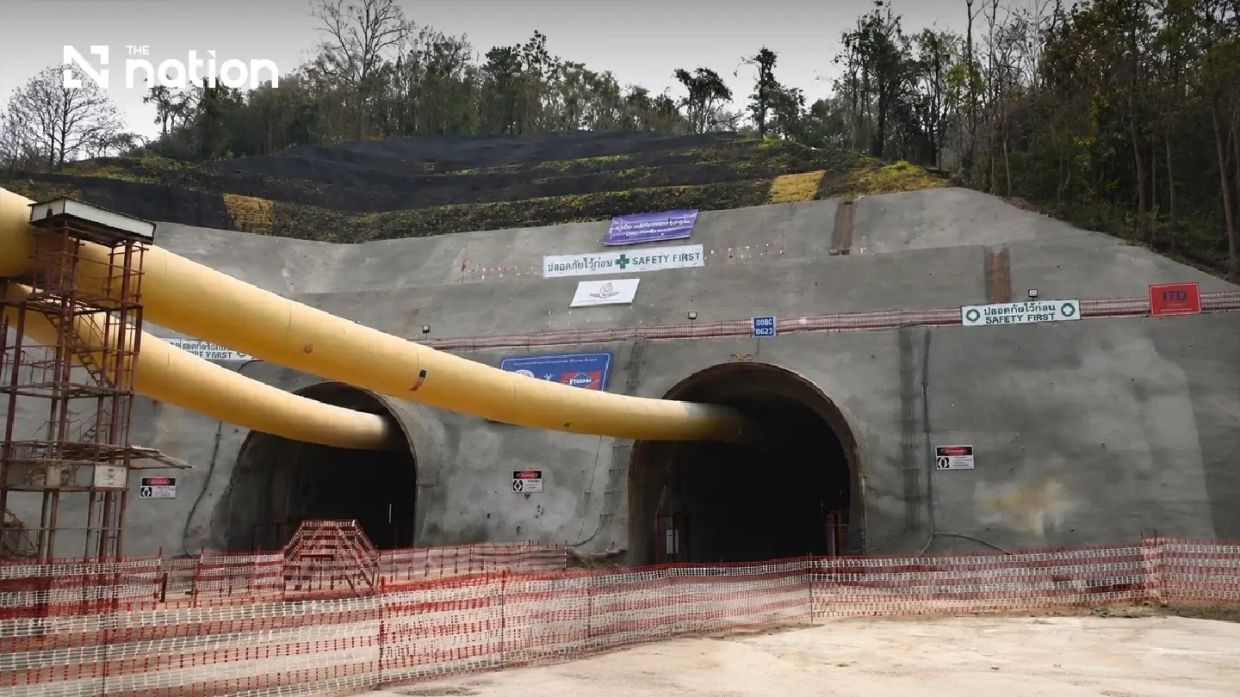
A catastrophic scaffolding failure deep within a northern Thailand tunnel has claimed two construction workers' lives and injured seven others, marking another safety setback for the ambitious Den Chai-Chiang Rai-Chiang Khong railway project. The incident unfolded on Saturday evening at the Doi Luang tunnel site in Chiang Saen district, where crews were undertaking specialized waterproofing installation work. Emergency responders attended the scene after receiving reports at 8:35 pm, transporting all casualties to hospital facilities immediately.
Deputy Transport Minister Siripong Angkasakulkiat disclosed that preliminary findings indicate rocks dislodging from the tunnel's interior walls likely triggered the collapse, a critical detail that suggests geological instability rather than purely structural failure. Initial accounts had pointed to complications within the shotcrete application phase, though investigators continue examining the sequence of events that led to the accident. The specificity of these observations remains important for understanding what went wrong, as different failure mechanisms require distinct remedial approaches across similar construction environments throughout Southeast Asia's expanding rail infrastructure.
The casualty toll comprised two deaths, three workers sustaining serious injuries, and four others with minor injuries. All individuals received hospital treatment, with the severity distribution suggesting the collapse affected workers across multiple sections of the work site simultaneously. The incident's impact extended beyond immediate human cost, forcing authorities to seal the accident zone pending comprehensive safety evaluation and investigation completion.
Responding to the crisis, Siripong confirmed that project authorities had secured the affected area and established controlled conditions to prevent further incidents. The safety management team assumed direct control of operations at the tunnel site, implementing enhanced monitoring protocols while technical experts commenced detailed investigation procedures. The deputy minister indicated that the Transport Ministry would release subsequent findings as investigations progressed, establishing a framework for transparency that regional stakeholders would monitor closely given the project's significance.
The Doi Luang tunnel represents a major engineering component of the broader rail development initiative spanning northern Thailand. At 3.4 kilometres in length, the tunnel has already achieved breakthrough status—meaning excavation is complete—and the project now focuses on finishing interior systems and safety installations. This construction phase, involving waterproofing and other specialized work, presents distinct hazards that differ substantially from initial excavation operations, particularly in confined underground environments where worker safety requires meticulous coordination.
This tunnel forms part of Contract 3 of the Chiang Rai-Chiang Khong segment, a 19.385 billion baht undertaking representing one of the railway line's major construction packages. The contract encompasses approximately 87 kilometres of track work across both elevated and ground-level sections, development of three full railway stations and three additional halts, comprehensive signalling and telecommunications infrastructure, plus the critical tunnel systems. The scope of these works highlights the project's complexity and the multiple hazard environments where construction workers operate daily.
The CKST-DC3 Joint Venture holds primary responsibility for executing Contract 3, bringing together three significant construction entities: CH. Karnchang Public Company Limited, Sino-Thai Engineering & Construction Public Company Limited, and Chiangmai Construction Co., Ltd. This consortium structure, common in large Thai infrastructure projects, distributes both responsibility and resources across experienced contractors, though such arrangements occasionally complicate accountability during incidents requiring swift investigation and corrective action.
The Den Chai-Chiang Rai-Chiang Khong railway line represents Thailand's continuing expansion of regional connectivity, linking production areas across the northern provinces while facilitating both freight movement and passenger services. For Malaysia and broader Southeast Asian observers, such developments underscore the competitive infrastructure race advancing across the region, with implications for cross-border connectivity and regional trade patterns. Thailand's railway modernization directly influences transportation corridors affecting neighbouring countries' economic prospects.
Construction fatalities within Thailand's railway sector, while individually tragic, reflect broader workplace safety challenges endemic to rapid infrastructure development across Southeast Asia. Tunnel and underground work presents compounded risks due to confined spaces, geological variables, and the specialization demanded of workers operating in such environments. Malaysia's own substantial rail expansion initiatives must extract lessons from incidents like this Chiang Rai collapse, particularly as Malaysian contractors increasingly participate in regional megaprojects requiring management of multiple complex hazard environments simultaneously.
The incident assumes additional significance given Thailand's high-profile positioning of the Den Chai-Chiang Rai-Chiang Khong railway as a flagship regional connectivity scheme. Delays stemming from safety investigations and potential contract modifications inevitably ripple through broader regional planning assumptions, particularly concerning freight corridors and international transport corridors that depend on Thai infrastructure development completing on schedule. For Malaysian businesses and government bodies engaged with Thai rail initiatives, this accident reinforces critical importance of rigorous site safety management and comprehensive worker protection standards.
Official investigations will necessarily examine whether current safety protocols adequately addressed the specific risks posed by tunnel waterproofing operations in this geological context. The answers will inform not only this project's immediate corrective measures but potentially establish benchmarks affecting how similar underground railway construction proceeds throughout Thailand and the wider region. The preliminary findings regarding rock falls from tunnel walls suggest that geological survey and support design may warrant reconsideration, considerations that extend far beyond the immediate Chiang Rai situation.

%22%2F%3E%3C%2Fpattern%3E%3C%2Fdefs%3E%3Crect%20width%3D%22100%25%22%20height%3D%22100%25%22%20fill%3D%22url(%23phy36tg)%22%2F%3E%3Crect%20width%3D%22100%25%22%20height%3D%22100%25%22%20fill%3D%22url(%23phy36tp)%22%2F%3E%3Ctext%20x%3D%2250%25%22%20y%3D%2250%25%22%20text-anchor%3D%22middle%22%20dominant-baseline%3D%22central%22%20fill%3D%22rgba(255%2C255%2C255%2C0.95)%22%20font-family%3D%22Georgia%2C%20'Times%20New%20Roman'%2C%20serif%22%20font-weight%3D%22700%22%20font-size%3D%22226%22%20letter-spacing%3D%22-0.02em%22%3EPenang%3C%2Ftext%3E%3C%2Fsvg%3E)