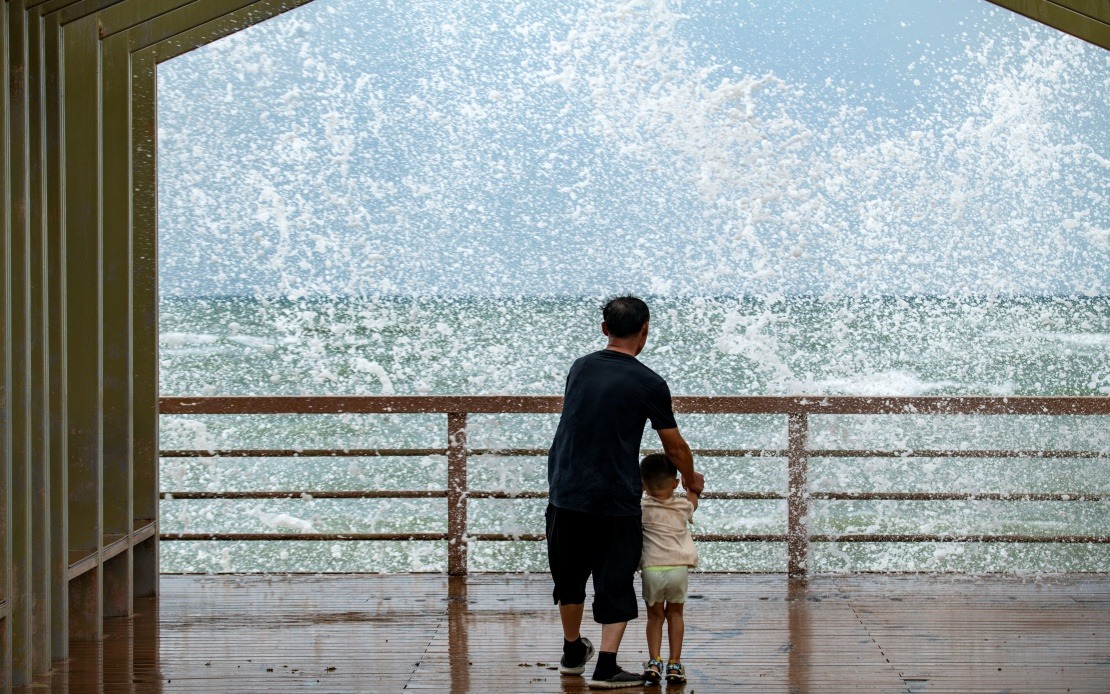
Hainan Province endured the arrival of Typhoon Maysak on Friday evening as the 10th tropical cyclone of the year made its push inland along the southern Chinese coast, triggering a cascade of service disruptions that left the island's transport infrastructure largely paralysed. The storm arrived at approximately 6.20 pm, crossing ashore in Yelin Township within Lingshui Li Autonomous County, bringing maximum sustained winds measured at 23 metres per second at its centre, according to data released by the provincial meteorological bureau.
The typhoon's impact reverberated immediately across Hainan's interconnected transport systems. Railway authorities took the precautionary step of halting all train services connecting the island to the mainland for both Friday and Saturday, effectively isolating the province by rail for a complete two-day period. The suspension reflected concerns that track conditions and bridge stability could be compromised by the storm's intensity and the heavy precipitation expected to accompany its passage.
Air travel ground to a standstill as Sanya Phoenix International Airport, the province's primary aviation hub and gateway for tourists and business travellers, ceased flight operations from 5 pm on Friday. This suspension left thousands of passengers stranded and forced airlines to reschedule hundreds of connections. The airport authority provided no immediate timeline for resuming normal operations, indicating that decisions would depend on real-time weather monitoring throughout the weekend.
Maritime transport suffered equally severe disruptions. The critical Qiongzhou Strait ferry service, which connects Hainan to the mainland and handles both passenger and vehicle traffic, suspended all operations from 2 am on Friday. Authorities warned that the shutdown would persist for one to two days as officials waited for sea conditions to stabilise and wind speeds to diminish to safe operating levels. This suspension proved particularly consequential for the many commuters and commercial vehicles that rely on the strait's daily crossings.
Beyond transport, local authorities issued precautionary school and childcare facility closures in Sanya and Ledong Li Autonomous County, sending students home and disrupting family routines as parents scrambled to arrange supervision. These closures underscored the meteorological bureau's assessment that conditions posed genuine safety risks to public gatherings, particularly for vulnerable populations.
Meteorological forecasts indicated that Typhoon Maysak would continue its trajectory toward the northwest, traversing through Baoting, Wuzhishan, Baisha and Danzhou before ultimately crossing into the Beibu Gulf. This projected path suggested that several inland counties would experience the storm's core effects over the subsequent 24 to 36 hours, prolonging the disruption beyond coastal areas into the provincial interior.
For regional observers in Southeast Asia, Hainan's experience with Maysak serves as a timely reminder of the typhoon season's intensity and the vulnerability of modern transport infrastructure to tropical cyclones. Malaysia's own east coast and Sabah and Sarawak regions face comparable seasonal risks, making the operational responses adopted by Hainan authorities instructive. The rapid suspension of all three transport modes—rail, air and sea—demonstrates a precautionary approach that prioritises passenger safety over continuity, a standard increasingly adopted across the region.
The economic implications of a two-day transport shutdown extend beyond immediate passenger inconvenience. Supply chains servicing the manufacturing and tourism sectors face disruptions, and businesses dependent on just-in-time logistics must absorb unexpected costs. Hotels in Sanya, already operating under post-pandemic recovery constraints, confront cancellations and reduced occupancy as travellers reschedule visits.
Hainan's status as a major international tourism destination and a cornerstone of China's economic integration with Southeast Asia amplifies the knock-on effects beyond the province itself. Investors and traders throughout the region tracking Hainan's recovery patterns and transport reliability will note the disruption when assessing operational risks in the broader area.
The province's response mechanism also reflects advances in meteorological forecasting and emergency coordination. By activating precautionary measures well in advance of peak storm intensity, authorities aimed to minimise casualties and injuries, a standard that has become embedded in disaster management protocols across coastal Asia in recent years.
As Typhoon Maysak progressed inland, focus shifted toward recovery timelines. Rail authorities would require several hours to inspect track integrity and signalling systems before declaring lines safe for traffic. Airport crews would need to verify runway conditions and equipment functionality. Ferry operators would monitor wind speeds and sea state forecasts before permitting vessels to resume crossings. Each sector operated independently yet coordinated through provincial emergency management channels to ensure a phased restoration rather than a chaotic scramble to resume services prematurely.
For Malaysian readers and businesses with exposure to Hainan or broader South China operations, the episode underscores the importance of maintaining flexible contingency arrangements during typhoon season. Supply chain resilience, employee safety protocols and customer communication strategies all warrant regular review, particularly as climate patterns potentially intensify extreme weather frequency. Typhoon Maysak's arrival thus served as both immediate operational challenge and longer-term strategic signal for those monitoring regional risks.

