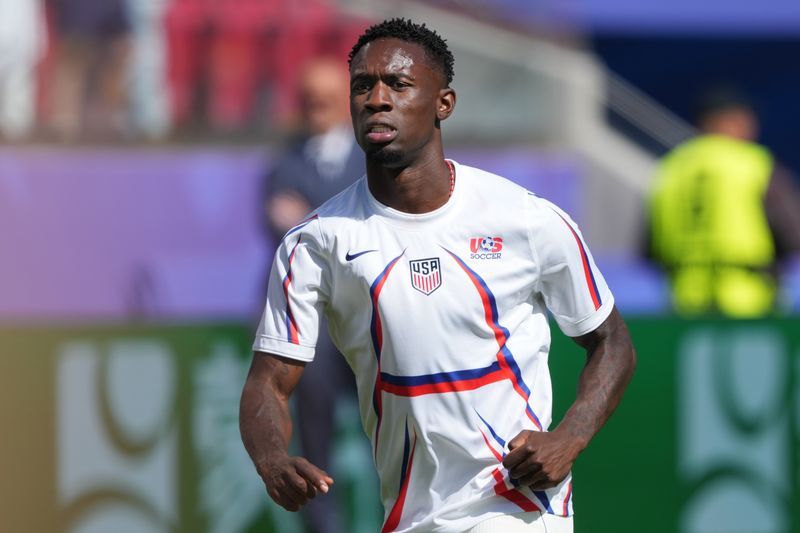
European football's governing body UEFA has delivered a withering condemnation of FIFA's controversial handling of a disciplinary case involving U.S. national team striker Folarin Balogun, accusing world soccer's governing body of crossing a fundamental line in the sand and compromising the sport's foundational credibility. The rebuke comes after FIFA opted to suspend implementation of Balogun's red card suspension for one year rather than enforce it immediately, following what sources indicate was direct intervention by U.S. President Donald Trump, who personally appealed to FIFA president Gianni Infantino to review the dismissal.
In a terse official statement released on Monday, UEFA expressed profound dismay at what it characterized as an "unprecedented, incomprehensible and unjustifiable decision," language that underscores the depth of European football's concern about the precedent being set. The organization's leadership stressed that when regulatory bodies fail to uphold the certainty and consistency of their own rulebooks, the entire scaffolding upon which competitive sport rests begins to crumble. This was not merely a disagreement over a single decision, UEFA suggested, but a fundamental challenge to whether the rules governing international football would continue to mean anything at all.
Balogun, who had contributed three goals to the U.S. tournament campaign, was sent off during a match against Bosnia following a VAR review that determined he had deliberately dragged his boot down the back of Bosnian defender Tarik Muharemovic's leg and onto his foot. The infraction, while notable, would normally have triggered an automatic suspension preventing the player from participating in the subsequent round of 16 encounter against Belgium. That suspended game was scheduled for Monday, making the timing of FIFA's intervention particularly striking to observers and rival nations.
Trump's direct lobbying of Infantino to reconsider the red card stands out as a rare instance of high-level political pressure on an international sporting decision. The U.S. President specifically requested that FIFA review the dismissal, effectively asking the global football body to overturn or mitigate a disciplinary ruling that had already been adjudicated through established protocols. FIFA's response—to suspend the ban for a probationary year while technically leaving the red card on record—represented a middle path that satisfied neither principle nor practical interest.
Belgium's football association, the Royal Belgian Football Association (RBFA), responded with its own statement of astonishment at FIFA's action. The organization subsequently lodged a formal appeal challenging the decision, The Athletic reported, signaling that nations beyond Europe viewed FIFA's handling as fundamentally compromised. The Belgian federation's move reflects growing concern that the disciplinary process, once considered sacrosanct, had become negotiable through political channels.
The unfolding dispute illuminates a critical tension within international sports governance: the vulnerability of regulatory independence when powerful nations bring diplomatic weight to bear on specific outcomes. FIFA's decision to suspend rather than enforce the ban creates an ambiguous middle ground that arguably satisfies no stakeholder except the beneficiary nation. For UEFA, the decision represents a troubling capitulation to external pressure that could fundamentally alter how disciplinary matters are handled across international competitions.
The incident also raises questions about whether FIFA's disciplinary framework possesses genuine autonomy or whether it remains subject to influence from major football nations. If political intervention can reshape outcomes after formal adjudication, the meaning of rules themselves becomes contingent rather than absolute. This calculus is particularly consequential in contexts where sporting outcomes carry substantial financial, political, and national prestige implications.
For Southeast Asian football observers, the broader implications warrant attention. The region's own football bodies often navigate complex relationships with FIFA and continental authorities, and developments affecting FIFA's credibility and independence directly influence how international football governance functions at all levels. Should political interference become normalized at the highest echelon of football administration, the principle of sporting meritocracy faces degradation.
UEFA's forceful response signals that European football intends to register this moment as a watershed, marking a line beyond which it believes FIFA has transgressed. The organization's language—unprecedented, incomprehensible, unjustifiable—deliberately avoids diplomatic softening, suggesting that UEFA views the matter not as a discretionary interpretation but as a fundamental breach of governance principles. Whether other confederations will escalate their protests or accept FIFA's decision remains an open question with potentially serious ramifications for the sport's institutional health.

