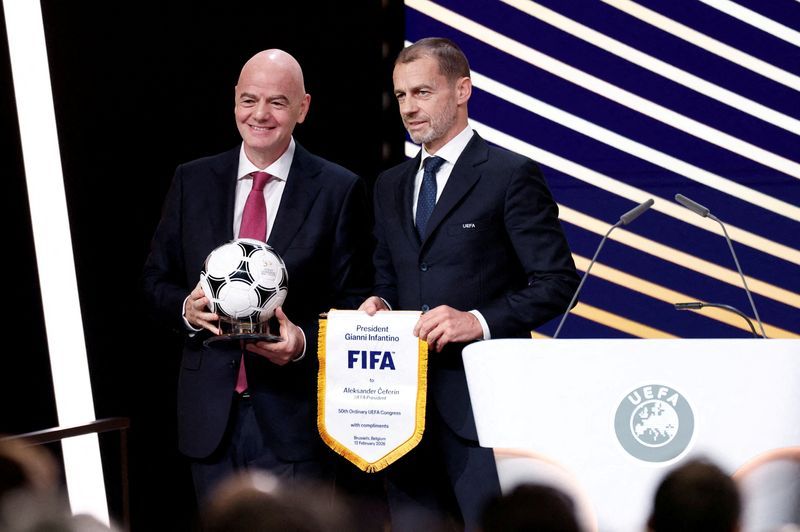
European football's governing body has moved to extract testimony and documents from FIFA's Florida-based entities through the US court system, laying the groundwork for a criminal complaint in Switzerland targeting FIFA President Gianni Infantino. The legal manoeuvre represents an escalation in the conflict that nearly fractured international football this month, and signals UEFA's determination to pursue accountability even after securing a temporary ceasefire with FIFA's leadership.
The central dispute concerns FIFA Forward Enterprise (FFE), a now-defunct proposal to transfer commercial rights tied to the men's and women's World Cups and Club World Cup into a subsidiary controlled by outside investors. UEFA alleges that Infantino orchestrated the scheme behind closed doors with a select coterie of advisers and investors, sidestepping FIFA's established governance structures and neglecting to consult the organisation's Council, regional confederations, or its 211 member associations. The plan surfaced publicly on 28 July before most football administrators had any awareness of its existence, triggering immediate and fierce opposition across the sport.
According to UEFA's court filing, external investors—led by Joshua Kushner through his Thrive Capital investment vehicle—were positioned to acquire a permanent financial stake in FIFA's commercial operations. The valuation placed the commercial rights portfolio at approximately $20 billion, with the investor group prepared to inject $4.2 billion. UEFA contends that this valuation substantially understated FIFA's actual commercial worth and bypassed transparent procedures such as competitive bidding or independent professional valuation. The lack of transparency and competitive process distinguishes this proposal from standard corporate transactions and amplifies concerns about fiduciary responsibility within world football's governing institution.
The threat posed by UEFA proved decisive. On 30 July, UEFA's 55 member associations unanimously voted to withdraw European teams from FIFA competitions—including the forthcoming World Cup—unless the FFE plan was scrapped entirely. The unprecedented show of unified resolve forced FIFA's hand within 24 hours. Infantino announced the proposal's abandonment on 31 July, acknowledging that despite its intended purpose of expanding development funding globally, the scheme had generated divisions contrary to football's interests. Yet this capitulation has not satisfied UEFA's leadership, which remains convinced that serious governance breaches occurred and must be examined through independent investigation and legal proceedings.
UEFA's pursuit of US court discovery procedures underscores the complexity and international dimensions of the dispute. By petitioning American courts for access to documents held by FIFA (AMERICAS), Inc. and FWC2026 US, Inc.—two FIFA subsidiaries registered in Florida—UEFA aims to gather evidence demonstrating how the FFE transaction was conceived, structured, valued, and provisionally approved. This jurisdictional strategy reflects the increasingly globalised nature of football governance disputes and the necessity of navigating multiple legal systems simultaneously. The Swiss criminal complaint will proceed on grounds of alleged mismanagement under Article 158 of the Swiss Criminal Code, making admissible evidence from foreign jurisdictions potentially crucial to establishing culpability.
Internal FIFA communications add another troubling dimension to UEFA's allegations. Staff members reportedly complained of being deliberately deceived about the proposal's scope and purpose, while FIFA Secretary General Mattias Grafstrom was apparently excluded from the drafting process entirely—an extraordinary breach of institutional protocol. These allegations suggest that the FFE scheme represented not merely a substantive policy disagreement but a deliberate circumvention of internal oversight mechanisms. The pattern of concealment and exclusion distinguishes this from legitimate policy discussions that face internal disagreement, instead suggesting intentional obstruction of normal scrutiny.
For Southeast Asian football stakeholders, this dispute carries significant implications. FIFA's governance structures and financial decisions directly affect the distribution of development resources to confederations across all continents. The FFE proposal's underlying premise—that FIFA's reserves prove insufficient for development funding—itself merits scrutiny, as the organisation currently maintains billions in reserves belonging collectively to member associations. Should external investors have acquired permanent equity stakes in FIFA's commercial operations, the incentive structures and decision-making processes governing world football would have fundamentally shifted toward maximising returns for private capital rather than optimising benefits for the global football community. Asian football confederations and associations would have faced a materially altered governance environment with potentially reduced influence over commercial strategy and revenue distribution.
Yet UEFA's provisional suspension of the planned World Cup boycott reflects diplomatic pragmatism. Having secured written guarantees that the FFE project has been irrevocably withdrawn, UEFA agreed to suspend—rather than permanently cancel—European teams' withdrawal threat pending the Under-20 Women's World Cup in Poland scheduled for September. This measured approach preserves UEFA's leverage while avoiding the catastrophic sporting disruption that a genuine boycott would have unleashed. Simultaneously, it demonstrates UEFA's confidence in the strength of its legal position and its commitment to pursuing accountability through formal procedures rather than relying solely on political pressure.
Nonetheless, UEFA has articulated clear expectations for reform. The confederation's member associations have unanimously authorised leadership to pursue every available institutional, political, and legal avenue to secure governance reforms and establish meaningful constraints on presidential authority. UEFA has explicitly called for a genuinely independent external review of the FFE proposal, arguing persuasively that FIFA cannot credibly investigate itself and expect the football community to accept conclusions emerging from internal processes. This demand reflects lessons learned from previous FIFA scandals, where institutional investigations consistently proved inadequate to public trust restoration.
Infantino's political position within FIFA remains substantially intact despite the humiliating reversal. The African and South American confederations have maintained their backing for his leadership, and the Saudi Arabian Football Federation issued a statement on Thursday expressing continued support for Infantino and FIFA's direction. This persistent support base means that while Infantino faces potential criminal prosecution in Switzerland, his position as FIFA President remains secure for the immediate term. However, UEFA has signalled that should Infantino seek election to a fourth presidential term in March 2027, the European confederation will mobilise its member associations to advance alternative candidates committed to institutional reform. This trajectory suggests that football's governance battle will persist irrespective of how the criminal proceedings conclude.
The broader significance of UEFA's legal manoeuvre extends beyond Infantino personally. The willingness to pursue international litigation, leverage US court mechanisms, and coordinate with multiple confederations toward unified reform objectives represents a shifting balance of power within FIFA's fractious political landscape. For decades, FIFA's President exercised formidable discretionary authority with minimal external constraints. UEFA's aggressive legal strategy and demonstrated capacity to marshal votes from 55 member associations for World Cup withdrawal demonstrates that presidential authority faces genuine limits when confederations coordinate effectively. This realignment carries implications for all continental confederations across Asia, Africa, South America, and Oceania, signalling that future FIFA leadership will operate within a more constrained governance environment characterised by enhanced confederal oversight and institutional accountability mechanisms.

