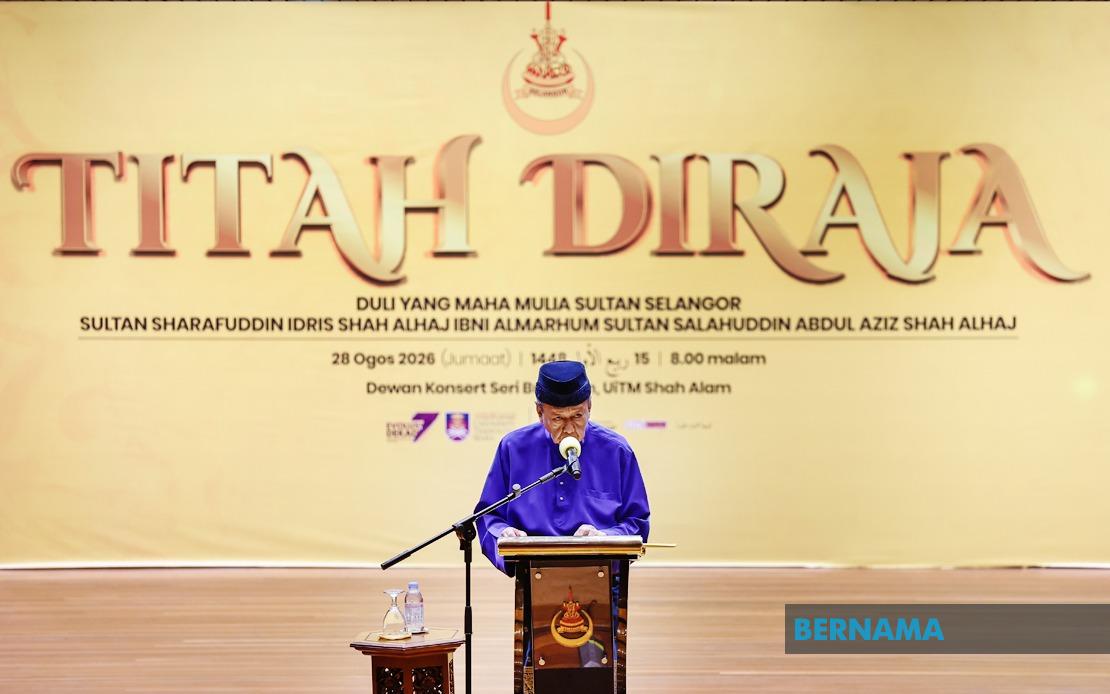
The Sultan of Selangor, Sultan Sharafuddin Idris Shah, has emphasized that Universiti Teknologi MARA must continue serving as a transformative pathway for Malay and Bumiputera youths from economically disadvantaged backgrounds and remote communities. Speaking at UiTM's 2026 Royal Address held at Dewan Konsert Seri Budiman in Shah Alam, His Royal Highness stressed that as the institution has expanded and modernized, it must not abandon the foundational mission that established it—providing educational opportunity to those who would otherwise struggle to access higher learning.
The Sultan's intervention carries particular weight given the ongoing national conversation about meritocracy, equity, and the role of public institutions in narrowing socioeconomic divides. His emphasis on maintaining accessibility for children of farmers, fishermen, factory workers, and families in rural poverty signals concern that UiTM's growth and evolution may inadvertently shift its character or student composition away from its original constituency. This is a substantive challenge: as universities modernize, expand their research profiles, and compete internationally, they frequently experience mission drift, with institutional prestige sometimes correlating with demographic shifts among the student body.
UiTM's historical trajectory underscores the magnitude of this transformation. When established in 1965 with merely 219 students and 11 faculty members, the institution was explicitly designed as an instrument of social mobility for a specific demographic. Within ten years, enrolment had surged to nearly 7,000 students and the faculty had grown to approximately 1,000, with the university offering around 60 academic programmes across multiple branch campuses. This rapid expansion demonstrated both the hunger for higher education among Bumiputera communities and the institution's capacity to respond at scale.
Today, UiTM has evolved into one of the nation's largest universities, graduating more than 40,000 students annually and boasting an alumni network exceeding one million individuals. This scale presents both opportunity and risk. While the numbers reflect extraordinary institutional success and the profound impact on Malaysian society, the sheer size creates potential for bureaucratic distance from the lived experiences of the economically marginalized students the university was founded to serve. The Sultan's address therefore functions partly as a reminder to institutional leadership about foundational values as the university navigates competitive pressures and resource constraints.
Central to the Sultan's message was a concrete proposal aimed at channeling the university's vast alumni network into sustainable support structures. He proposed that each graduate contribute RM10 monthly or RM100 annually to UiTM as an expression of gratitude and institutional loyalty. The Sultan characterized this sum as neither onerous nor beyond the means of most graduates, framing it as a meaningful sacrifice in service of the institution's continuity and progression. This is psychologically astute positioning: the contribution is framed not as taxation but as voluntary token, and not as cost but as acknowledgment of benefit received.
The financial implications are substantial. The Sultan projected that a graduated alumni contribution scheme could generate approximately RM100 million annually. For context, this represents a significant supplementary revenue stream that could dramatically expand the university's capacity to provide student financial aid, fund facility improvements, and expand academic offerings. In an environment of constrained public higher education funding, such mechanisms allow institutions to sustain their public missions while reducing dependency on government allocations. For Malaysian policymakers grappling with competing budgetary demands across healthcare, infrastructure, and defence, alternative funding models for public universities hold strategic importance.
Funding mechanisms, however, are merely instrumental to the Sultan's deeper argument about institutional purpose and social value. His Royal Highness articulated a vision of UiTM's success not measured solely by enrolment numbers, graduation rates, or research output—metrics by which modern universities are typically evaluated—but by the extent to which the institution transforms lives and contributes to national development. This philosophical stance challenges conventional university rankings and strategic planning paradigms. The Sultan cited the professional and occupational diversity of UiTM graduates: accountants, engineers, doctors, lawyers, architects, academics, entrepreneurs, civil servants, corporate leaders, artists, and media practitioners spanning virtually every sector of the Malaysian economy.
This occupational breadth reveals something important about social mobility outcomes in Malaysia. A university that serves primarily disadvantaged students has measurable multiplier effects when those students graduate and enter the workforce. They earn incomes substantially above their parents' generation, supporting extended family members, investing in property and small businesses, and participating more robustly in the consumer economy. Their children inherit educational advantages and higher family income, reducing intergenerational poverty. They model educational attainment within their communities, influencing younger siblings and cousins to pursue higher learning. Some become entrepreneurs, creating employment for others from similar backgrounds. This is the mechanism by which targeted educational access translates into broader economic and social development.
The Sultan's reference to UiTM's foundational spirit—encapsulated in the student and alumni slogan "UiTM Dihatiku" (UiTM in My Heart)—serves as emotional and normative reinforcement for his practical proposals. He explicitly called upon this emotional attachment as motivation for alumni contributions, suggesting that institutional loyalty should translate into tangible commitment. This approach recognizes that universities are not merely economic enterprises but communities bound by shared history, common experience, and collective identity. For many UiTM graduates from disadvantaged backgrounds, the institution represents a decisive turning point in their personal trajectory, lending particular resonance to appeals framed in terms of gratitude and reciprocal obligation.
The presence of Higher Education Minister Datuk Seri Dr Zambry Abd Kadir at the event, alongside Tengku Permaisuri Norashikin, signaled government awareness of and alignment with the Sultan's concerns. In Malaysia's constitutional framework, the Rulers maintain significant symbolic and cultural authority, and royal pronouncements on matters of public importance frequently carry weight in policy deliberation. The Minister's attendance suggests receptiveness to proposals for sustaining UiTM's accessibility mission, though implementation details would require coordination among university leadership, government funding bodies, and alumni organizations.
For Southeast Asian higher education broadly, the Sultan's intervention offers instructive perspective. The region includes numerous universities established explicitly to serve marginalized populations—ethnic minorities, rural youth, women, low-income families—yet all face pressure to modernize, internationalize, and climb rankings. Balancing these imperatives with foundational missions to serve disadvantaged constituencies presents a recurring policy challenge. The Sultan's framework—maintaining accessibility while leveraging successful alumni to create self-sustaining support mechanisms—offers a potential model for other institutions navigating similar tensions.
The challenge ahead for UiTM will be operationalizing the Sultan's vision while preserving institutional quality and competitiveness. Ensuring that expanded financial aid reaches intended beneficiaries, maintaining academic standards across an increasingly diverse student body, and competing for top faculty and resources in a higher education market that rewards prestige and selectivity all present genuine management difficulties. Yet the Sultan's address suggests that such difficulties are not excuses for mission abandonment but rather complexities to be navigated while maintaining core commitments to equity and social transformation.

