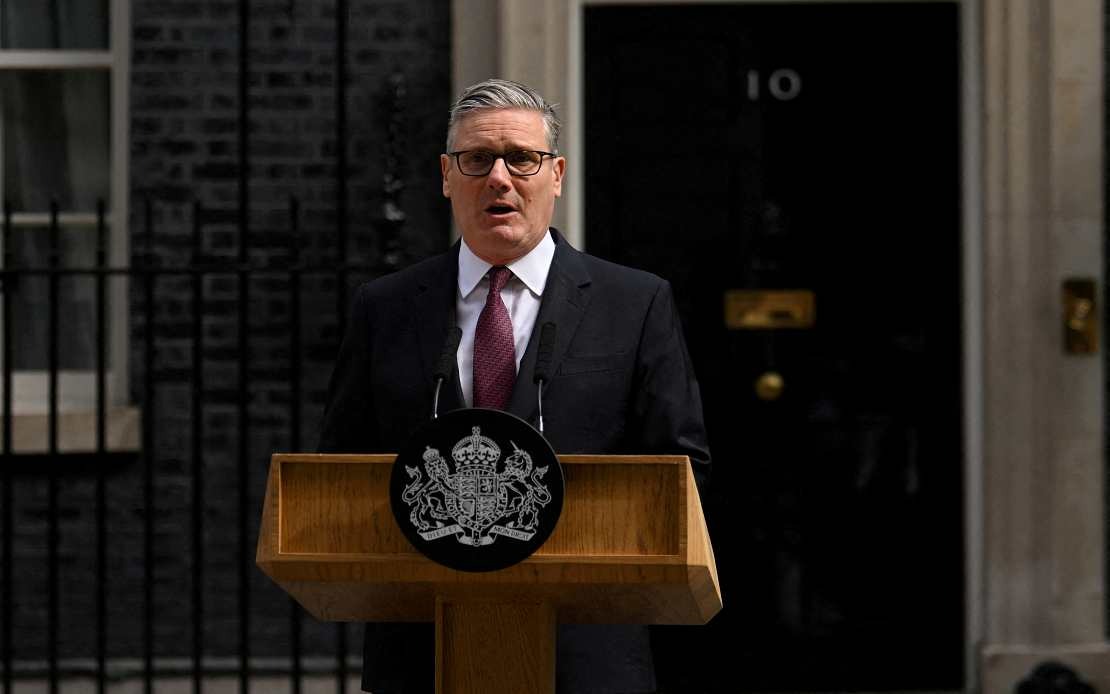
British Prime Minister Keir Starmer has issued a forceful appeal for the immediate restoration of ceasefire talks between the United States and Iran, warning that the current standoff over the Strait of Hormuz demands urgent international intervention. Speaking at a joint press conference in Paris on Monday alongside French, German and Ukrainian leaders following a "coalition of the willing" meeting, Starmer emphasised the critical nature of the situation facing global maritime commerce.
The British leader issued a stark condemnation of Iranian actions, declaring his opposition to what he characterised as deliberate strikes targeting commercial vessels and allied nations in the Gulf region. Starmer's rhetoric reflected growing Western frustration with the breakdown in the fragile peace arrangement that had briefly appeared to offer stability to one of the world's most strategically important waterways. His statement underscored the severity with which London views the threat to international shipping, which represents a lifeline for trade across Asia, the Middle East and Europe.
Starmer reiterated Britain's readiness to support diplomatic initiatives aimed at restoring order and enabling freedom of navigation through the contested strait. The British government signalled its willingness to contribute military assets and logistical support to ensure safe passage for commercial shipping, reflecting a coordinated Western approach to managing the crisis. This commitment illustrates the degree to which maritime security in the region has become a shared concern among Western powers, rather than an isolated bilateral dispute.
The underlying trigger for the current escalation traces back to a brutal conflict that erupted in late February between the United States and Israel on one side, and Iranian forces on the other. During this period, Iran effectively blockaded the Strait of Hormuz, one of the world's most critical chokepoints through which roughly one-third of all seaborne traded oil passes daily. The closure created severe disruptions to global energy markets and supply chains, with particular impact on Asian economies heavily dependent on Middle Eastern oil, including Malaysia, which sources significant petroleum imports from the region.
A memorandum of understanding signed in June had promised to end the military conflict and restore normal shipping operations through the strait. However, recent exchanges of strikes between Tehran and Washington over the weekend have shattered this tentative accord. President Donald Trump announced that the United States was "reinstating" a comprehensive blockade targeting Iran and declared that American forces would charge merchant vessels for safe passage through the waterway, a move that effectively privatises maritime security and shifts commercial risk onto shipping companies.
The reimposition of American economic pressure comes as Iran continues to demonstrate its capacity and willingness to disrupt global commerce. The cycle of tit-for-tat military actions has created a dangerous dynamic where each side's escalatory moves invite proportional responses, raising the risk of an uncontrolled spiral into broader regional conflict. For maritime-dependent economies throughout Southeast Asia, including those in the ASEAN bloc that rely heavily on the Strait of Hormuz for trade and energy security, this deterioration represents a tangible threat to economic stability and growth prospects.
Starmer's call for unrestricted freedom of navigation reflects a core principle of international maritime law that has underpinned global trade for centuries. The notion that shipping should be charged for safe passage through international waters represents a fundamental challenge to the rules-based order that has enabled unprecedented prosperity across the Indo-Pacific region. Malaysia, as a significant trading nation and member of ASEAN, has a direct interest in preserving this principle, as disruptions to the Strait of Hormuz cascade rapidly into higher transport costs and energy inflation throughout Southeast Asian economies.
The involvement of French, German and Ukrainian representatives at the Paris meeting signals that Western concern extends beyond immediate Middle Eastern allies to encompass the broader global community. This gathering demonstrated an attempt to forge a unified position among diverse stakeholders, though the effectiveness of such diplomatic coordination remains questionable given the deteriorating situation. The presence of Ukrainian leadership reflected broader concerns about the interconnection between Middle Eastern instability and European security challenges.
Britain's explicit offer to deploy assets constitutes a significant commitment that carries both symbolic and practical weight. The Royal Navy maintains a permanent presence in the Persian Gulf and has historically played a protective role for international shipping. However, the resources required to guarantee safe passage for thousands of daily transits vastly exceed what any single nation can realistically provide, suggesting that a political settlement remains essential. Without a genuine diplomatic breakthrough, military measures alone will prove insufficient to restore the confidence necessary for normal commercial operations.
The fundamental challenge facing international diplomacy lies in bridging the widening gap between Washington's maximalist demands and Tehran's apparent determination to maintain leverage through disruption. Trump's decision to levy charges for safe passage introduces a new economic dimension that complicates negotiations and suggests a hardening of the American position. For Malaysian policymakers and businesses dependent on stable energy supplies and predictable shipping costs, the implications are deeply concerning, as prolonged uncertainty in the Strait of Hormuz directly translates into economic headwinds.
The path forward requires sustained engagement from regional and international actors willing to facilitate genuine dialogue between the principal antagonists. Britain's positioning as a mediator reflects its historical role in regional affairs, though contemporary British influence falls considerably short of its Cold War capacity. The involvement of France and Germany, both possessing diplomatic relationships with Iran, suggests an attempt to leverage European channels for negotiation, yet their practical ability to influence outcomes remains limited in the face of Trump administration unilateralism.
As tensions persist, the international community faces a critical test of its capacity to manage great power competition while protecting the vital interests of smaller trading nations. Malaysia and neighbouring Southeast Asian economies must closely monitor developments in the Strait of Hormuz, as any prolonged disruption will inevitably flow through to higher costs for consumers and reduced competitiveness for exporters. The outcome of current diplomatic initiatives will significantly shape the regional economic environment for months ahead.

