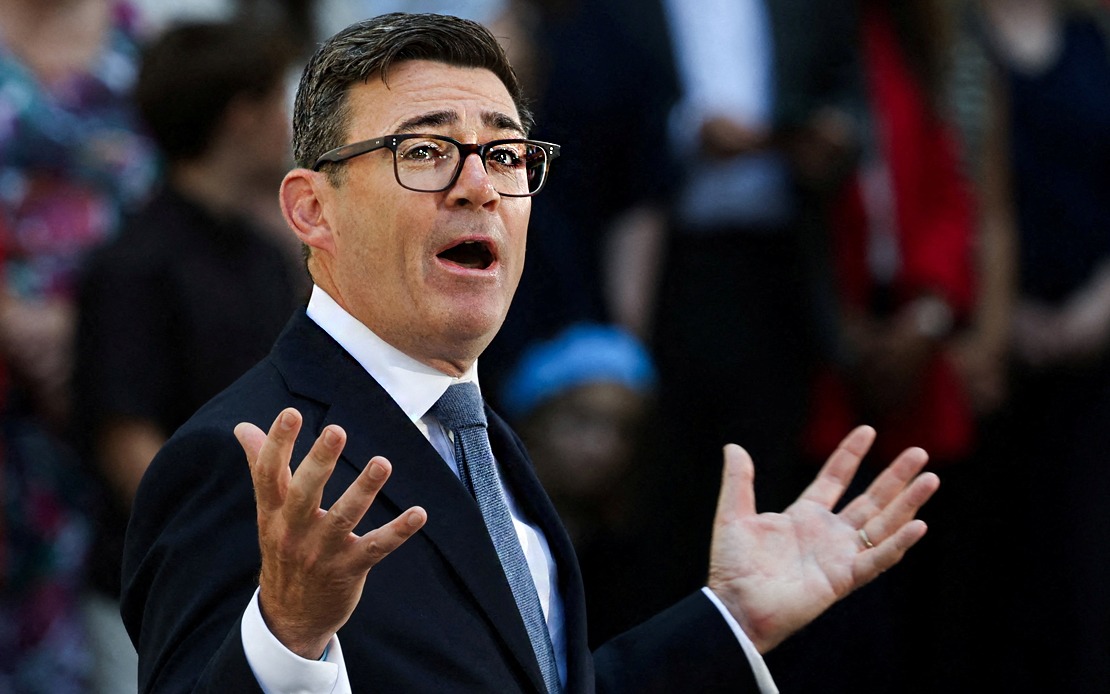
Andy Burnham has officially taken the helm as the United Kingdom's new Prime Minister following King Charles III's acceptance of Keir Starmer's resignation on Monday. In his inaugural address from Downing Street, Burnham outlined an ambitious agenda centred on delivering what he characterised as the most transformative reforms in British governance and economic policy within the past forty years, signalling a decisive break from recent political precedent.
The Prime Minister framed his government's overarching mission as a "circuit breaker" for Britain, emphasising that the coming years would witness a fundamental recalibration of how the country operates at both political and economic levels. His rhetoric suggested recognition that incremental adjustments no longer suffice to address entrenched structural challenges that have persisted across regions and communities, with his administration prepared to implement what he described as a "new political model and a new economic model" to reshape the British landscape.
Burnham's diagnostic assessment of Britain's contemporary predicament centres on policy decisions made during the 1980s, which he characterised as representing critical junctures where the nation chose a particular development path with lasting consequences. He specifically highlighted how political authority became progressively concentrated in central institutions while simultaneously economic activity was transferred from public to private hands through privatisation programmes. This dual movement, according to his analysis, established conditions under which significant portions of the country experienced industrial decline and have struggled to recover their former economic vitality.
The geographical dimension of Britain's challenge remains particularly acute in Burnham's assessment. He acknowledged that communities across substantial swathes of the nation continue to experience the subjective reality of persistent decline, with citizens expressing deep scepticism about their capacity to influence or reverse their circumstances through conventional means. This diagnosis suggests his government intends to address not merely economic indicators but also the profound erosion of confidence and agency that communities feel when confronted with long-term marginalisation.
Central to Burnham's stated reform agenda is a recalibration of political culture itself. Rather than perpetuating the adversarial, score-keeping dynamics that have characterised Westminster politics, he articulated a vision of governance oriented toward collaboration and pragmatic problem-solving. This rhetorical commitment suggests frustration with existing parliamentary conventions and an intention to shift the tone and substance of political engagement, at least at the executive level where the Prime Minister wields considerable influence.
For Malaysian and Southeast Asian observers, Burnham's accession and his policy priorities carry several dimensions of interest. The British governance model continues to influence Commonwealth nations, including Malaysia, whose own institutional frameworks reflect colonial-era parliamentary traditions. Burnham's explicit critique of centralised political power and his apparent commitment to devolving authority resonates with ongoing debates within Malaysia regarding federal-state relations and the concentration of executive authority.
Moreover, Burnham's emphasis on addressing regional economic decline through structural reform offers potential lessons for Southeast Asian economies grappling with uneven development. Many nations in the region have similarly experienced the effects of deindustrialisation and face challenges in revitalising communities that have been left behind by processes of globalisation and economic restructuring. Malaysia's own experience with industrial transition and regional disparities makes Burnham's focus on reversing geographic decline particularly instructive.
The timing of this leadership transition in Britain also carries broader geopolitical significance for the region. The UK remains an important player in Southeast Asian security architectures, particularly through mechanisms such as the Five Power Defence Arrangements involving Malaysia, Singapore, Australia, New Zealand, and Britain itself. Leadership changes in London inevitably influence priorities and resource allocation toward regional commitments, making Burnham's stated focus on domestic transformation a factor that regional nations must consider when anticipating shifts in British strategic engagement.
Burnham's background as a former Mayor of Manchester, a major city in Britain's economically struggling North, lends particular credibility to his stated commitment to reversing regional decline. His prior experience navigating urban governance in a post-industrial setting suggests he possesses practical familiarity with the challenges he has identified as central to his government's mission. This biographical dimension distinguishes him from predecessors whose regional credentials may have been less pronounced and potentially reinforces commitment among communities outside London and the Southeast to his reformist agenda.
The specific articulation of a "new political model" alongside a "new economic model" suggests Burnham perceives Britain's contemporary challenges as fundamentally intertwined rather than compartmentalised. His framework implies that economic underperformance in particular regions stems partly from political structures that concentrate decision-making authority away from affected communities, and that remedying this situation requires simultaneous reform of both governance arrangements and economic organisation.
As Burnham moves from rhetoric to implementation, the practical question becomes which specific policies will operationalise his vision and how substantial will be the resistance to transformative change from interests invested in existing arrangements. His elevation to the premiership represents a rhetorical commitment to departing from established patterns, but translating ambitious language into institutional change remains among the primary tests any incoming government faces.
The broader international dimension of Burnham's reformist agenda may also shape Britain's approach to economic policy, trade relationships, and international engagement more broadly. A government focused on reversing domestic regional decline might adjust its international priorities accordingly, with potential implications for British engagement with Southeast Asia and the Indo-Pacific region where economic partnership and security cooperation remain important vectors of British statecraft.

