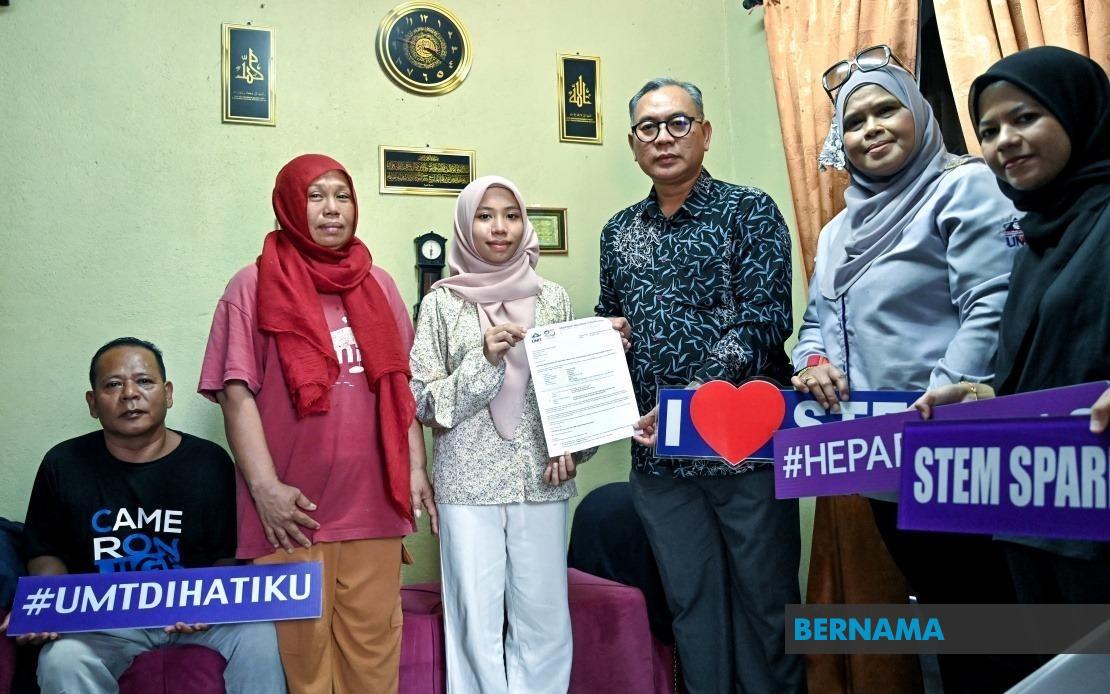
Universiti Malaysia Terengganu (UMT) has become a lifeline for Nurul Amira Abdul Hamid, an 18-year-old from Parit Jawa in Bagan Serai, whose university dreams nearly evaporated when her family proved unable to meet the costs of higher education. The intervention by the public institution demonstrates how Malaysian universities are increasingly taking proactive steps to identify and support talented students from economically vulnerable backgrounds, ensuring that financial constraints do not become an insurmountable barrier to tertiary education.
Nurul Amira's circumstances reflect a reality many Malaysian families face. Following her completion of the Sijil Pelajaran Malaysia (SPM) examination, during which she achieved three A grades, she found herself in an impossible position. Rather than proceeding directly to university, she accepted employment at a retail goods store, earning RM1,300 monthly to contribute to household expenses. Her family's situation had deteriorated significantly when her father, Abdul Hamid Othman, aged 58, developed serious health complications that left him unable to work consistently, while her mother, Asmah Che Ros, aged 53, remained at home without independent income. As the youngest of three siblings, Nurul Amira's wages became essential to the family's survival.
The turning point arrived when Nurul Amira received her initial offer to pursue the one-year Science, Technology, Engineering and Mathematics (STEM) Foundation programme at UMT, with the pathway to complete a Bachelor's degree in Science specialising in Nautical Science and Maritime Transportation. Recognising the opportunity's significance but faced with the practical reality of registration and tuition fees she could not afford, she considered rejecting the admission. Rather than remaining silent about her predicament, she took initiative by contacting UMT directly and candidly explaining her family's financial situation and her deep desire to continue her education. This decision to communicate openly with the institution proved transformative.
UMT responded with genuine institutional commitment rather than a generic rejection or referral. The university secured for her the Al-Ikhlas Scholarship worth RM500, complemented by additional forms of financial assistance that substantially reduced her out-of-pocket obligations. Beyond the scholarship, university officials arranged payment of RM400 in related administrative fees. More significantly, recognising that financial burdens extend beyond tuition fees alone, UMT committed to providing living allowances throughout her entire study period, ensuring she could concentrate fully on her coursework without the distraction of subsistence concerns. This comprehensive approach distinguishes genuine support from token gestures.
UMT Vice-Chancellor Prof Dr Mohd Zamri Ibrahim articulated the institution's philosophical approach to student welfare, emphasising that the university views support for struggling learners not as an optional charity but as a core institutional responsibility. He revealed that UMT adopts a proactive methodology, initiating meetings with students and families identified as facing financial hardship rather than waiting passively for students to approach the university. This stance reflects an understanding that stigma and unfamiliarity with university systems sometimes prevent vulnerable families from accessing available assistance. By reaching out directly, UMT removes barriers and ensures that capability and determination, rather than parental wealth, determine who accesses higher education.
The scale of UMT's commitment to students from economically disadvantaged backgrounds extends beyond Nurul Amira's case. Prof Dr Mohd Zamri disclosed that during the current year alone, more than ten students from underprivileged families have received financial assistance through various university mechanisms. This suggests an institutional pattern rather than an isolated instance of generosity, indicating that UMT has embedded support for low-income students into its operational framework. The vice-chancellor furthermore invited broader awareness among prospective and current students, emphasising that financial inability to pay fees should never deter anyone from approaching the university, as multiple assistance mechanisms exist to bridge gaps.
The maritime and nautical science pathway that Nurul Amira has chosen aligns with Malaysia's significant strategic interests. As a nation heavily dependent on shipping, port infrastructure, and maritime trade, the country requires a steady pipeline of trained professionals in nautical sciences and maritime transportation. By facilitating access to such specialised programmes for talented students regardless of economic background, UMT contributes both to individual social mobility and to national capacity building in critical sectors. Nurul Amira's journey from retail worker to prospective maritime professional exemplifies how educational access directly translates into human capital development.
The broader implications of UMT's approach warrant consideration within Malaysia's higher education landscape. Public universities across the country operate under budgetary constraints and competing demands, yet UMT's example suggests that prioritising support for economically marginalised students need not represent unsustainable expenditure. The institution's willingness to allocate scholarships, cover administrative fees, and provide living allowances reflects a calculation that investing in capable students from poor families generates long-term returns through graduate success and workforce development. For other Malaysian universities facing similar decisions about resource allocation, UMT's framework offers a replicable model.
Nurul Amira's gratitude, expressed during the interview at her family home, captures the profound personal impact of institutional intervention. The combination of emotional validation—being told directly that her situation mattered and the university would help—alongside concrete financial support transformed despair into possibility. Her willingness to work while studying, her academic achievement in the SPM, and her clear determination to advance her circumstances despite family adversity all represent precisely the qualities universities should wish to cultivate. Her success will be measured not only by degree attainment but by her subsequent contributions as a maritime professional and as a member of her community.
Looking forward, Nurul Amira's progression through the STEM Foundation programme and into her degree represents an ongoing institutional commitment. Universities cannot support students through financial access alone; they must maintain the academic scaffolding, mentoring, and workplace preparation necessary for genuine success. UMT's stated intention to provide living support throughout her entire study period acknowledges this reality. For Malaysian policymakers and higher education administrators, this case study underscores that access to university—particularly for disadvantaged but capable students—remains not a settled question but an ongoing challenge requiring sustained institutional will, creative financing, and genuine commitment to meritocracy beyond family wealth.

