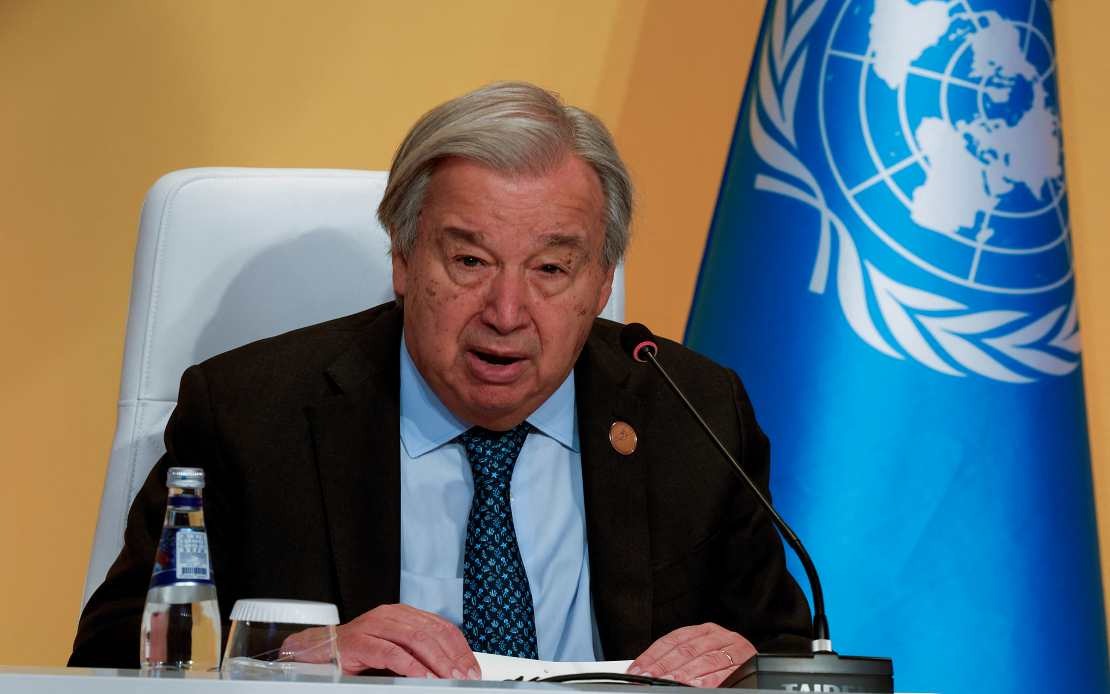
The United Nations has sounded an urgent alarm about deteriorating security conditions in the Persian Gulf, with Secretary-General Antonio Guterres expressing grave concern over the cycle of military escalation involving Iranian naval attacks, American military responses, and strikes by Iran on neighbouring targets. The senior diplomat's statement, delivered through his spokesperson Stephane Dujarric on Sunday, reflects mounting anxiety within the international community about the region's trajectory and the potential for an uncontrolled spiral into broader conflict.
Guterres emphasised that the current pattern of tit-for-tat military actions represents a dangerous inflection point that demands immediate diplomatic intervention. The secretary-general has specifically called upon all parties engaged in the dispute to exercise what he terms "maximum restraint," signalling that the UN views the present situation as one where miscalculation or further provocation could trigger consequences far exceeding the immediate participants' intentions. This language reflects the secretary-general's assessment that the region stands at a precarious threshold where de-escalation remains possible but requires urgent action.
The statement underscores that a return to large-scale hostilities would unleash consequences reaching far beyond the Gulf's shores. Such an outcome would fundamentally destabilise the region, displace millions, and create humanitarian crises of potentially historic proportions. Equally important in the UN's calculation are the international ramifications: a major conflict would undermine global peace and security architecture already strained by geopolitical tensions elsewhere. For Southeast Asian nations including Malaysia, which rely heavily on stable international order and predictable trade relationships, such a prospect represents a direct threat to regional prosperity.
The economic dimension cannot be overstated. The Strait of Hormuz remains one of the world's most critical energy chokepoints, through which approximately one-third of global maritime trade in petroleum passes daily. Any sustained military conflict or blockade in these waters would trigger immediate shocks to oil prices, freight costs, and supply chain reliability that would ripple across Asia-Pacific markets. Malaysian industries dependent on affordable energy inputs and smooth maritime commerce would face significant disruption, making the Gulf's stability a matter of direct national economic interest rather than mere geopolitical concern.
Guterres has specifically reiterated the international community's commitment to maintaining unobstructed freedom of navigation through the Strait of Hormuz. This principle, enshrined in international maritime law, represents a cornerstone of the rules-based global order that benefits all nations, particularly smaller economies that depend on open sea lanes for commerce. The secretary-general's emphasis on this point signals that any attempt by regional powers to restrict passage or weaponise shipping routes would be viewed as fundamentally contrary to established norms.
Central to the UN's response has been an appeal for direct engagement between Tehran and Washington. The statement urges both Iran and the United States to "urgently resume negotiations" and resolve their differences through diplomatic channels rather than military confrontation. This call acknowledges a fundamental reality: these two powers possess the capacity to either stabilise or destabilise the entire region through their choices. Historical precedent suggests that direct dialogue, however difficult and slow-moving, remains more effective than escalatory cycles in preventing catastrophic miscalculation.
The current confrontation has roots extending back decades, encompassing sanctions regimes, nuclear agreements, regional proxy conflicts, and competing spheres of influence. The 2015 Joint Comprehensive Plan of Action, which aimed to constrain Iran's nuclear programme in exchange for sanctions relief, has become a contentious issue following the United States' withdrawal in 2018. This backdrop complicates any diplomatic resolution, as both sides must address not merely immediate military concerns but also long-standing grievances and strategic interests.
For Malaysia and other Southeast Asian states, the situation presents a dual imperative. First, these nations benefit from and depend upon the stability that the international rules-based order provides, including freedom of navigation and predictable energy markets. Second, ASEAN's founding principle of non-interference and its emphasis on dialogue as the path to resolving disputes align naturally with the UN's call for diplomacy. Malaysia's position as a moderate Muslim-majority nation with strong commercial ties across the Islamic world and beyond gives it potential standing to contribute constructively to efforts toward de-escalation.
The broader geopolitical context adds urgency to the UN's warning. A major conflict in the Gulf would almost certainly draw in regional allies, reshape global energy markets, and create humanitarian emergencies that would stretch international relief systems. It could also provide openings for other international actors to advance their own interests during a period of instability, potentially spreading conflict beyond the immediate theatre.
Guterres' framing of the issue emphasises that the current moment, while serious, is not yet irreversible. The secretary-general's call for maximum restraint and immediate de-escalation suggests that dialogue remains viable if pursued earnestly and quickly. The UN is essentially warning that the international community cannot remain passive observers while the risk calculus deteriorates, and that all stakeholders—including major powers with interests in Gulf stability—must actively work to lower tensions.
The statement ultimately reflects institutional responsibility on the UN's part to articulate clearly the stakes of continued escalation and to advocate for the diplomatic path. For Malaysian policymakers and observers, the message carries particular resonance: regional peace anywhere affects economic conditions everywhere, and the international system's capacity to address crises through negotiation rather than conflict remains essential to global prosperity and security.

