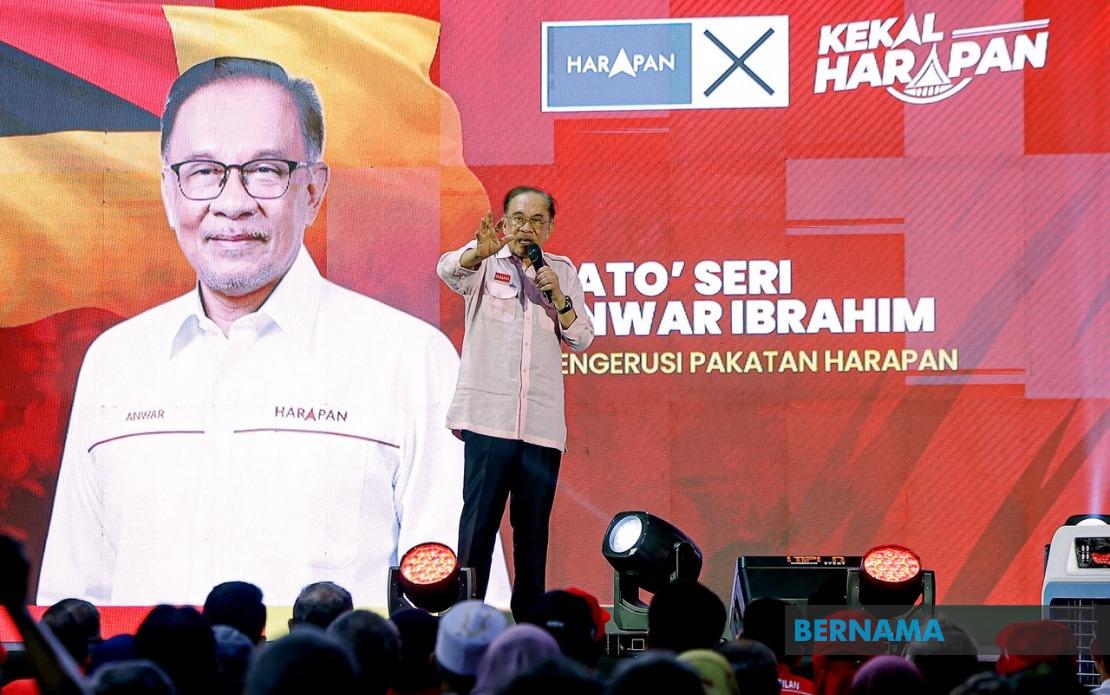
Prime Minister Datuk Seri Anwar Ibrahim has moved to reassure the public that the federal Unity Government remains on solid footing, emphasising that the coalition's stability at the national level is not under threat. Speaking in Seremban on July 22, the premier stressed that the administration's cohesion remains robust enough to sustain economic momentum and retain the confidence of international investors who continue to eye Malaysia as a key destination for capital deployment.
The prime minister's public reaffirmation comes as Malaysia navigates a period of electoral competition, with state-level contests potentially creating friction among coalition partners. Anwar acknowledged that while tensions may surface in individual states where parties compete directly, these friction points have not infected the collaborative machinery at the federal centre. This distinction between state and national dynamics underscores a deliberate effort by the leadership to compartmentalise political competition and preserve the institutional frameworks that drive national economic policy.
Anwar pointed to the smooth functioning of Cabinet operations as tangible evidence of the coalition's underlying stability. He noted that regular Cabinet meetings continue to proceed in their customary manner, with ministers from different coalition parties cooperating effectively on governance matters. The premier specifically referenced recent gatherings that included Agriculture and Food Security Minister Datuk Seri Mohamad Sabu, Transport Minister Anthony Loke, Deputy Prime Minister Datuk Seri Dr Ahmad Zahid Hamidi, and other senior leaders, all working in concert to advance the government's agenda.
For Malaysian investors and business leaders, the assurance of federal stability carries considerable weight. Economic policy continuity and predictable governance are fundamental to capital allocation decisions. Any perception of instability or coalition fracture could dampen investment appetite, discourage long-term planning, and potentially trigger capital outflows. By publicly affirming the government's cohesion, Anwar is signalling to both domestic and foreign investors that the regulatory environment and policy frameworks they depend upon remain anchored in stable hands.
The tension between inter-party competition at state level and coalition unity at federal level reflects a broader challenge facing Malaysia's political system. The Unity Government itself represents an unprecedented arrangement, bringing together diverse political factions that previously stood in opposition. Managing this coalition while allowing constituent parties to contest elections independently requires careful choreography and a shared commitment to preserving the partnership despite electoral rivalry. This balancing act has become central to the government's operational strategy.
The premier's remarks also carry implicit significance regarding the upcoming elections Anwar referenced. By stating his hope that stability persists after electoral contests, he is flagging that the government's survival depends on maintaining coalition discipline even as parties canvass voters separately. This suggests an understanding among coalition leaders that notwithstanding electoral competition, the federal government's composition and governing mandate should remain broadly consistent. The message implicitly warns against any dramatic reshuffling or coalition breakdown that could destabilise the national administration.
Economic considerations loom large in Anwar's emphasis on stability. Malaysia faces persistent challenges including inflation concerns, exchange rate pressures, and the need for sustained infrastructure investment. These objectives require consistent policy implementation and long-term strategic planning. Coalition instability could interrupt these efforts, delaying critical decisions and deterring the strategic investments required to diversify the economy and improve productivity. By underlining the government's cohesion, Anwar is essentially arguing that economic imperatives demand continued political cooperation.
The specific mention of Cabinet meetings proceeding smoothly despite competing agendas is instructive. It suggests that coalition partners have established effective protocols for managing disagreements and reaching consensus on policy matters. The ability to disagree on electoral strategy while maintaining administrative harmony represents a form of political maturity that has not always characterised Malaysian governance. This institutional discipline, if sustained, could serve as a model for future coalition arrangements.
For regional observers, Malaysia's experience with coalition governance also carries broader implications. Throughout Southeast Asia, multiparty coalitions are increasingly common, and Malaysia's track record in managing competing political interests while sustaining economic policy could offer lessons for neighbouring nations grappling with similar arrangements. The success or failure of the Unity Government's longevity will likely influence perceptions about the viability of coalition-based governance in the region.
Looking ahead, the real test of the coalition's stability will emerge in the period following the elections Anwar referenced. How the parties navigate post-electoral negotiations, whether seat distributions remain relatively unchanged, and whether policy priorities remain aligned will determine whether the reassurances offered today prove durable. The prime minister's emphasis on maintaining stability suggests a recognition that the government's effectiveness ultimately rests on its ability to function as a coherent unit, notwithstanding the competitive pressures that electoral politics inevitably introduce into Malaysian political life.

