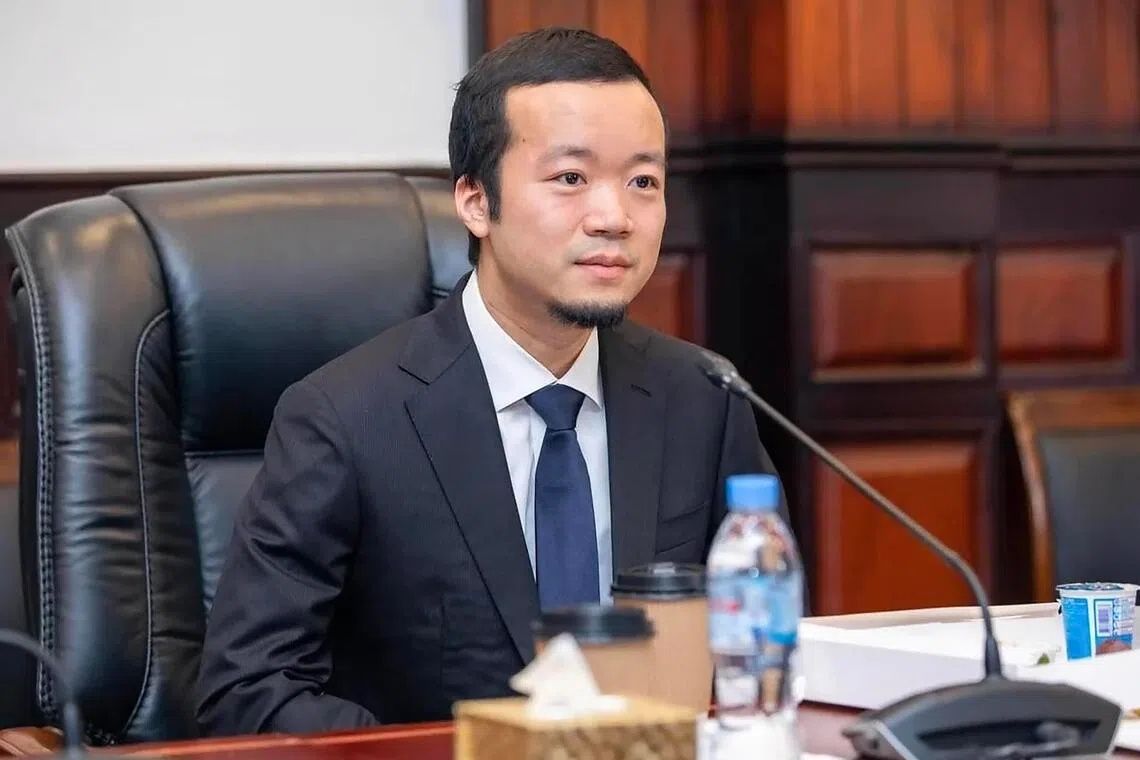
A six-month joint investigation by The Straits Times and the Organised Crime and Corruption Reporting Project has unmasked a critical member of an international fraud syndicate, revealing how he accumulated substantial wealth through properties, shell companies and corrupt networks spanning multiple continents. Chen Sokly, identified as co-conspirator to scam kingpin Chen Zhi in a US criminal indictment filed on October 8, 2025, operated at the heart of the Prince Holding Group's global money-laundering apparatus, directing risk control operations and managing relationships with corrupted government officials across Asia and beyond.
Born in Shanghai in 1986 as Chen Xing, this individual transformed his identity when he acquired Cambodian citizenship in late 2017, subsequently adopting the name Chen Sokly according to official government records. The investigation verified his true identity by cross-referencing corporate histories across multiple jurisdictions, tracking his citizenship acquisitions in both Cambodia and Cyprus, and reconstructing his residential movements through Singapore and the United States. Within certain Singapore business circles, he cultivated yet another persona—the ostensibly legitimate entrepreneur Martin Chen—demonstrating the sophisticated compartmentalisation that enabled the syndicate's operations to remain obscured from authorities.
Chen Sokly's strategic role within the Prince Group centred on monitoring law enforcement investigations and orchestrating corrupt arrangements with foreign officials to shield the syndicate from legal consequences. Documents produced during the investigation revealed that in May 2023, he communicated with a Chinese government official who claimed an ability to protect Prince Group associates from legal jeopardy. In exchange for this protection, Sokly pledged financial support for the official's son, exemplifying the transactional corruption that underpinned the organisation's resilience. His confidence in these illicit partnerships proved extraordinary—he dismissed warnings about the Cambodian government's crackdown on scam compounds, assuring associates that the Prince Group faced no genuine threat.
The scope of Sokly's corrupt influence became apparent through seized documents that catalogued his network of compromised officials. Internal ledgers maintained by Chen Zhi recorded that Sokly had purchased a yacht valued in excess of US$3 million as a bribe for a foreign government official in 2019. Beyond financial coercion, Sokly also functioned as the syndicate's enforcer, wielding violence to maintain dominance over rival operators and manage internal discipline. When a group member allegedly misappropriated funds in July 2024, Chen Zhi specifically requested Sokly's intervention, indicating his trusted position as the kingpin's problem-solver.
Proceeds from the Prince Group's criminal enterprise—which generated approximately US$30 million daily through investment fraud and other illicit activities according to Sokly's own boastful claims—flowed into an intricate property and corporate network. In 2019, Sokly purchased a California property from Fang Zhizhen, a member of the Knight Attack Group, a Chinese cybercriminal organisation that preceded the Prince Group. This transaction itself revealed deeper connections within transnational organised crime ecosystems. That property was subsequently sold in 2024 for approximately US$4.5 million, demonstrating the velocity at which assets moved through the network. Weeks after international sanctions were imposed on the Prince Group in October 2025, Sokly transferred ownership of a separate US$4 million property to his wife, subsequently placing it into a trust structure operated by her name in December 2025—a manoeuvre suggesting anticipatory asset protection.
Singapore represented a crucial hub for Sokly's wealth accumulation and operational presence. In 2017, he announced his arrival in the city-state with the acquisition of a S$11 million apartment at 10 Leedon Heights, a prestigious residential address comprising 5,694 square feet. That same year, he established M Capital Global Holdings, a Singapore company into which he and his wife jointly invested just over S$5 million in equal proportions. Both remain registered shareholders of this entity, maintaining a seemingly legitimate corporate foothold in the jurisdiction. Over the subsequent two years, Sokly's name appeared on the directorship registers of at least 16 Singapore firms, though most removed his association between 2020 and 2023, suggesting a deliberate effort to reduce visibility following heightened scrutiny of organised crime networks.
The firms listing Sokly as director shared a registered address on Shenton Way in Singapore's central business district, yet investigators who visited the premises discovered only two companies maintaining offices on the 12th floor, with no apparent operational connection to Sokly. This disconnection between registered addresses and actual business operations typifies money-laundering methodology, wherein shell entities provide nominal corporate structures for fund transfers without engaging in legitimate commercial activity. Former employees, speaking on condition of anonymity, revealed that Sokly typically spent between two and three months annually in Singapore, preferring to spend his evenings socialising with associates including Chen Zhi himself, suggesting the city functioned as a periodic operational and social centre rather than his primary residence.
Sokly's material accumulation extended beyond real property into a luxury automobile collection stored at his Leedon Heights residence, including a Bentley and a high-end seven-seater vehicle. These acquisitions reflected the syndrome of ostentatious spending that characterises organised crime figures attempting to signal wealth and status within their networks. The investigation's documentation of specific properties, vehicles and corporate shells demonstrates how proceeds from billion-dollar fraud operations—built substantially on the exploitation of foreign nationals forced into scam operations within Cambodian compounds—were recycled into tangible assets across multiple jurisdictions.
The US government's indictment led to the forfeiture of 127,271 bitcoins valued at approximately US$15 billion at the time of confiscation, representing one of the largest financial fraud takedowns in history. Remarkably, this enforcement action preceded by six days the US government's decision to drop sanctions against Chen Zhi, the Prince Holding Group and affiliated entities—a sequence suggesting complex diplomatic or investigative considerations. For Malaysian and Southeast Asian observers, the case exemplifies how regional hubs including Singapore, Cambodia and Thailand have been exploited by transnational criminal syndicates to launder proceeds from fraud targeting global victims, whilst corrupting local officials to ensure operational continuity.
The exposure of Sokly's multi-jurisdictional asset accumulation carries significant implications for regional financial regulation and asset recovery efforts. The investigation revealed how legitimate-appearing corporate structures, property acquisitions and business relationships can mask underlying criminal enterprise, challenging the effectiveness of conventional anti-money laundering compliance frameworks that rely on documentary verification. Sokly's ability to maintain multiple identities, acquire citizenship in multiple nations, and move assets rapidly across jurisdictions underscores vulnerabilities in international information-sharing mechanisms between financial regulators, property authorities and law enforcement agencies.
For Malaysia specifically, the case serves as a cautionary illustration of how organised crime networks exploit Southeast Asian financial infrastructure and real estate markets. The Prince Group's operations extended throughout the region, with Cambodia serving as the primary location for scam compounds. Singapore's role as a regional financial hub meant it became a destination for asset placement by individuals at every level of the syndicate hierarchy. As Malaysian authorities continue developing counter-organised crime capacity, the Sokly investigation provides empirical evidence of tactics employed by transnational syndicates—including shell company proliferation, identity falsification, corrupt official engagement and rapid asset repositioning—that may be deployed or replicated within Malaysian jurisdiction.
The investigation also highlights the critical role of sustained investigative journalism working in partnership with regional and international bodies to penetrate the opacity surrounding organised crime finances. The Straits Times and OCCRP's six-month effort to unmask Sokly required cross-jurisdictional document analysis, property record research, citizenship verification and financial tracing—resources and capabilities that individual law enforcement agencies may struggle to coordinate independently. This collaborative model offers potential lessons for Malaysian media organisations and civil society institutions seeking to enhance transparency regarding transnational financial crime.
Moving forward, authorities across the region must grapple with asset recovery from individuals like Sokly who have deliberately distributed holdings across multiple jurisdictions. The timing of his property transfer to his wife in late 2025, following sanctions announcements, suggests tactical responses to legal exposure. International cooperation mechanisms, including mutual legal assistance treaties and coordinated enforcement actions, will prove essential to preventing the preservation of proceeds derived from exploitation and fraud. For Malaysian readers, the Sokly case underscores that organised crime's infrastructure often remains geographically proximate—situated within trading partners and regional neighbours—rendering comprehensive regional responses imperative to protecting citizens and financial system integrity.

